 Score
Polymerisation (A Level)
0. What Examiners Want
This guide covers Topic 35 of Cambridge International AS & A Level Chemistry 9701 (2025–27) and follows the learning outcomes below, word for word. The right-hand column shows where each one is taught. It builds on Topic 15 (addition polymers), Topic 33 (esters and acyl chlorides) and Topic 34 (amides and amino acids).
| 35 Polymerisation. Candidates should be able to: | Section |
|---|---|
| 35.1 Condensation polymerisation | |
| 1 describe the formation of polyesters: (a) the reaction between a diol and a dicarboxylic acid or dioyl chloride (b) the reaction of a hydroxycarboxylic acid | 2 |
| 2 describe the formation of polyamides: (a) the reaction between a diamine and a dicarboxylic acid or dioyl chloride (b) the reaction of an aminocarboxylic acid (c) the reaction between amino acids | 3 |
| 3 deduce the repeat unit of a condensation polymer obtained from a given monomer or pair of monomers | 4 |
| 4 identify the monomer(s) present in a given section of a condensation polymer molecule | 4 |
| 35.2 Predicting the type of polymerisation | |
| 1 predict the type of polymerisation reaction for a given monomer or pair of monomers | 5 |
| 2 deduce the type of polymerisation reaction which produces a given section of a polymer molecule | 5 |
| 35.3 Degradable polymers | |
| 1 recognise that poly(alkenes) are chemically inert and can therefore be difficult to biodegrade | 6 |
| 2 recognise that some polymers can be degraded by the action of light | 6 |
| 3 recognise that polyesters and polyamides are biodegradable by acidic and alkaline hydrolysis | 6 |
- Repeat units: the correct atoms inside the brackets, both end bonds drawn out of the brackets, and n outside; the ester or amide link shown in full.
- Monomers: the correct diol, diacid, diamine or dioyl chloride with the functional groups drawn at both ends.
- Small molecule: H2O (from a carboxylic acid) or HCl (from a dioyl chloride), with the right number of molecules.
- Type of polymerisation: a reason based on the monomer (C=C, or two functional groups) or on the backbone (all carbon, or –COO– or –CONH–).
- Degradation: inert, non-polar C–C chain; light absorbed by C=O; hydrolysis of polar ester and amide links, with the products in acid and in alkali.
1. Addition and Condensation Polymers
A polymer is a large molecule made by joining many small molecules, the monomers, in a long chain. The part of the chain that repeats is the repeat unit. The number of repeat units is n; for a typical polymer it is in the hundreds or thousands. There are two ways to join the monomers.
- Addition polymerisation (Topic 15): the monomer has a C=C bond. The double bonds open and the molecules join, so the polymer is the only product. The backbone is a chain of carbon atoms.
- Condensation polymerisation: each monomer has two functional groups. Each time two groups react a new link forms and a small molecule (H2O or HCl) is lost. The backbone contains the link: an ester (–COO–) or an amide (–CONH–).
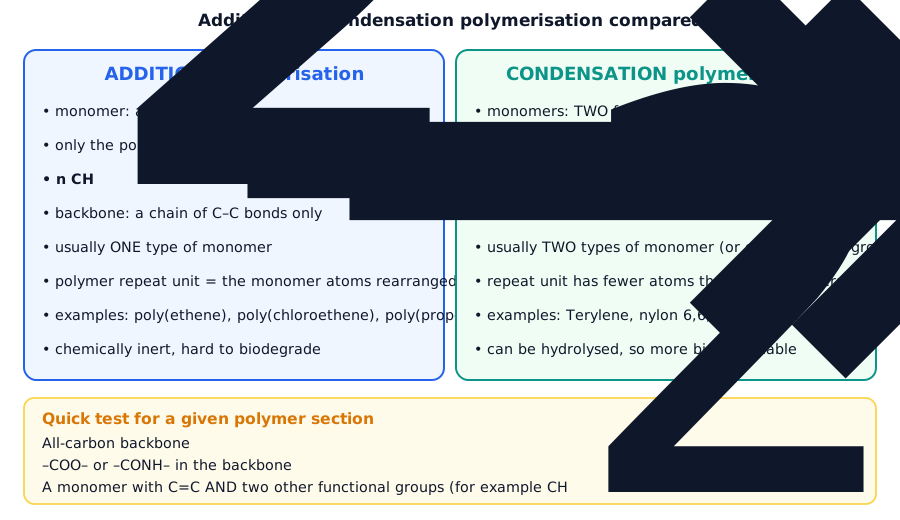
The chain can only keep growing if each monomer can react at both ends. A monomer with only one reactive group stops the chain, so condensation monomers are always bifunctional: a diol (two –OH), a dicarboxylic acid (two –COOH), a dioyl chloride (two –COCl), a diamine (two –NH2), or one molecule that carries two different groups (a hydroxycarboxylic acid or an amino acid).
| Monomer(s) | Link formed | Small molecule lost | Polymer class |
|---|---|---|---|
| diol + dicarboxylic acid | ester, –COO– | H2O | polyester |
| diol + dioyl chloride | ester, –COO– | HCl | polyester |
| hydroxycarboxylic acid | ester, –COO– | H2O | polyester |
| diamine + dicarboxylic acid | amide, –CONH– | H2O | polyamide |
| diamine + dioyl chloride | amide, –CONH– | HCl | polyamide |
| aminocarboxylic acid, amino acids | amide (peptide), –CONH– | H2O | polyamide (polypeptide) |
2. Polyesters
A polyester is a polymer held together by ester links. You met the ester link in Topic 33: it forms when an alcohol group reacts with a carboxylic acid group. A polyester forms when the alcohol groups and acid groups are on different molecules that each have two of them.
(a) A diol and a dicarboxylic acid or dioyl chloride. The best-known example is Terylene (PET), made from ethane-1,2-diol and benzene-1,4-dicarboxylic acid. The mixture is heated with an antimony(III) oxide, Sb2O3, catalyst and water is removed as the chain grows.
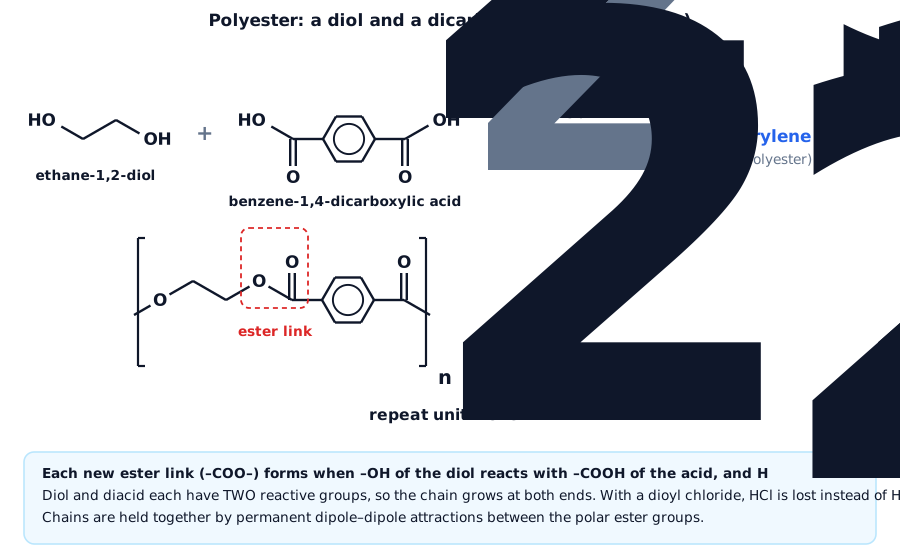
| Reagent pair | Conditions | Equation (general) |
|---|---|---|
| diol + dicarboxylic acid | heat, acid or Sb2O3 catalyst, remove H2O | n HO–R–OH + n HOOC–R′–COOH → [–O–R–O–CO–R′–CO–]n + 2n H2O |
| diol + dioyl chloride | room temperature or gentle heat | n HO–R–OH + n ClOC–R′–COCl → [–O–R–O–CO–R′–CO–]n + 2n HCl |
The dioyl chloride is more reactive than the diacid because the C–Cl bond is easier to break (Topic 33), so it reacts faster and at a lower temperature, but it costs more.
(b) A hydroxycarboxylic acid. One molecule that has an –OH group at one end and a –COOH group at the other can react with itself. Poly(lactic acid), PLA, is made from lactic acid, 2-hydroxypropanoic acid, CH3CH(OH)COOH. Lactic acid is made by the fermentation of plant sugars, so PLA comes from a renewable source and is biodegradable.
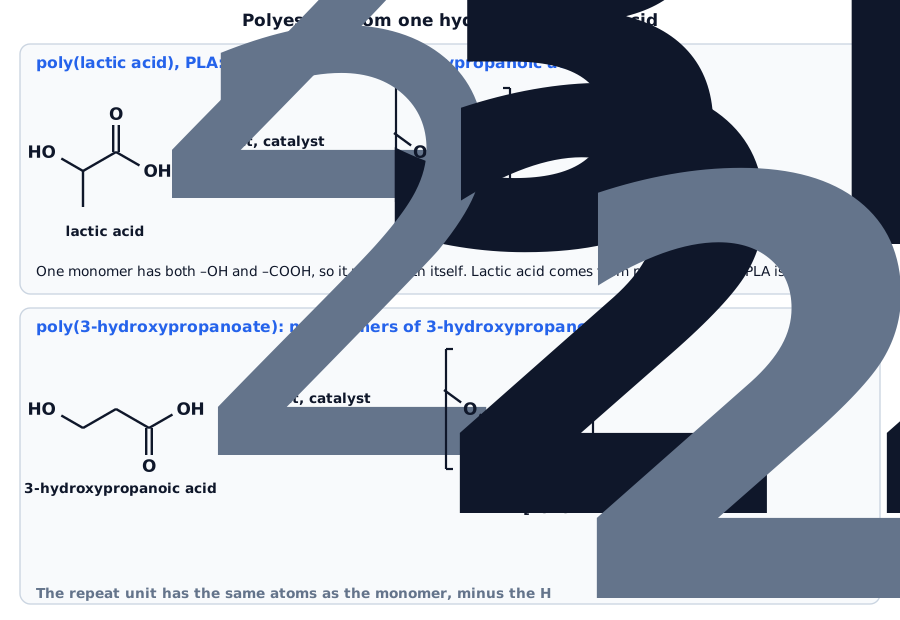
Diol + diacid: 2n H2O for n repeat units (two links per repeat unit, each shared). Hydroxy- or amino-acid: n H2O.
Worked example. Write an equation for the formation of the polyester from hexanedioic acid and ethane-1,2-diol. Name the small molecule lost. [3]
n HOOC(CH2)4COOH + n HOCH2CH2OH → [–OC(CH2)4COOCH2CH2O–]n + 2n H2O [2]. The small molecule is water [1]. (Check: the repeat unit is C8H12O4, Mr = 172, which is 146 + 62 − 36.)
Worked example. A sample of Terylene has relative molecular mass 9.60 × 10⁴. The repeat unit is –OCH2CH2O–CO–C6H4–CO–. Calculate n. [2]
Formula of the repeat unit: C10H8O4, Mr = 10(12.0) + 8(1.0) + 4(16.0) = 192 [1]. n = 9.60 × 10⁴ ÷ 192 = 500 [1].
3. Polyamides
A polyamide is held together by amide links, –CONH–. This is the same link as the peptide bond in proteins (Topic 34), so a protein is a natural polyamide. Synthetic polyamides are made from a diamine and a diacid (or dioyl chloride), or from one molecule that carries both an amine and a carboxylic acid group.
(a) A diamine and a dicarboxylic acid or dioyl chloride: nylon 6,6. Nylon 6,6 is made from 1,6-diaminohexane and hexanedioic acid (or hexanedioyl dichloride). The two numbers show the carbon atoms in the diamine (6) and in the diacid (6). Using decanedioyl dichloride, ClOC(CH2)8COCl, gives nylon 6,10.
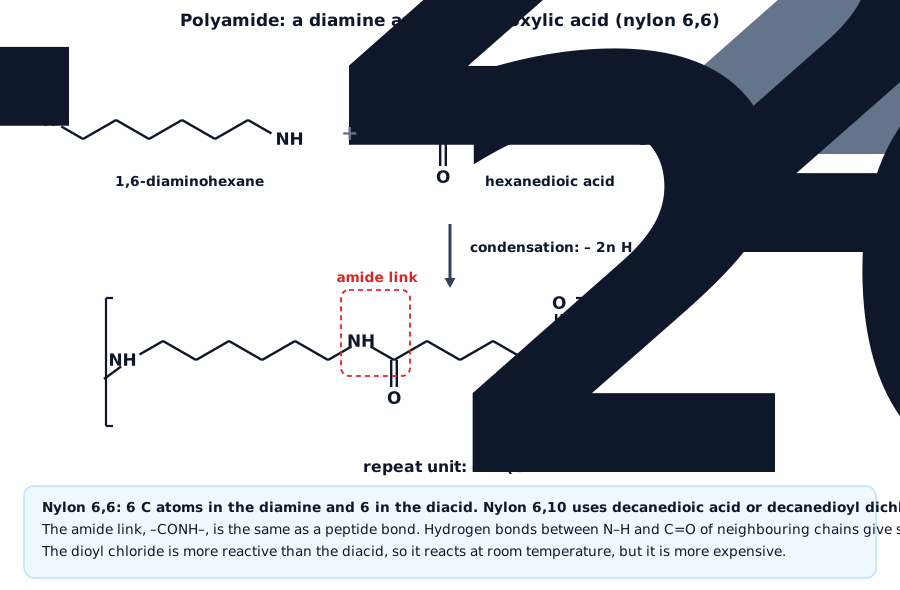
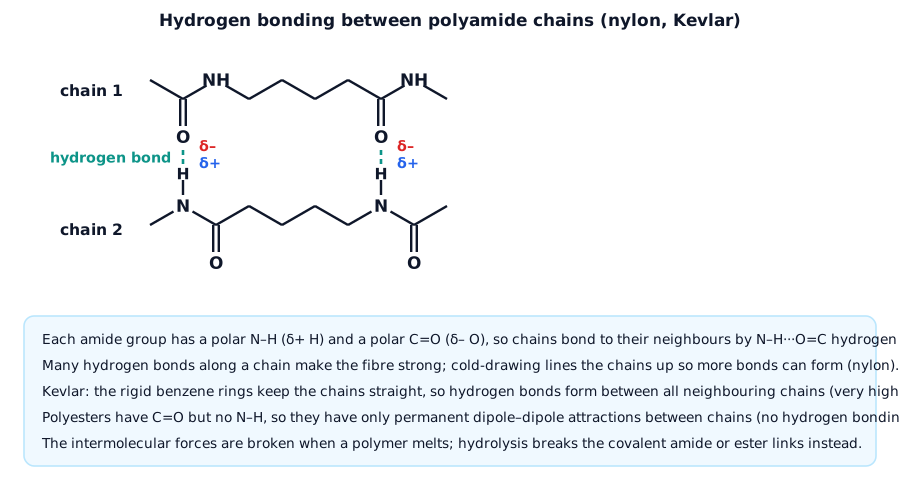
Nylon fibres are strong because the chains lie parallel and the N–H of one chain forms hydrogen bonds with the C=O of the next. In manufacture the fibre is cold-drawn (stretched), which lines the chains up so that more hydrogen bonds can form and the strength rises.
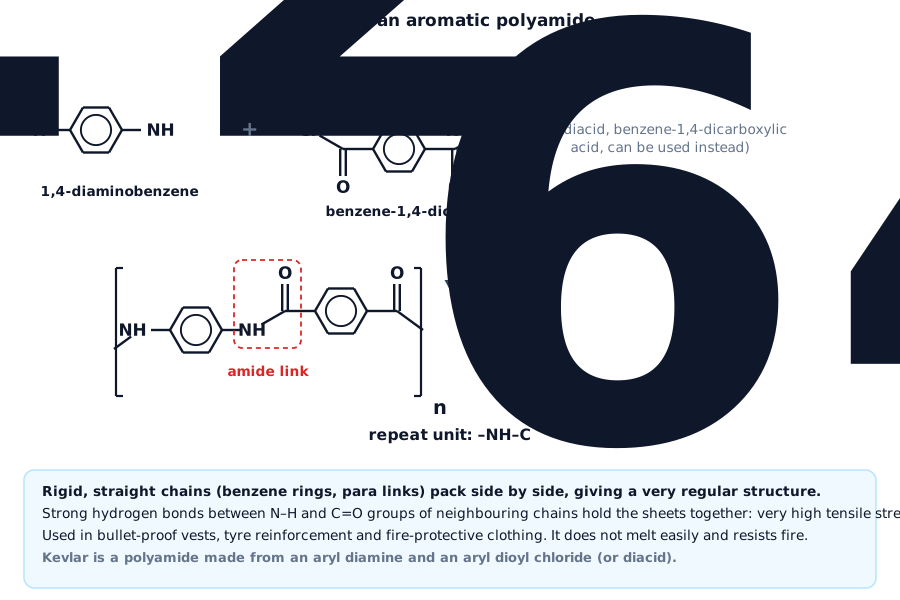
Kevlar is an aromatic polyamide made from 1,4-diaminobenzene and benzene-1,4-dicarboxylic acid or benzene-1,4-dioyl chloride. The benzene rings make the chains rigid and straight, so they pack tightly and form hydrogen bonds with every neighbour. Kevlar is therefore extremely strong for its mass, does not melt easily and resists fire. Uses: bullet-proof vests, tyre reinforcement, protective clothing.
(b) An aminocarboxylic acid, and (c) amino acids. A molecule with –NH2 at one end and –COOH at the other reacts with itself. 6-Aminohexanoic acid gives nylon 6. The simplest amino acid, glycine, gives poly(glycine). If the monomers are different α-amino acids, the polymer is a polypeptide or protein, with the residues in a particular sequence.

| Polymer | Monomer(s) | Link | Key property |
|---|---|---|---|
| nylon 6,6 | 1,6-diaminohexane + hexanedioic acid (or dioyl chloride) | amide | strong fibre; hydrogen bonds; cold-drawn |
| nylon 6,10 | 1,6-diaminohexane + decanedioyl dichloride | amide | similar to nylon 6,6, absorbs less water |
| nylon 6 | 6-aminohexanoic acid | amide | one monomer, loses n H2O |
| Kevlar | 1,4-diaminobenzene + benzene-1,4-dioyl chloride | amide | very strong; rigid chains; heat-resistant |
| protein | α-amino acids | peptide (amide) | sequence of residues; N-terminus and C-terminus |
| Terylene | ethane-1,2-diol + benzene-1,4-dicarboxylic acid | ester | strong, light fibre; no hydrogen bonds |
Worked example. Write an equation for the formation of nylon 6,10 from 1,6-diaminohexane and decanedioyl dichloride. [3]
n H2N(CH2)6NH2 + n ClOC(CH2)8COCl → [–NH(CH2)6NH–CO(CH2)8CO–]n + 2n HCl [3: correct repeat unit, ends open with n, 2n HCl].
Worked example. Explain why Kevlar is stronger than a polyester such as Terylene. [3]
Kevlar is a polyamide and has N–H and C=O groups, so neighbouring chains are held by hydrogen bonds [1]. Terylene is a polyester with C=O but no N–H, so it has only permanent dipole–dipole attractions between chains, which are weaker [1]. The benzene rings in Kevlar make the chains rigid and straight, so they pack closely and more hydrogen bonds form [1].
Worked example. A section of a polypeptide is made from glycine and alanine. Write an equation for the formation of the polymer from n molecules of each. [2]
n H2NCH2COOH + n H2NCH(CH3)COOH → [–NHCH2CO–NHCH(CH3)CO–]n + 2n H2O [2]. (The sequence may be random; the alternating form is the simplest to draw.)
4. Repeat Units and Monomers
Deducing the repeat unit from the monomers uses three steps: write the monomers with a reactive group at each end; remove the small molecule at each link; join the open ends and put the unit in square brackets with n. The ends of the repeat unit are left as open bonds because the chain continues.
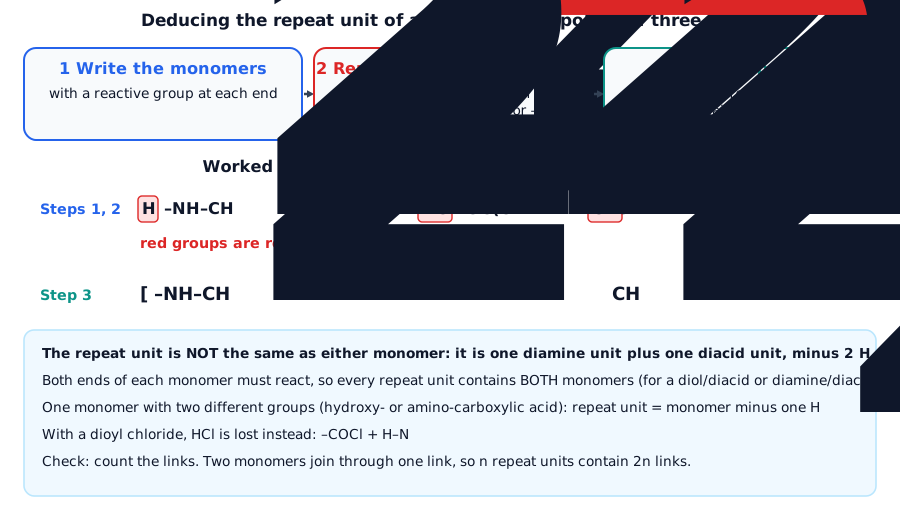
Identifying the monomers from a section of polymer is the reverse process. Find the links, cut each one, and put back what was removed.
| Link in the polymer | Where to cut | Add to the C=O end | Add to the other end | Monomer pair |
|---|---|---|---|---|
| ester, –CO–O– | between C and O | –OH | –H (so –OH on that carbon) | carboxylic acid + alcohol |
| amide, –CO–NH– | between C and N | –OH | –H (so –NH2) | carboxylic acid + amine |

- If the section shows two alternating units (for example –NH–R–NH–CO–R′–CO–), there are two monomers: a diamine (or diol) and a diacid.
- If every unit is identical and has a link at one end only (for example –NH–(CH2)5–CO–), there is one monomer with two different groups.
- If a dioyl chloride is asked for, add Cl to the C=O end instead of OH.
Worked example. Draw the repeat unit of the polymer formed from propane-1,3-diol and hexanedioyl dichloride. State what else is formed. [3]
–O(CH2)3O–CO(CH2)4CO– [2: both residues, ends open]. HCl is also formed (2n HCl for n repeat units) [1].
Worked example. A section of a polymer is –O–CH2CH2–O–CO–(CH2)4–CO–O–CH2CH2–O–CO–(CH2)4–CO–. Identify the monomers. [3]
The link –CO–O– is an ester, so the polymer is a polyester [1]. Cutting each C–O bond of the link and adding –OH and –H gives ethane-1,2-diol, HOCH2CH2OH [1] and hexanedioic acid, HOOC(CH2)4COOH [1].
Worked example. Compound J, HO–CH2CH2CH2–COOH, forms a polymer. Draw two repeat units and show the new functional group. [2]
–O–CH2CH2CH2–CO–O–CH2CH2CH2–CO– [1]. The new group is the ester link, –COO–, drawn in full [1].
5. Predicting the Type of Polymerisation
The question gives either the monomer(s) or a section of the polymer, and you decide which type of polymerisation is involved. Work from the functional groups.
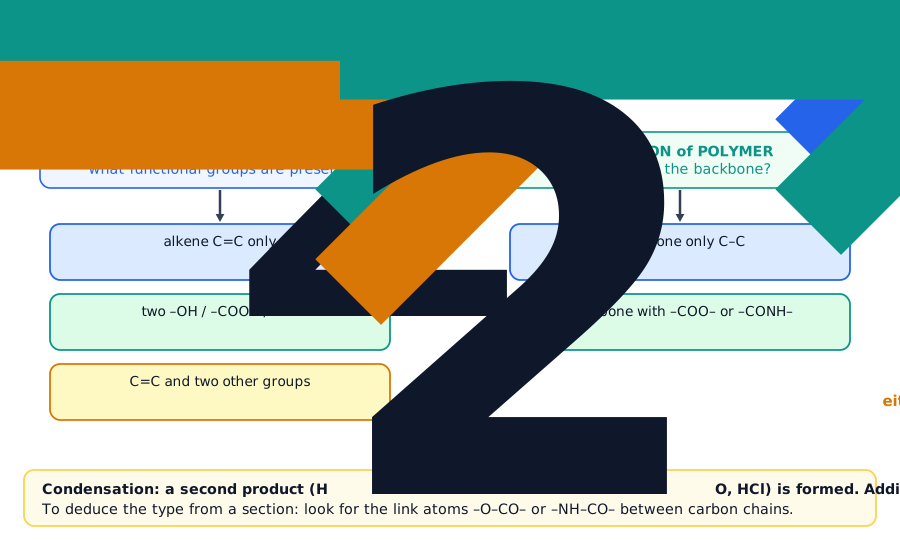
| Given | Look for | Type | Reason to write |
|---|---|---|---|
| monomer | C=C only | addition | the C=C bond opens; no other product |
| monomers | two reactive groups on each (–OH, –COOH, –NH2, –COCl) | condensation | H2O or HCl is lost at each link |
| one monomer | –OH and –COOH, or –NH2 and –COOH | condensation | the two groups react together |
| section of polymer | all-carbon backbone, C–C only | addition | formed from C=C monomers |
| section of polymer | –COO– or –CONH– in the backbone | condensation | link formed with loss of a small molecule |
A molecule such as CH2=CH–CH2–CH(NH2)COOH has both a C=C bond and an amino acid group. It can undergo addition polymerisation through the C=C (the amine and acid groups hang off the chain) or condensation polymerisation through the –NH2 and –COOH (the C=C remains in the side chain). The question tells you which to draw.
Worked example. State, with a reason, the type of polymerisation for each. [4]
(i) CH2=CHCN – addition, because it has a C=C bond and forms only the polymer. (ii) H2N(CH2)2NH2 + ClOC(CH2)4COCl – condensation, because each monomer has two functional groups and HCl is lost. (iii) HOCH2CH2COOH – condensation, because the –OH and –COOH groups react and water is lost. (iv) CH2=C(CH3)COOCH3 – addition: the ester group is not involved; only the C=C bond reacts [1 each].
Worked example. The sections below are P: –CH2CH(CH3)CH2CH(CH3)– and Q: –NH(CH2)6NH–CO(CH2)4CO–. Deduce the type of polymerisation for each. [2]
P has an all-carbon backbone, so it is formed by addition polymerisation from propene [1]. Q has an amide link, –CONH–, in the chain, so it is formed by condensation polymerisation [1].
6. Degradable Polymers
Polymers are a disposal problem when they do not break down. Their behaviour depends on the type of bond in the chain.

- Poly(alkenes) are chemically inert. The chain has only non-polar C–C and C–H bonds, so water, acid, alkali and most reagents do not attack it. Microorganisms cannot easily break it down, so poly(ethene) and poly(propene) persist in landfill and in the sea.
- Photodegradable polymers. Some polymers contain C=O (carbonyl) groups. These absorb ultraviolet light, and the chain breaks near the C=O. The polymer breaks into smaller pieces in sunlight; a polymer buried in a landfill gets no light.
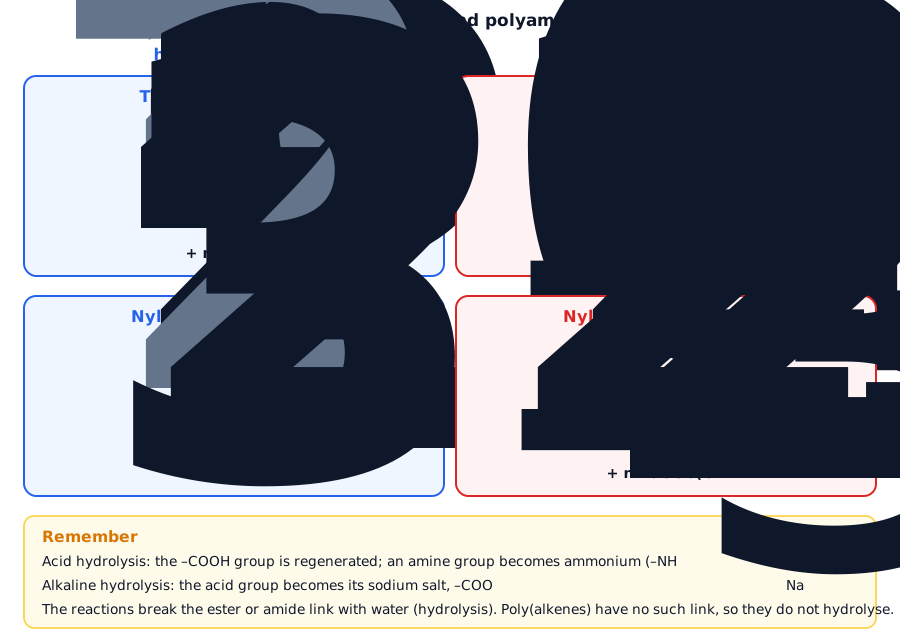
- Polyesters and polyamides are biodegradable. Their ester and amide links contain a polar C=O: the carbon is δ+ and is attacked by water (with H+ or OH− as catalysts or reagents) in hydrolysis. The polymer breaks into its monomers (or their salts). Many microorganisms can use the products, so these polymers biodegrade more readily than poly(alkenes).
| Polymer | Hot dilute acid, H+(aq) | Hot aqueous alkali, OH−(aq) |
|---|---|---|
| polyester | dicarboxylic acid + diol | disodium dicarboxylate + diol |
| polyamide | dicarboxylic acid + diammonium salt (–NH3+) | disodium dicarboxylate + diamine (–NH2) |
Disposal also matters. Landfill takes up space and poly(alkenes) stay for years. Incineration gives useful heat but produces CO2 and, from polymers containing Cl or N, toxic gases such as HCl and HCN. Recycling reduces waste but needs sorting. A biodegradable polymer such as PLA is a more sustainable choice for packaging.
Worked example. Explain why poly(ethene) is difficult to biodegrade whereas a polyester biodegrades more readily. [3]
Poly(ethene) has only non-polar C–C and C–H bonds in the chain, so it is chemically inert and is not attacked by water, acid or alkali [1]. A polyester contains polar ester links with a δ+ carbon in C=O [1], which can be hydrolysed by water, so the chain breaks into small molecules that microorganisms can use [1].
Worked example. Terylene is heated with aqueous sodium hydroxide. Give the formulae of the organic products. [2]
HOCH2CH2OH [1] and NaOOC–C6H4–COONa [1] (sodium benzene-1,4-dicarboxylate).
Worked example. Nylon 6,6 is refluxed with dilute hydrochloric acid. Give the formulae of the two organic products. [2]
HOOC(CH2)4COOH [1] and +H3N(CH2)6N+H3 (as its chloride salt) [1]. The –NH2 groups are protonated by the acid.
7. Quick Sheet and Checklist
| Topic | What to remember |
|---|---|
| addition polymer | C=C monomer; only polymer formed; all-carbon backbone; inert |
| condensation polymer | two groups per monomer; H2O or HCl lost; ester or amide link in the backbone |
| polyester | diol + diacid (or dioyl chloride), or a hydroxycarboxylic acid; link –COO– |
| polyamide | diamine + diacid (or dioyl chloride), or an aminocarboxylic acid; link –CONH– |
| nylon 6,6 / 6,10 | 1,6-diaminohexane + hexanedioic / decanedioic acid (or dioyl chloride) |
| Kevlar | 1,4-diaminobenzene + benzene-1,4-dioyl chloride; rigid chains; hydrogen bonds |
| Terylene | ethane-1,2-diol + benzene-1,4-dicarboxylic acid; Sb2O3 catalyst |
| PLA | 2-hydroxypropanoic acid; renewable; biodegradable |
| water lost | diol + diacid: 2n; hydroxy- or amino-acid: n |
| find monomers | cut at C–O or C–N of the link; add –OH to C=O, –H to the other end |
| hydrolysis | acid: –COOH and –NH3+; alkali: –COO−Na+ and –NH2 |
| degradation | alkene: inert; C=O: UV; ester and amide: hydrolysis |
- [ ] I can write the equation for a polyester from a diol with a diacid or a dioyl chloride, and from a hydroxycarboxylic acid.
- [ ] I can write the equation for a polyamide from a diamine with a diacid or a dioyl chloride, from an aminocarboxylic acid, and from amino acids.
- [ ] I can draw the repeat unit with open ends and n, and state the number of small molecules lost.
- [ ] I can identify the monomers in a section of polymer by cutting the ester or amide links.
- [ ] I can predict the type of polymerisation from monomers and from a polymer section, with a reason.
- [ ] I can explain why poly(alkenes) persist and why polyesters and polyamides biodegrade, and give the hydrolysis products in acid and in alkali.
- [ ] I can explain the strength of nylon and Kevlar using hydrogen bonds.