 Score
Nitrogen Compounds (A Level)
0. What Examiners Want
This guide covers Topic 34 of Cambridge International AS & A Level Chemistry 9701 (2025–27) and follows the learning outcomes below, word for word. The right-hand column shows where each one is taught. It builds on Topic 19 (primary amines and nitriles at AS), Topic 32 (phenol and azo coupling with a phenoxide) and Topic 33 (acyl chlorides, the route to amides). Amino acids lead straight into Topic 35, where the same amide link makes polyamides.
| 34 Nitrogen compounds. Candidates should be able to: | Section |
|---|---|
| 34.1 Primary and secondary amines | |
| 1 recall the reactions (reagents and conditions) by which primary and secondary amines are produced: (a) reaction of halogenoalkanes with NH3 in ethanol heated under pressure (b) reaction of halogenoalkanes with primary amines in ethanol, heated in a sealed tube / under pressure (c) the reduction of amides with LiAlH4 (d) the reduction of nitriles with LiAlH4 or H2 / Ni | 1 |
| 2 describe the condensation reaction of ammonia or an amine with an acyl chloride at room temperature to give an amide | 5 |
| 3 describe and explain the basicity of aqueous solutions of amines | 2 |
| 34.2 Phenylamine and azo compounds | |
| 1 describe the preparation of phenylamine via the nitration of benzene to form nitrobenzene followed by reduction with hot Sn/concentrated HCl followed by NaOH(aq) | 3 |
| 2 describe: (a) the reaction of phenylamine with Br2(aq) at room temperature (b) the reaction of phenylamine with HNO2 or NaNO2 and dilute acid below 10 °C to produce the diazonium salt; further warming of the diazonium salt with H2O to give phenol | 3 |
| 3 describe and explain the relative basicities of aqueous ammonia, ethylamine and phenylamine | 2 |
| 4 recall the following about azo compounds: (a) describe the coupling of benzenediazonium chloride with phenol in NaOH(aq) to form an azo compound (b) identify the azo group (c) state that azo compounds are often used as dyes (d) that other azo dyes can be formed via a similar route | 4 |
| 34.3 Amides | |
| 1 recall the reactions (reagents and conditions) by which amides are produced: (a) the reaction between ammonia and an acyl chloride at room temperature (b) the reaction between a primary amine and an acyl chloride at room temperature | 5 |
| 2 describe the reactions of amides: (a) hydrolysis with aqueous alkali or aqueous acid (b) the reduction of the CO group in amides with LiAlH4 to form an amine | 5 |
| 3 state and explain why amides are much weaker bases than amines | 5 |
| 34.4 Amino acids | |
| 1 describe the acid / base properties of amino acids and the formation of zwitterions, to include the isoelectric point | 6 |
| 2 describe the formation of amide (peptide) bonds between amino acids to give di- and tripeptides | 7 |
| 3 interpret and predict the results of electrophoresis on mixtures of amino acids and dipeptides at varying pHs (the assembling of the apparatus will not be tested) | 8 |
- Reagents and conditions: excess NH3 in ethanol under pressure; LiAlH4 in dry ether; H2/Ni; hot Sn/conc. HCl then NaOH(aq); NaNO2 + dilute HCl below 10 °C.
- Explanations of basicity: the availability of the lone pair on N, with the effect of the alkyl group, the benzene ring or the C=O group.
- Structures: amides (with the N-labelling), zwitterions, the ions present at low and high pH, and dipeptides with the peptide bond displayed.
- Equations and observations: white precipitate with Br2(aq), N2 bubbles on warming a diazonium salt, orange azo dye.
- Electrophoresis: compare the buffer pH with the isoelectric point to give the direction and relative speed.
1. Amines: Classes and Preparation
An amine is a derivative of ammonia in which one or more H atoms are replaced by alkyl or aryl groups. The class depends on the number of carbon groups on the nitrogen atom. Every amine has a lone pair on N, and this lone pair controls nearly all of their chemistry.
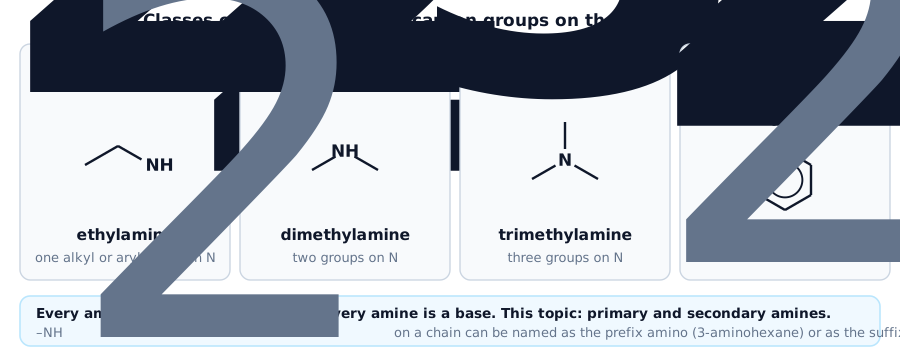
There are four ways to make alkylamines in the syllabus, and one of them leads to a secondary amine.
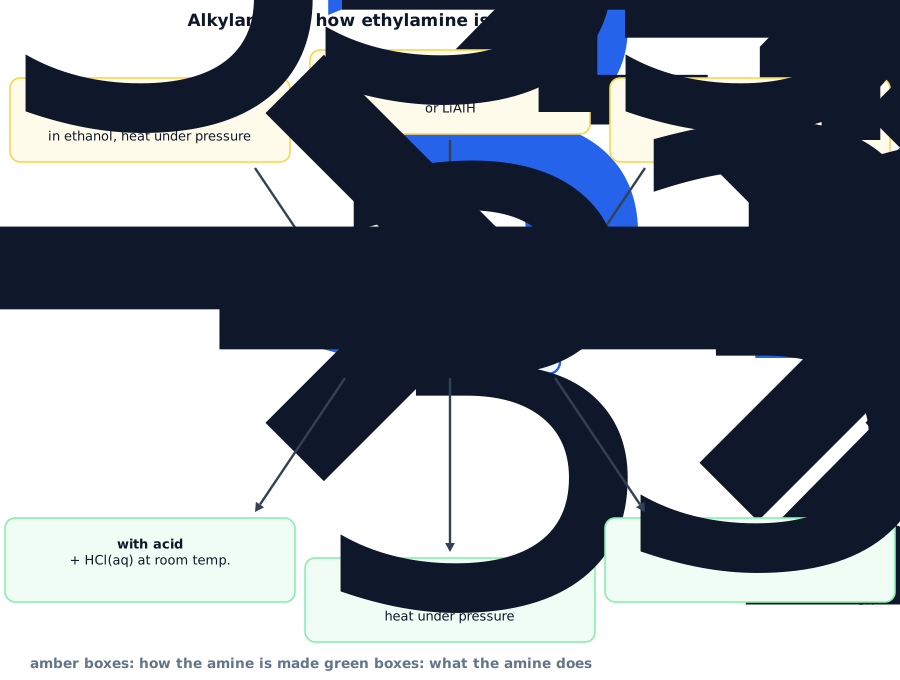
| Route | Reagents and conditions | Equation (example) |
|---|---|---|
| halogenoalkane + NH3 (a) | excess NH3 in ethanol, heated under pressure | CH3CH2Br + 2NH3 → CH3CH2NH2 + NH4Br |
| halogenoalkane + primary amine (b) | in ethanol, heated in a sealed tube (under pressure) | CH3CH2NH2 + CH3CH2Br → (CH3CH2)2NH + HBr |
| reduction of an amide (c) | LiAlH4 in dry ether | CH3CONH2 + 4[H] → CH3CH2NH2 + H2O |
| reduction of a nitrile (d) | H2 with a Ni catalyst, or LiAlH4 in dry ether | CH3CN + 4[H] → CH3CH2NH2 |
Halogenoalkane and ammonia. This is nucleophilic substitution: the lone pair on NH3 attacks the δ+ carbon (Topic 31). Excess ammonia is used for two reasons. It makes the chance of a second halogenoalkane molecule meeting the product small (the amine product is also a nucleophile and would give a secondary and then a tertiary amine), and it takes up the HBr as NH4Br. The reaction is carried out under pressure because ammonia is a gas and the mixture is heated.
Secondary amines. Heating a halogenoalkane with a primary amine in ethanol in a sealed tube gives the secondary amine. Ethylamine and bromoethane give diethylamine.
Reduction routes. The nitrile route adds a carbon atom: to make ethylamine start from bromomethane, which gives CH3CN with KCN in ethanol (Topic 19). Reducing an N-substituted amide gives a secondary amine: CH3CONHCH3 → CH3CH2NHCH3.
Because amines are bases, they dissolve in dilute acid to give salts, for example ethylammonium chloride, CH3CH2NH3+Cl−. Adding NaOH(aq) to the salt releases the free amine.
Worked example. Give the reagents and conditions to make propylamine from (i) 1-bromopropane and (ii) 1-bromoethane, using two steps. [4]
(i) A large excess of ammonia in ethanol, heated under pressure [1]; CH3CH2CH2Br + 2NH3 → CH3CH2CH2NH2 + NH4Br [1]. (ii) KCN in ethanol, heat under reflux, to give CH3CH2CN [1]; then H2 with Ni catalyst (or LiAlH4 in dry ether) [1].
2. Basicity of Amines
An amine is a Brønsted–Lowry base: it accepts H+ by donating the lone pair on nitrogen to form a dative (co-ordinate) bond. In water it sets up an equilibrium that produces OH−:
The more available the lone pair, the stronger the base (larger Kb, smaller pKb).
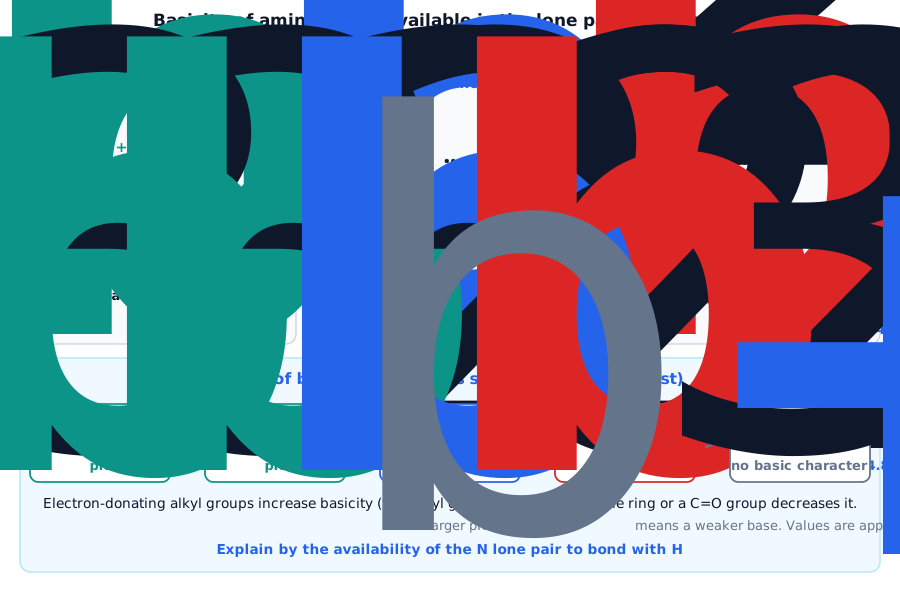
- Ethylamine > ammonia. The ethyl group is electron-donating (positive inductive effect). It pushes electron density on to N, so the lone pair is more available and the RNH3+ ion formed is stabilised.
- Diethylamine > ethylamine. Two electron-donating ethyl groups push more density on to N.
- Ammonia > phenylamine. In phenylamine the lone pair on N overlaps with the π system of the benzene ring and is delocalised into the ring. It is less available to bond with H+.
- Ethanamide is neutral (Section 5): the lone pair is delocalised on to the C=O group.

Worked example. Place CH3CH2NH2, NH3 and C6H5NH2 in order of basicity, strongest first, and explain. [4]
CH3CH2NH2 > NH3 > C6H5NH2 [1]. Basicity depends on the availability of the lone pair on N to accept H+ [1]. The ethyl group is electron-donating, so it increases the electron density on N [1]. In phenylamine the lone pair is delocalised into the benzene ring, so it is less available [1].
Worked example. Calculate the pH of 0.10 mol dm−3 ethylamine, Kb = 5.0 × 10⁻⁴ mol dm−3 (Kw = 1.00 × 10⁻¹⁴). [3]
[OH−] = √(Kb × c) = √(5.0 × 10−4 × 0.10) = 7.07 × 10⁻³ mol dm−3 [1]. pOH = 2.15 [1]. pH = 14.00 − 2.15 = 11.85 [1].
3. Phenylamine
Preparation. Phenylamine, C6H5NH2, cannot be made from chlorobenzene and ammonia (the C–Cl bond is too strong, Topic 31). It is made from benzene in two steps: nitration to nitrobenzene (Topic 29: conc. HNO3 + conc. H2SO4, 25–60 °C), then reduction of the nitro group by heating with tin and concentrated hydrochloric acid under reflux. Finally NaOH(aq) is added.
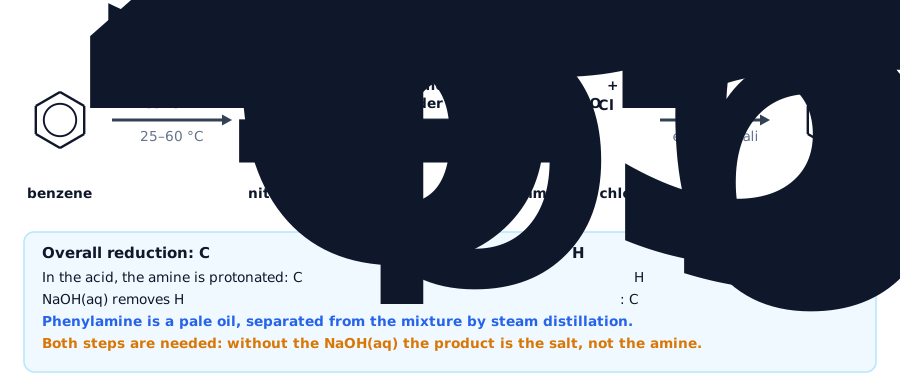
C6H5NH3+ + OH− → C6H5NH2 + H2O
Reactions of phenylamine. The delocalised lone pair makes the ring electron-rich, so the –NH2 group is 2-, 4- and 6-directing and strongly activating (compare phenol, Topic 32). Phenylamine also gives the diazonium salt and the other reactions of a primary amine.
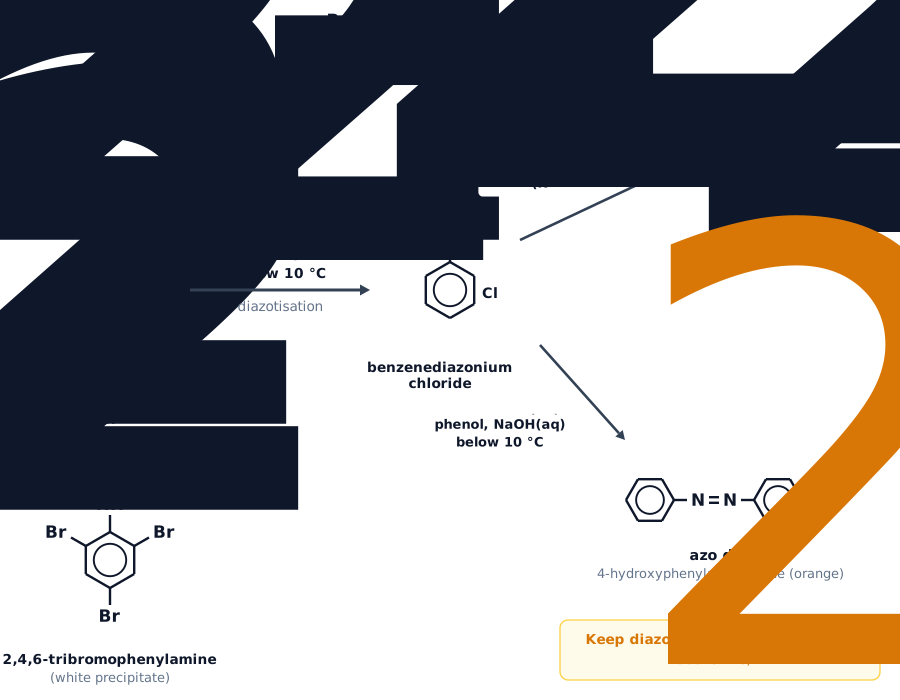
With bromine water. At room temperature, with no catalyst, Br2(aq) is decolourised and a white precipitate of 2,4,6-tribromophenylamine forms. All three activated positions are substituted:
C6H5NH2 + 3Br2 → C6H2Br3NH2 + 3HBr
Diazotisation. Nitrous acid, HNO2 (nitric(III) acid), is unstable, so it is made in the mixture from NaNO2 and dilute HCl: NaNO2 + HCl → HNO2 + NaCl. The temperature must be kept below 10 °C (ice bath), because the benzenediazonium ion decomposes above this, giving off N2.
C6H5NH2 + HNO2 + HCl → C6H5N2+Cl− + 2H2O
Warming with water. If the diazonium salt solution is deliberately warmed, it is hydrolysed to phenol and nitrogen gas is evolved (effervescence):
C6H5N2+ + H2O → C6H5OH + N2 + H+
Worked example. Phenylamine is converted into phenol in two steps. Give the reagents and conditions. [4]
Step 1: NaNO2 and dilute HCl (or HNO2) [1] below 10 °C [1]. Step 2: warm the solution of benzenediazonium chloride with water [1]; N2 is given off [1].
4. Diazonium Salts and Azo Dyes
A benzenediazonium ion is a weak electrophile. It attacks the electron-rich ring of a phenol (as the phenoxide ion) in a coupling reaction, giving an azo compound. The azo group, –N=N–, is a bridge between the two rings.
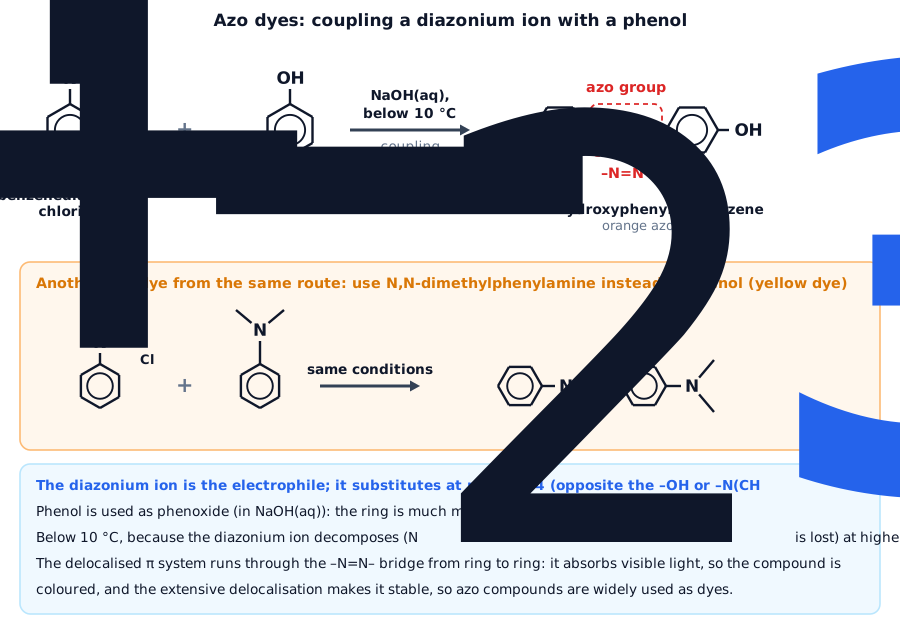
Conditions: phenol dissolved in NaOH(aq), below 10 °C. Product: 4-hydroxyphenylazobenzene, an orange solid.
- The diazonium ion substitutes at position 4, opposite the –OH group (position 2 is possible if 4 is blocked).
- The reaction is carried out in NaOH(aq): phenol is converted to the phenoxide ion, a much more reactive (more strongly activated) ring than phenol itself.
- Azo compounds are coloured because the delocalised π system extends over both rings and through the –N=N– bridge. Extensive delocalisation also makes them stable. They are widely used as dyes.
- Other azo dyes are made by the same route: change the amine (so that the diazonium ion differs) and/or the coupling component (a different phenol, naphthol or aromatic amine such as C6H5N(CH3)2, which gives a yellow dye).
Worked example. State the reagents and conditions for each step in making an azo dye from phenylamine and phenol. [5]
Step 1: NaNO2 + dilute HCl [1], below 10 °C [1], gives C6H5N2+Cl− [1]. Step 2: add the diazonium solution to phenol dissolved in NaOH(aq) [1], below 10 °C, to give the orange azo dye with the –N=N– group [1].
5. Amides
An amide contains the group –CONH–. In names, the italic N shows which group is on the nitrogen: CH3CONHCH3 is N-methylethanamide, and CH3CON(CH3)2 is N,N-dimethylethanamide.
Preparation. Acyl chlorides react with ammonia or a primary amine at room temperature (Topic 33; this is a condensation: HCl is lost). The HCl formed is taken up by a second molecule of the amine, so two moles are used:
CH3COCl + 2NH3 → CH3CONH2 + NH4Cl
CH3COCl + 2CH3NH2 → CH3CONHCH3 + CH3NH3+Cl−
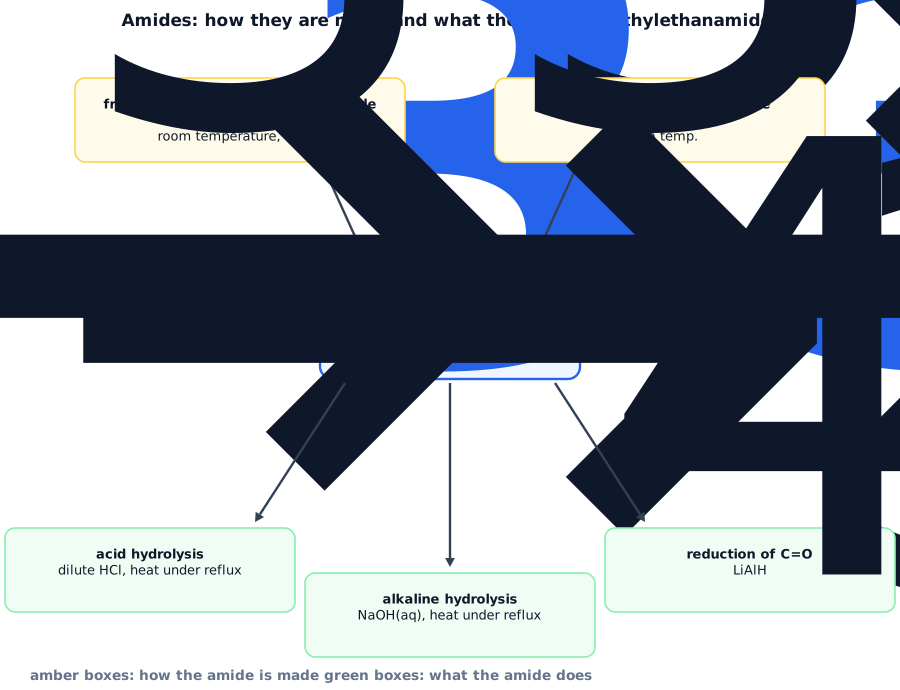
Hydrolysis. The amide link is broken by water in the presence of acid or alkali, by heating under reflux:
- with dilute acid (HCl): the products are the carboxylic acid and the ammonium salt of the amine: CH3CONHCH3 + H2O + HCl → CH3COOH + CH3NH3+Cl−;
- with aqueous alkali (NaOH): the products are the sodium salt of the acid and the free amine: CH3CONHCH3 + NaOH → CH3COO−Na+ + CH3NH2.
An unsubstituted amide, RCONH2, gives ammonia (or NH4+ in acid) in place of the amine.
Reduction. LiAlH4 in dry ether reduces the C=O group of an amide to CH2, giving an amine: CH3CONH2 → CH3CH2NH2; CH3CONHCH3 → CH3CH2NHCH3.
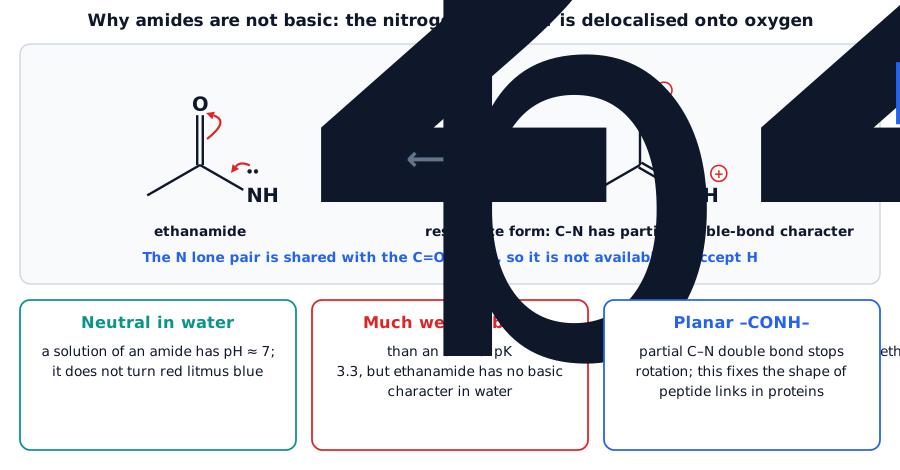
Why amides are much weaker bases than amines. In an amide the lone pair on N is delocalised over the N–C=O system, partly on to the electronegative oxygen. The C=O group is electron-withdrawing. The lone pair is therefore not available to accept H+, and amides are neutral in water.
Worked example. Compare the products of heating N-methylethanamide under reflux with (i) dilute HCl and (ii) NaOH(aq). [4]
(i) Ethanoic acid [1] and methylammonium chloride, CH3NH3+Cl− [1]. (ii) Sodium ethanoate [1] and methylamine [1].
Worked example. Explain why ethanamide is a much weaker base than ethylamine. [3]
In ethylamine the ethyl group is electron-donating and the lone pair on N is available to accept H+ [1]. In ethanamide the lone pair on N is delocalised into the C=O group [1], so it is not available to bond with H+ [1].
6. Amino Acids and Zwitterions
An amino acid has an amino group (–NH2, basic) and a carboxylic acid group (–COOH, acidic). The 2-aminocarboxylic acids, RCH(NH2)COOH, are the building blocks of proteins. The group R may be neutral (H in glycine, CH3 in alanine), acidic (an extra –COOH, as in glutamic acid) or basic (an extra –NH2, as in lysine).
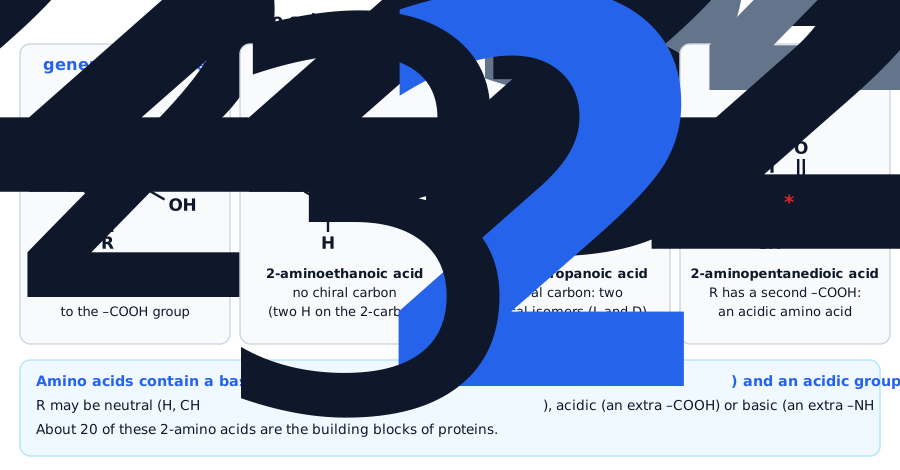
All the 2-amino acids except glycine have a chiral carbon (four different groups on the 2-carbon: H, NH2, COOH and R), so they exist as two optical isomers (enantiomers). Glycine has two H atoms on that carbon, so it has none.
Zwitterions. The acidic –COOH group donates H+ to the basic –NH2 group within the same molecule, giving a zwitterion, RCH(NH3+)COO−. It carries a positive and a negative charge, and no net charge. Because of this ionic character amino acids are crystalline solids with relatively high melting points and are soluble in water (strong ionic attractions between the ions, not the weak forces of a small molecule).

Acid and base properties. An amino acid is amphoteric: it reacts with acids and with alkalis.
- In acid (low pH): the –COO− group accepts H+, giving RCH(NH3+)COOH, a cation.
- In alkali (high pH): the –NH3+ group loses H+, giving RCH(NH2)COO−, an anion.
Because the zwitterion can remove added H+ or OH−, a solution of an amino acid is a buffer.
Buffer equations for glycine: H3N+CH2COO− + H+ → H3N+CH2COOH and H3N+CH2COO− + OH− → H2NCH2COO− + H2O
The value of the pI depends on the R group. Acidic amino acids have a low pI (glutamic acid 3.2) because extra acid must be present to remove the charge on the side chain; basic amino acids have a high pI (lysine 9.7); neutral ones are near 6 (glycine 6.0, alanine 6.0). For a neutral amino acid the pI is halfway between the two pKa values: for glycine ½(2.3 + 9.6) = 6.0 (5.95).
| Amino acid | pI | Net charge at pH 2 | Net charge at pH 6 | Net charge at pH 12 |
|---|---|---|---|---|
| glycine | 6.0 | +1 | 0 | −1 |
| glutamic acid | 3.2 | +1 | −1 | −2 |
| lysine | 9.7 | +2 | +1 | −1 |
Worked example. Write two equations to show how an aqueous solution of alanine acts as a buffer. [2]
CH3CH(NH3+)COO− + H+ → CH3CH(NH3+)COOH [1]; CH3CH(NH3+)COO− + OH− → CH3CH(NH2)COO− + H2O [1].
Worked example. Explain why glycine is a solid at room temperature with a high melting point, whereas ethylamine is a gas at room temperature. [2]
Glycine exists as a zwitterion, H3N+CH2COO−, so there are strong ionic attractions between oppositely charged ions in the lattice [1]. Ethylamine has only weak hydrogen bonding and van der Waals’ forces between its molecules [1].
7. Peptides
The –COOH group of one amino acid reacts with the –NH2 group of another, and a molecule of water is eliminated. The new –CONH– link is an amide bond, called a peptide bond. Two amino acids give a dipeptide, three give a tripeptide, and many give a polypeptide or protein. This is a condensation reaction.
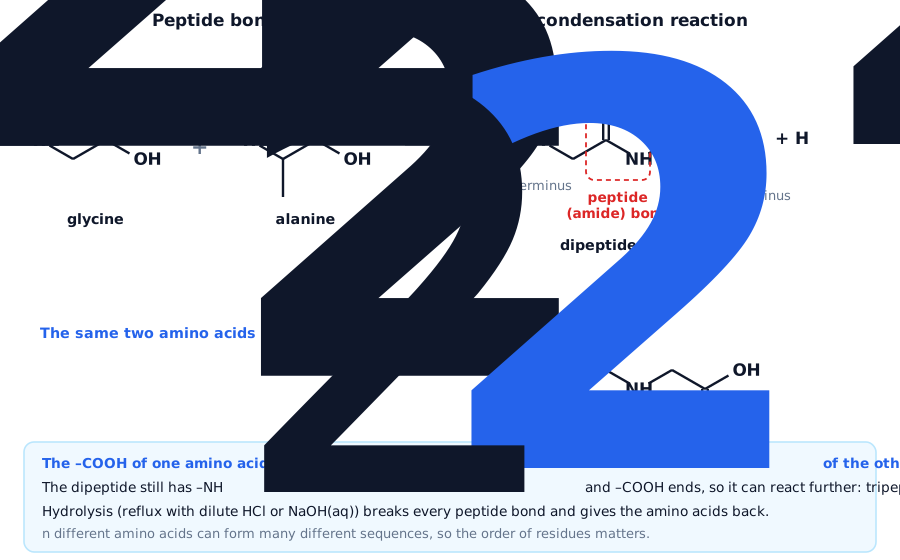
- A dipeptide still has a free –NH2 at one end (the N-terminus) and a free –COOH at the other (the C-terminus), so the chain can grow.
- Two different amino acids, X and Y, can form two dipeptides, X–Y and Y–X. Three different amino acids can be joined in 3! = 6 different tripeptide sequences.
- Hydrolysis of a peptide: heating under reflux with dilute HCl (or NaOH(aq)) breaks every peptide bond and gives the amino acids again (as their ammonium salts in acid).
Worked example. Draw the dipeptide ala–glu (alanine at the N-terminus), formed from alanine and glutamic acid. Show the peptide bond. [2]
CH3CH(NH2)–CO–NH–CH(CH2CH2COOH)COOH [1 for the amide link, displayed as C(=O)–N–H], with the side chain of glutamic acid intact [1].
Worked example. The tripeptide Gly–Ala–Ser is refluxed with dilute hydrochloric acid. State the bond broken and give the products. [3]
The peptide (amide) bonds, C–N [1]. Glycine, alanine and serine are formed [1], as their ammonium chlorides because the acid is in excess [1].
8. Electrophoresis
Electrophoresis separates charged species in an electric field. A drop of the mixture is placed on the centre line (the origin) of a strip of paper or a gel soaked in a buffer of known pH, and a direct voltage is applied. Positively charged ions move towards the cathode (−), negatively charged ions towards the anode (+). Afterwards a locating agent (such as ninhydrin) shows the spots. You do not need to describe the apparatus in detail, but you must interpret results.

Rule. For each amino acid or peptide, compare the pH of the buffer with its pI:
- pH < pI: the species is positive and moves towards the cathode;
- pH = pI: no net charge, it does not move;
- pH > pI: negative, moves towards the anode.
The rate depends on the charge and on the size: the greater the charge and the smaller the species, the faster it moves. Two species with the same charge are therefore separated by size, the larger moving more slowly.
Worked example. A mixture of alanine (pI 6.0), glutamic acid (pI 3.2) and the dipeptide ala–glu is analysed by electrophoresis in a buffer at pH 6.0. Predict the positions of the three species. [3]
Alanine stays at the origin because pH = pI, so it has no net charge [1]. Glutamic acid (pH > pI) is negatively charged and moves towards the anode [1]. Ala–glu also moves to the anode but more slowly than glutamic acid, because it is larger [1].
Worked example. Lysine (pI 9.7) and glycine (pI 6.0) are separated at pH 8.0. Predict the direction of each. [2]
Lysine: pH 8.0 < pI 9.7, so it is positive and moves to the cathode [1]. Glycine: pH 8.0 > pI 6.0, so it is negative and moves to the anode [1].
9. Quick Sheet and Checklist
| Topic | What to remember |
|---|---|
| Primary amine from halogenoalkane | excess NH3 in ethanol, heat under pressure |
| Secondary amine | halogenoalkane + primary amine, ethanol, sealed tube, heat |
| Reduction to amines | nitrile: H2/Ni or LiAlH4; amide: LiAlH4 in dry ether |
| Basicity | ethylamine > ammonia > phenylamine (lone pair availability); amides neutral |
| Phenylamine | benzene → nitrobenzene → Sn/conc. HCl, reflux, then NaOH(aq) |
| Phenylamine + Br2(aq) | white precipitate of 2,4,6-tribromophenylamine, room temperature |
| Diazotisation | NaNO2 + dilute HCl, below 10 °C |
| Diazonium + warm water | phenol + N2 |
| Coupling | diazonium + phenol in NaOH(aq), below 10 °C: orange azo dye, –N=N– |
| Amide formation | acyl chloride + NH3 / primary amine, room temperature |
| Amide hydrolysis | reflux, dilute HCl (acid + RNH3+Cl−) or NaOH(aq) (salt + amine) |
| Zwitterion | H3N+–CHR–COO−; pI = no net charge |
| Peptide | condensation, amide bond, H2O eliminated; hydrolysis by reflux with acid |
| Electrophoresis | pH < pI → cathode; pH = pI → stays; pH > pI → anode |
- [ ] I can state the reagents and conditions for each preparation of a primary and secondary amine.
- [ ] I can rank ammonia, ethylamine, diethylamine, phenylamine and ethanamide by basicity and explain each.
- [ ] I can describe the preparation of phenylamine and its reaction with bromine water.
- [ ] I can describe diazotisation, the hydrolysis to phenol and the coupling to an azo dye, with conditions.
- [ ] I can describe how amides are made, hydrolysed and reduced, and explain why they are not basic.
- [ ] I can draw a zwitterion and the ions at low and high pH, and define the isoelectric point.
- [ ] I can draw a dipeptide with the peptide bond displayed and describe its hydrolysis.
- [ ] I can predict the result of electrophoresis from the pH and the pI values.