 Score
Halogen Compounds (A Level)
0. What Examiners Want
This guide covers Topic 31 of Cambridge International AS & A Level Chemistry 9701 (2025–27) and follows the learning outcomes below, word for word. The right-hand column shows where each one is taught. It builds on Topic 15 (halogenoalkanes), Topic 29 (naming arenes) and Topic 30 (the reactions of arenes). The reactivity of an acyl chloride compared with these two is the subject of Topic 33.
| 31.1 Halogen compounds. Candidates should be able to: | Section |
|---|---|
| 1 recall the reactions by which halogenoarenes can be produced: substitution of an arene with Cl2 or Br2 in the presence of a catalyst, AlCl3 or AlBr3 to form a halogenoarene, exemplified by benzene to form chlorobenzene and methylbenzene to form 2-chloromethylbenzene and 4-chloromethylbenzene | 1, 2, 6 |
| 2 explain the difference in reactivity between a halogenoalkane and a halogenoarene as exemplified by chloroethane and chlorobenzene | 3, 4, 5 |
- Recall of reagents: Cl2 or Br2, the halogen carrier (AlCl3, AlBr3 or the iron(III) halides), room temperature, anhydrous.
- Products and names: chlorobenzene, 2-chloromethylbenzene and 4-chloromethylbenzene, with both isomers stated for methylbenzene.
- Explanation of low reactivity: delocalisation of the chlorine lone pair into the ring, partial double-bond character of C–Cl, and repulsion of nucleophiles by the π electron cloud.
- Comparison with a halogenoalkane: the observation (no AgCl precipitate) and the reason, in the same answer.
- Practical detail: the order NaOH(aq), then HNO3, then AgNO3(aq), and the purpose of the acid.
1. Halogenoarenes: Structure and Names
A halogenoarene (also called an aryl halide) is an arene in which one or more ring hydrogen atoms have been replaced by halogen atoms. The halogen is bonded directly to a carbon of the benzene ring. The simplest examples are chlorobenzene, C6H5Cl, and bromobenzene, C6H5Br.
The names follow the rules in Topic 29:
- A halogen on a benzene ring is a prefix: chlorobenzene, bromobenzene.
- If another group is present, number the ring so that the principal group (or the parent, such as methylbenzene) is carbon 1, in the direction that gives the lowest numbers. So the two isomers of C7H7Cl with chlorine on the ring are 2-chloromethylbenzene and 4-chloromethylbenzene. (They are also written as 1-chloro-2-methylbenzene and 1-chloro-4-methylbenzene, which mean the same.)
- A halogen on a side chain is named differently: C6H5CH2Cl is (chloromethyl)benzene. The brackets show that the Cl is on the CH3 carbon, not on the ring.
2. Making Halogenoarenes
Halogenoarenes are made by electrophilic substitution of an arene (the reaction in Topic 30). Chlorine or bromine reacts with the arene in the presence of a halogen carrier: anhydrous AlCl3 for chlorination and AlBr3 for bromination. Iron(III) chloride and bromide work in the same way.
Bromination: C6H6 + Br2 → C6H5Br + HBr (AlBr3, anhydrous, room temperature, no light)
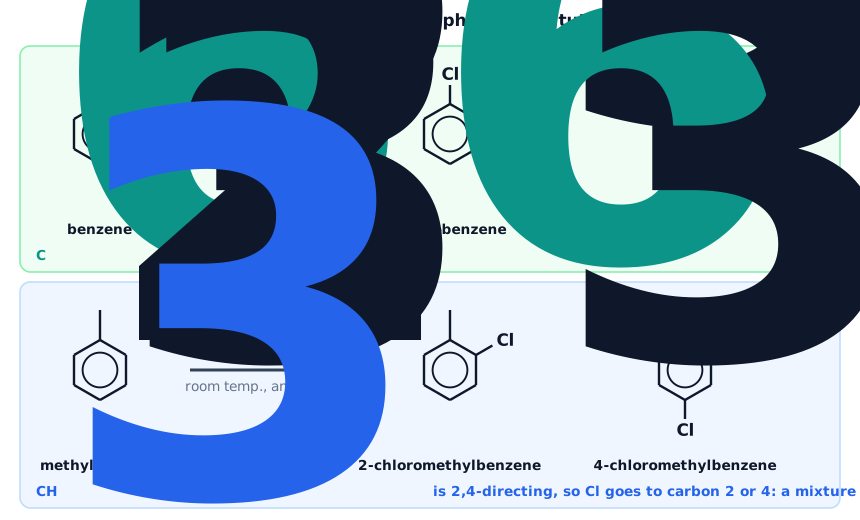
The mechanism. The halogen carrier makes the electrophile, which attacks the π ring. The method is the same as for bromination in Topic 30.

- Make the electrophile: Cl2 + AlCl3 → Cl+ + AlCl4−.
- Attack: a pair of π electrons forms a bond to Cl+, giving the positively charged intermediate (the delocalisation is broken, and Cl and H are on the same carbon).
- Loss of H+: the C–H electrons return to the ring. H+ + AlCl4− → HCl + AlCl3.
Methylbenzene. The CH3 group is 2,4-directing and activating (Topic 30), so methylbenzene reacts faster than benzene and chlorine enters at position 2 or position 4. The products are 2-chloromethylbenzene and 4-chloromethylbenzene. Bromination with Br2 and AlBr3 gives the 2- and 4-bromo equivalents.
Worked example. State the reagents and conditions, and the names of the products, for the chlorination of methylbenzene on the ring. [4]
Reagents: Cl2 and AlCl3 (or FeCl3) as catalyst [1]; conditions: room temperature, anhydrous, in the dark (no UV light) [1]. Products: 2-chloromethylbenzene [1] and 4-chloromethylbenzene [1].
3. Recap: Reactivity of Halogenoalkanes
To explain why halogenoarenes are unreactive, you need to remember why halogenoalkanes are reactive (Topic 15).
- The C–X bond is polar: the carbon is δ+ because the halogen is more electronegative. A nucleophile (a lone-pair donor) attacks the δ+ carbon and replaces the halogen. This is nucleophilic substitution.
- Primary halogenoalkanes react by the SN2 mechanism: the nucleophile attacks the carbon from the back, in one step. Tertiary halogenoalkanes react by SN1: the C–X bond breaks first, giving a carbocation, which is then attacked.
- The rate of hydrolysis is controlled by the bond energy, not the polarity: C–I (240 kJ mol−1) breaks faster than C–Br (280) and C–Cl (340).

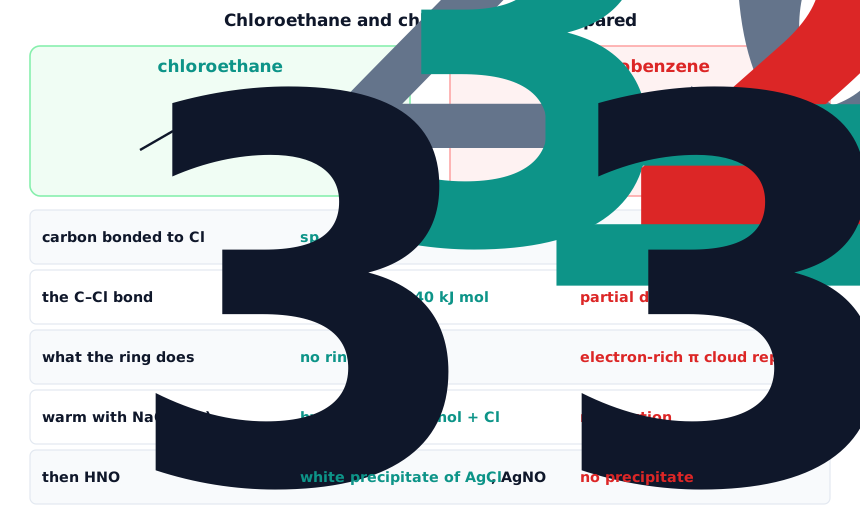
The reactions of chloroethane that you must be able to compare are summarised below. The right-hand side of the figure shows the result of using the same reagents with chlorobenzene: none of them works.

| Reagent and conditions | Chloroethane | Chlorobenzene |
|---|---|---|
| NaOH(aq), warm, under reflux | ethanol (substitution) | no reaction |
| KCN in ethanol, reflux | propanenitrile (substitution) | no reaction |
| excess NH3 in ethanol, heat under pressure | ethylamine (substitution) | no reaction |
| NaOH in ethanol, heat | ethene (elimination) | no reaction |
| warm AgNO3(aq) in ethanol | white AgCl precipitate | no precipitate |
4. Why Halogenoarenes Are Unreactive
Chlorobenzene does not hydrolyse when warmed with aqueous sodium hydroxide. Industrially, a halogenoarene can be converted to a phenol only with aqueous alkali at very high temperature and pressure. The main reasons are as follows.
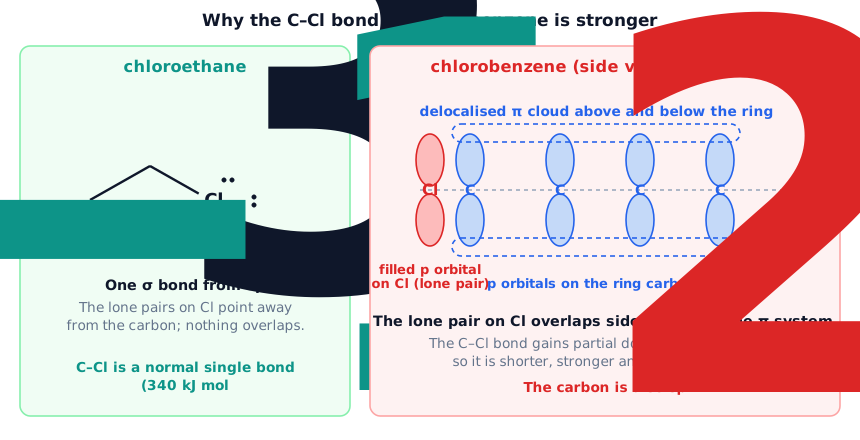
Reason 1: the C–Cl bond is stronger. A chlorine atom has lone pairs of electrons in p orbitals. In chlorobenzene one of these p orbitals overlaps sideways with the p orbitals of the ring carbons, so the lone pair is partly delocalised into the π system of the ring. This gives the C–Cl bond some double-bond character: it is shorter and stronger than the single bond in chloroethane, and so it is harder to break. (The carbon is also sp2 hybridised, which holds the bonding electrons closer to the carbon than an sp3 carbon does.)
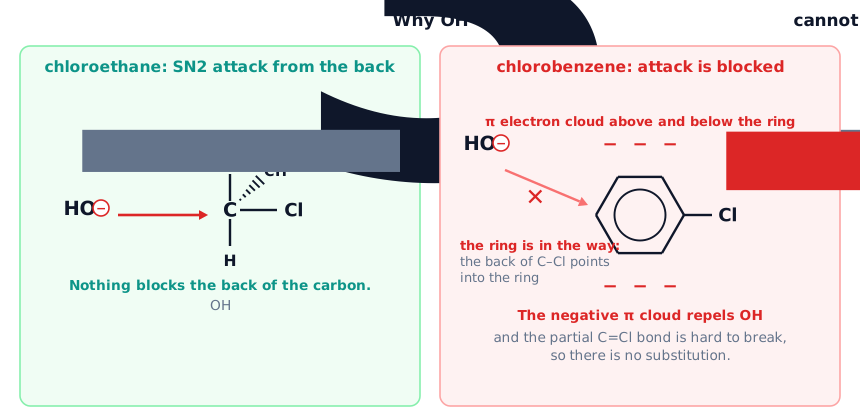
Reason 2: the ring repels nucleophiles. A nucleophile such as OH− is negatively charged. The benzene ring has a cloud of π electrons above and below the plane, so it repels the incoming ion. Also, the SN2 route needs the nucleophile to attack the carbon from the side opposite the chlorine; in chlorobenzene that side is inside the ring, so the attack is blocked.
Reason 3: no stable carbocation for SN1. The SN1 route would need a phenyl cation, C6H5+. The empty orbital lies in the plane of the ring, so it is not stabilised by the π system, and the cation is very unstable. (Tertiary halogenoalkanes can do SN1 because their carbocation is stabilised by three alkyl groups.)
Worked example. Explain why chlorobenzene is much less reactive than chloroethane towards nucleophiles. [3]
(1) In chlorobenzene a lone pair on chlorine overlaps with (is delocalised into) the π system of the ring [1]. (2) The C–Cl bond therefore has partial double-bond character, so it is stronger and harder to break than the C–Cl bond in chloroethane [1]. (3) The electron-rich ring repels the nucleophile (OH−), so the carbon cannot be attacked [1].
5. The Silver Nitrate Test
A halogenoalkane is hydrolysed to release its halide ion, and the halide ion is then identified with silver nitrate. A halogenoarene gives no halide ion, so there is no precipitate.
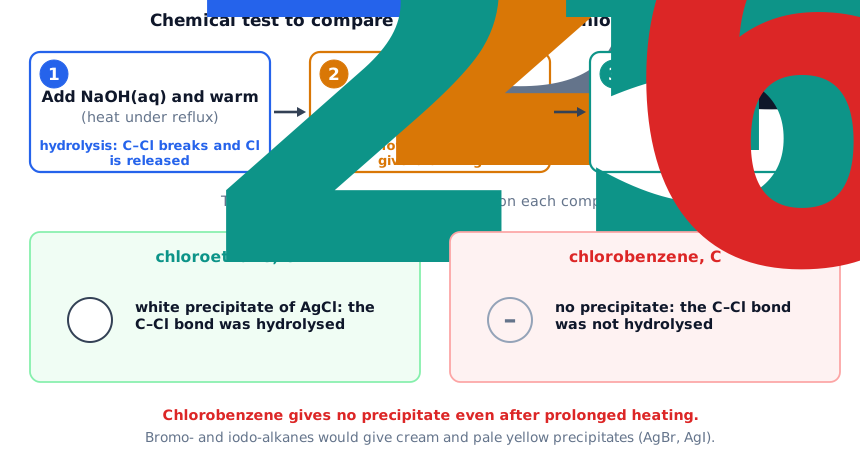
- Warm with aqueous NaOH. CH3CH2Cl + OH− → CH3CH2OH + Cl−.
- Cool and acidify with dilute HNO3. This neutralises the excess OH−, which would otherwise form a brown precipitate of silver oxide with Ag+, hiding the result.
- Add AgNO3(aq). Ag+(aq) + Cl−(aq) → AgCl(s), a white precipitate. A bromoalkane gives a cream precipitate (AgBr) and an iodoalkane a pale yellow one (AgI).
For chlorobenzene the C–Cl bond is not hydrolysed, so there are no Cl− ions in step 3 and no precipitate forms, even after prolonged heating.
Worked example. 0.645 g of chloroethane (Mr = 64.5) is hydrolysed completely and the mixture is treated with excess acidified silver nitrate. Calculate the mass of silver chloride formed (Mr = 143.3). [2]
Amount of C2H5Cl = 0.645 / 64.5 = 0.0100 mol [1]. Each mole gives one mole of Cl− and so one mole of AgCl: mass = 0.0100 × 143.3 = 1.43 g [1]. (If chlorobenzene were present in the same flask it would add nothing to this mass.)
6. Ring or Side Chain?
The formula C7H7Cl fits three isomers that you should know, and their reactivity depends on where the chlorine is.
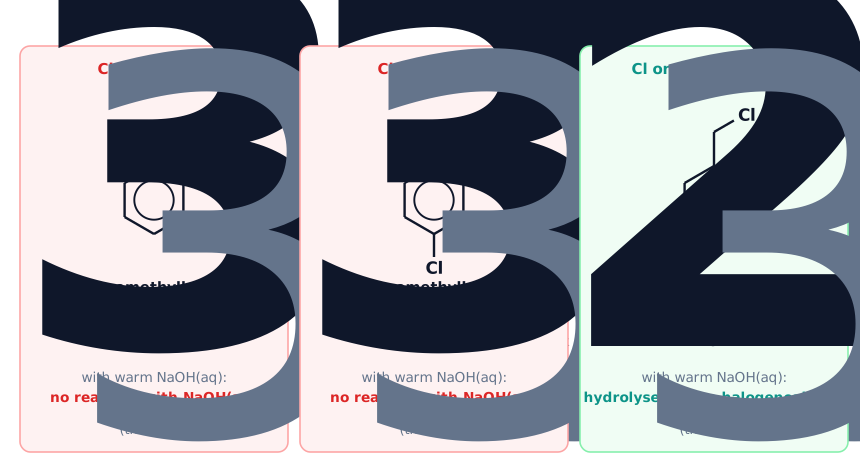
- Cl on the ring (2- and 4-chloromethylbenzene): made with Cl2 and AlCl3 in the dark. It is a halogenoarene and does not hydrolyse.
- Cl on the side chain ((chloromethyl)benzene): made with Cl2 and UV light (free-radical substitution, Topic 30). It is a primary halogenoalkane carrying a phenyl group, so it does hydrolyse with warm NaOH(aq) and gives a white precipitate in the silver nitrate test.
This gives a simple way to tell the isomers apart: warm each with NaOH(aq), acidify with HNO3 and add AgNO3(aq). Only the side-chain isomer gives a precipitate.
Worked example. Compounds M and N both have the formula C7H7Cl. M has Cl on the ring (4-position) and N has Cl on the CH3 carbon. Describe a test that distinguishes them. [3]
Warm each with aqueous NaOH [1], cool and acidify with dilute HNO3, then add AgNO3(aq) [1]. N gives a white precipitate; M gives no precipitate [1].
7. Quick Sheet and Checklist
| Topic | Statement to learn |
|---|---|
| halogenoarene | halogen bonded directly to a ring carbon, e.g. chlorobenzene, C6H5Cl |
| formation | arene + Cl2 or Br2, AlCl3 or AlBr3 (or FeX3), anhydrous, room temperature, dark |
| electrophile | Cl2 + AlCl3 → Cl+ + AlCl4−; catalyst regenerated |
| from methylbenzene | 2-chloromethylbenzene and 4-chloromethylbenzene (CH3 is 2,4-directing) |
| side-chain chlorination | Cl2, UV light, no catalyst: (chloromethyl)benzene |
| halogenoalkane | polar C–X; nucleophilic substitution; rate set by bond energy, C–I < C–Br < C–Cl |
| why chlorobenzene is inert | lone pair on Cl delocalised into the ring; partial double bond, stronger C–Cl; ring π cloud repels nucleophiles; back of the carbon blocked |
| test | NaOH(aq), warm; acidify with HNO3; AgNO3(aq). Chloroethane: white precipitate. Chlorobenzene: none |
Checklist. Before the exam you should be able to:
- [ ] define a halogenoarene and name chlorobenzene, 2-chloromethylbenzene, 4-chloromethylbenzene and (chloromethyl)benzene
- [ ] give the reagents and conditions for making a halogenoarene from benzene and from methylbenzene, and state the products
- [ ] write the equation for forming the electrophile (Cl+ or Br+) and describe the role of the halogen carrier
- [ ] distinguish ring substitution (AlCl3, dark) from side-chain substitution (UV light)
- [ ] recall why halogenoalkanes are reactive and how bond energy controls the rate
- [ ] explain, in three linked points, why chlorobenzene is much less reactive than chloroethane
- [ ] describe the silver nitrate test, give the purpose of each step, and state the result for each compound
- [ ] distinguish C7H7Cl isomers with the chlorine on the ring and on the side chain