 Score
Introduction to A Level Organic Chemistry
0. What Examiners Want
This guide covers Topic 29 of Cambridge International AS & A Level Chemistry 9701 (2025–27) and follows the learning outcomes below, word for word. The right-hand column shows where each one is taught. It builds on Topic 13 (AS organic basics) and prepares you for Topics 30 to 40.
| 29.1 Formulas, functional groups and the naming of organic compounds. Candidates should be able to: | Section |
|---|---|
| 1 understand that the compounds in the table on page 47 contain a functional group which dictates their physical and chemical properties | 1 |
| 2 interpret and use the general, structural, displayed and skeletal formulas of the classes of compound stated in the table on page 47 | 1 |
| 3 understand and use systematic nomenclature of simple aliphatic organic molecules (including cyclic compounds containing a single ring of up to six carbon atoms) with functional groups detailed in the table on page 47, up to six carbon atoms (six plus six for esters and amides, straight chains only for esters and nitriles) | 2 |
| 4 understand and use systematic nomenclature of simple aromatic molecules with one benzene ring and one or more simple substituents, for example 3-nitrobenzoic acid or 2,4,6-tribromophenol | 3 |
| 29.2 Characteristic organic reactions. Candidates should be able to: | Section |
|---|---|
| 1 understand and use the following terminology associated with types of organic mechanisms: (a) electrophilic substitution (b) addition–elimination | 4 |
| 29.3 Shapes of aromatic organic molecules; σ and π bonds. Candidates should be able to: | Section |
|---|---|
| 1 describe and explain the shape of benzene and other aromatic molecules, including sp2 hybridisation, in terms of σ bonds and a delocalised π system | 5 |
| 29.4 Isomerism: optical. Candidates should be able to: | Section |
|---|---|
| 1 understand that enantiomers have identical physical and chemical properties apart from their ability to rotate plane polarised light and their potential biological activity | 6 |
| 2 understand and use the terms optically active and racemic mixture | 6 |
| 3 describe the effect on plane polarised light of the two optical isomers of a single substance | 6 |
| 4 explain the relevance of chirality to the synthetic preparation of drug molecules including: (a) the potential different biological activity of the two enantiomers (b) the need to separate a racemic mixture into two pure enantiomers (c) the use of chiral catalysts to produce a single pure optical isomer (Candidates should appreciate that compounds can contain more than one chiral centre, but knowledge of meso compounds and nomenclature such as diastereoisomers is not required.) | 7 |
- Names and formulae: correct systematic names, with locants in the right place, and structures drawn clearly in skeletal, structural or displayed form.
- Terminology: electrophile, electrophilic substitution, addition–elimination, chiral centre, enantiomer, racemic mixture, each used precisely.
- Bonding: hybridisation, bond angle, and the difference between σ and π bonds in benzene.
- Diagrams: 3D structures with wedges and dashes, and mechanisms with correctly placed curly arrows.
- Applying ideas: identifying chiral centres in unfamiliar molecules, and explaining why a racemic mixture forms or why a single enantiomer is wanted.
1. New Functional Groups and Formulae
A functional group is the atom or group of atoms that gives an organic compound its characteristic chemical and physical properties. At AS you met alkanes, alkenes, halogenoalkanes, alcohols, aldehydes, ketones, carboxylic acids, esters, nitriles and primary amines. At A Level you add the families below.

| Family | General / structural formula of the group | Example |
|---|---|---|
| arene | benzene ring, C6H6 (phenyl group, C6H5–) | benzene |
| halogenoarene | C6H5–X | chlorobenzene, C6H5Cl |
| phenol | C6H5–OH | phenol |
| acyl chloride | R–COCl | propanoyl chloride, CH3CH2COCl |
| amine (secondary and tertiary) | R–NH–R′ and R3N | (naming not required) |
| amide (primary, secondary, tertiary) | R–CONH2 (R–CONHR′, R–CONR′R″) | propanamide, CH3CH2CONH2 |
| amino acid | H2N–CHR–COOH | 2-aminoethanoic acid, H2NCH2COOH |
Reading the four kinds of formula. The same molecule can be written four ways. For propanamide:
| Type | What it shows | Propanamide |
|---|---|---|
| molecular | number of each atom | C3H7NO |
| structural | groups in order | CH3CH2CONH2 |
| displayed | every atom and every bond | H–C–C–C(=O)–N–H with all H drawn |
| skeletal | carbon skeleton as lines; C and H on carbon omitted | a zig-zag with C=O and NH2 drawn |
Primary, secondary and tertiary amines and amides. The classification depends on how many carbon groups are bonded to the nitrogen atom: one is primary, two is secondary, three is tertiary. CH3NH2 is a primary amine, (CH3)2NH is a secondary amine and (CH3)3N is a tertiary amine. For amides, CH3CONH2 is primary, CH3CONHCH3 is secondary and CH3CON(CH3)2 is tertiary.
2. Naming Aliphatic Compounds
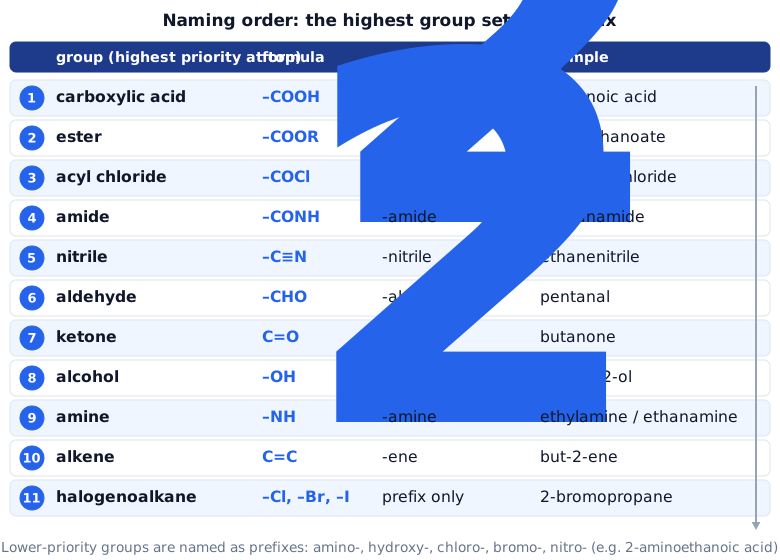
Systematic names are built from a parent chain, a suffix for the highest-priority functional group, and prefixes for everything else.
- Find the longest carbon chain that contains the principal functional group (for rings of up to six carbons use cyclo…).
- Give the parent its stem (meth, eth, prop, but, pent, hex) and the ending for the group of highest priority.
- Number the chain so that the principal group has the lowest possible number; for acids, acyl chlorides, amides, nitriles and aldehydes the group is always carbon 1, so no number is written.
- Name the other groups as prefixes in alphabetical order with their position numbers.
| Family | Pattern | Examples |
|---|---|---|
| acyl chloride | alkanoyl chloride | ethanoyl chloride, CH3COCl; propanoyl chloride; butanoyl chloride |
| amide | alkanamide (N- before a group on nitrogen) | ethanamide; propanamide; N-methylpropanamide, CH3CH2CONHCH3 |
| amino acid | aminoalkanoic acid | 2-aminoethanoic acid; 2-aminopropanoic acid, CH3CH(NH2)COOH; 3-aminobutanoic acid |
| ester | alkyl alkanoate | methyl ethanoate; ethyl propanoate, CH3CH2COOCH2CH3 |
| nitrile | alkanenitrile | ethanenitrile; butanenitrile |
| cyclic | cycloalkane, -ol, -ene | cyclohexane; cyclohexanol; cyclopentene; 2-methylcyclohexanol |
Worked example. Name CH3CH(NH2)CH2COOH.
The COOH is the principal group, so it is carbon 1; the chain has four carbons (butanoic acid) and the NH2 is on carbon 3. The name is 3-aminobutanoic acid.
Worked example. Name CH3CH2COOCH2CH3.
The ester name has two parts: the alkyl group on the oxygen (ethyl) and the acid part (propanoate, from the three-carbon acyl chain). The name is ethyl propanoate. The acyl part is always named second.
3. Naming Aromatic Compounds
Aromatic compounds have one benzene ring with simple substituents. There are three patterns to learn.
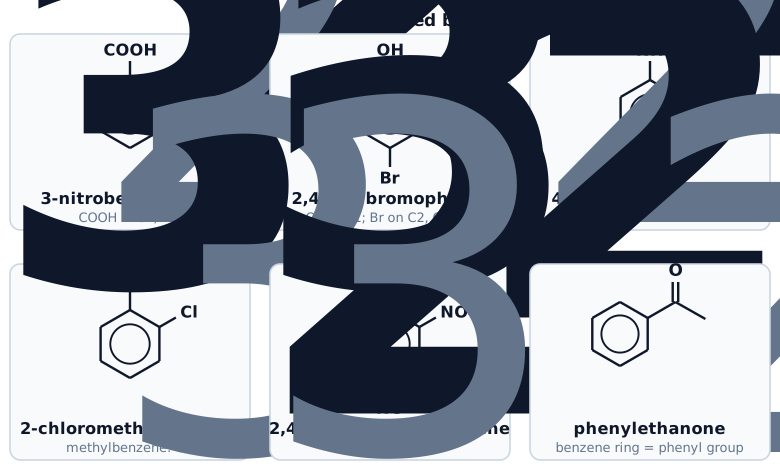
Pattern 1: substituents named as prefixes on benzene. Halogen and nitro groups are always prefixes: chlorobenzene, nitrobenzene, 1,3-dinitrobenzene, 1,3,5-tribromobenzene. A single substituent needs no number.
Pattern 2: the ring carries a principal group that changes the parent name. The carbon bonded to this group is carbon 1:
- –OH gives phenol: 2,4,6-tribromophenol; 4-nitrophenol.
- –COOH gives benzoic acid: 3-nitrobenzoic acid; 4-methylbenzoic acid.
- –NH2 gives phenylamine: 4-chlorophenylamine.
- –COCH3 gives phenylethanone. Here the benzene ring is a phenyl group (C6H5–) attached to the chain of ethanone.
Pattern 3: alkylbenzenes. The ring is the parent: methylbenzene, ethylbenzene. With further substituents, the syllabus names the compound with methylbenzene as the parent and the methyl carbon as carbon 1: 2-chloromethylbenzene, 4-chloromethylbenzene, 2,4-dinitromethylbenzene. (The IUPAC form with the prefixes in alphabetical order, for example 1-chloro-2-methylbenzene, is the same compound.)
| Substituents | Ring positions | Name |
|---|---|---|
| –COOH, –NO2 | 1, 3 | 3-nitrobenzoic acid |
| –OH, three –Br | 1, 2, 4, 6 | 2,4,6-tribromophenol |
| –NH2, –Cl | 1, 4 | 4-chlorophenylamine |
| –CH3, –Cl | 1, 2 | 2-chloromethylbenzene |
| –CH3, two –NO2 | 1, 2, 4 | 2,4-dinitromethylbenzene |
| –COCH3 | 1 | phenylethanone |
Worked example. Draw 2,4,6-trinitromethylbenzene and give its molecular formula.
Start with methylbenzene, C6H5CH3; put a nitro group on carbons 2, 4 and 6 (both ortho positions and the para position). Three H on the ring are replaced, so the formula is C7H5N3O6 (C6H2(NO2)3CH3).
4. Mechanism Terminology
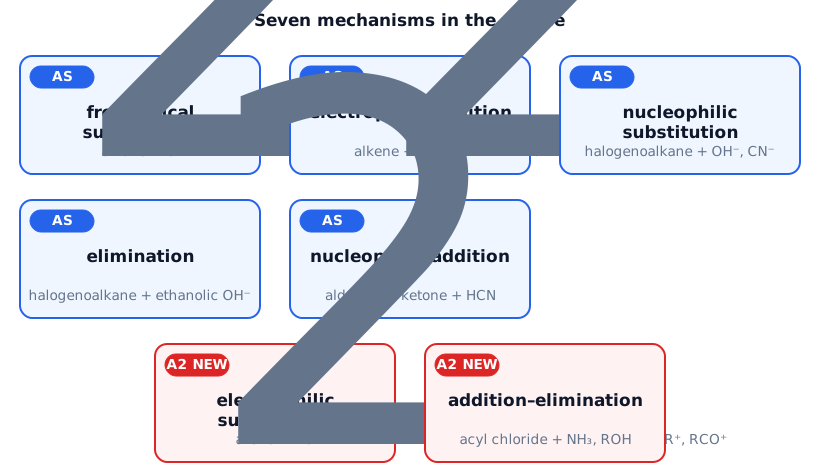
You already know five mechanism types from AS. At A Level there are two more. Every mechanism name has two parts: who attacks (the nucleophile or electrophile or radical) and what happens (substitution, addition, elimination).
- A nucleophile is a species that donates a lone pair of electrons to an electron-deficient (δ+) carbon.
- An electrophile is a species that accepts a pair of electrons from an electron-rich region.
(a) Electrophilic substitution. An electrophile attacks an electron-rich region and replaces an atom (usually H) in the molecule. This is the characteristic mechanism of benzene and other arenes, because the delocalised π electron ring is a region of high electron density. Two steps: the electrophile attacks the ring and a positively charged intermediate (the σ-complex) forms; then H+ is lost and the delocalised ring is restored.

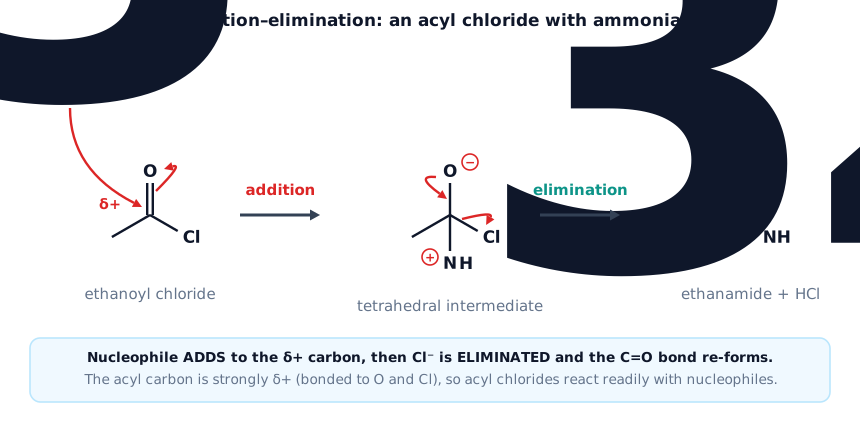
(b) Addition–elimination. A nucleophile first adds to a δ+ carbon atom (the C=O carbon), and then a small molecule or ion is eliminated (Cl− from an acyl chloride), so that the C=O bond re-forms. The overall change is a substitution of Cl by the nucleophile, but it is not the same mechanism as the SN1 or SN2 reactions of halogenoalkanes. You will use it for acyl chlorides in later topics.
| Mechanism | Attacking species | Starting compound | Result |
|---|---|---|---|
| free-radical substitution | radical | alkane | H replaced |
| electrophilic addition | electrophile | alkene | across C=C |
| nucleophilic substitution | nucleophile | halogenoalkane | X replaced |
| elimination | base | halogenoalkane, alcohol | C=C forms |
| nucleophilic addition | nucleophile | aldehyde, ketone | across C=O |
| electrophilic substitution | electrophile | arene | H replaced |
| addition–elimination | nucleophile | acyl chloride | Cl replaced |
5. The Shape of Benzene
Benzene is C6H6. Kekulé (1865) suggested a ring of six carbons with alternating single and double bonds. Measurements show that this is wrong.
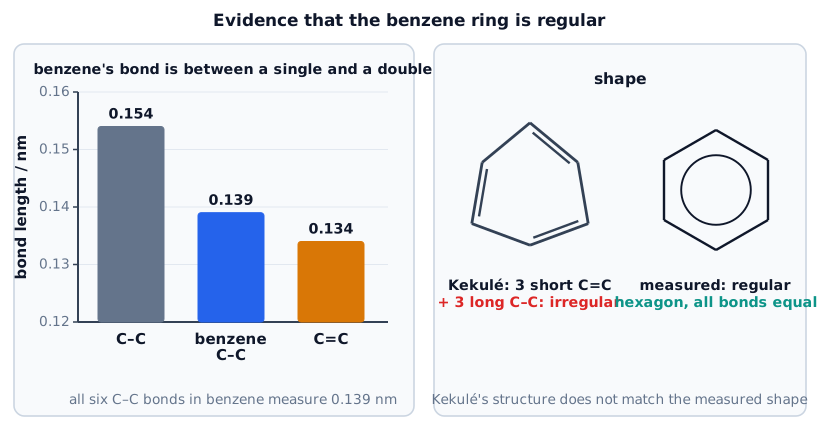
| Bond | Length / nm |
|---|---|
| C–C | 0.154 |
| C=C | 0.134 |
| C–C in benzene | 0.139 |
The bonding model. Each of the six carbon atoms is sp2 hybridised. One 2s and two 2p orbitals mix to give three sp2 orbitals in one plane, 120° apart.
- Each carbon forms three σ bonds by head-on overlap of sp2 orbitals: two C–C bonds and one C–H bond. A σ bond has electron density between the nuclei.
- The six carbons and six hydrogens are therefore in one plane, and the molecule is a regular hexagon with all bond angles 120° (C–C–C and C–C–H).
- Each carbon has one electron left in a 2p orbital pointing at right angles to the plane. These six p orbitals overlap sideways (laterally) with both neighbours to form a delocalised π system: a ring of electron density above and below the plane, containing six electrons.

In an alkene the two p electrons of a π bond are shared by only two carbon atoms (localised). In benzene the six π electrons are shared by all six carbons (delocalised), which makes the ring more stable than a ring with three isolated C=C bonds.
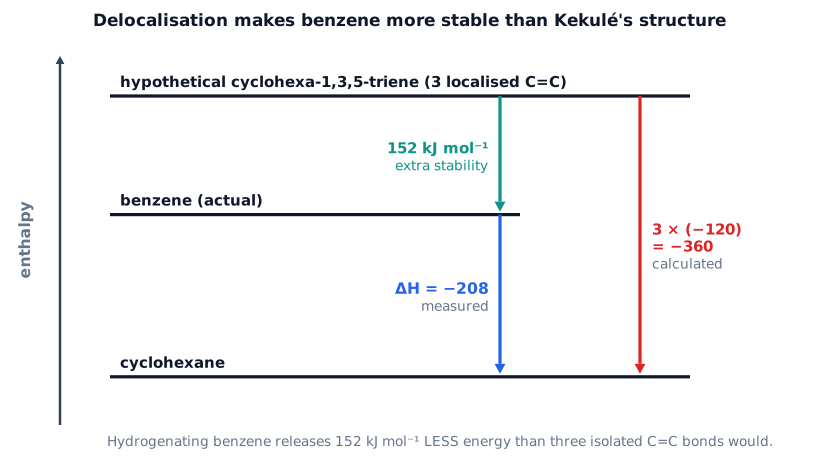
More evidence for delocalisation (supporting data). If benzene had three separate C=C bonds, hydrogenation should release three times the enthalpy change of cyclohexene (3 × −120 = −360 kJ mol−1). The measured value is only −208 kJ mol−1, so benzene is about 152 kJ mol−1 more stable than Kekulé’s structure predicts.
Other aromatic molecules. The same ideas apply to any molecule with a benzene ring. In methylbenzene the six ring carbons are sp2 and the methyl carbon is sp3 (tetrahedral, 109.5°). In phenol and phenylamine the ring carbons are sp2, and a lone pair on the O or N atom can overlap with the π system. Naphthalene is two fused rings; its carbons are also sp2 and it is planar with a delocalised π system over both rings.
Counting hybridisation. An sp carbon has two σ bonds and two π bonds around it (C≡C or C=C=C); an sp2 carbon has three σ bonds and one π bond (C=C or aromatic C); an sp3 carbon has four σ bonds and no π bond.

| C6H6 structure | sp carbons | sp2 carbons | sp3 carbons |
|---|---|---|---|
| Kekulé benzene | 0 | 6 | 0 |
| Dewar benzene | 0 | 4 | 2 |
| Ladenburg benzene | 0 | 0 | 6 |
| delocalised benzene | 0 | 6 | 0 |
Dewar and Ladenburg benzene are unstable because the bond angles in their three- and four-membered rings (60° and 90°) are far from the preferred 109.5° or 120°: they have ring strain (bond strain).
Worked example. Describe the shape of benzene, including the geometry of each carbon and the types of bond.
Planar and hexagonal; each carbon is trigonal planar (sp2) with C–C–H and C–C–C angles of 120°. The C–H bonds are σ bonds; each C–C bond is a σ bond plus a share in the delocalised π system.
6. Optical Isomerism
Isomers have the same molecular formula but a different arrangement of atoms. Stereoisomers have the same structural formula but a different arrangement of atoms in space. At AS you met one kind, cis–trans isomerism. The second kind is optical isomerism.
Chiral centre. A carbon atom bonded to four different atoms or groups is a chiral centre (chiral carbon). A molecule with one chiral centre exists as two non-superimposable mirror images called enantiomers. Just as your left and right hands are mirror images that cannot be placed exactly on top of each other, the two forms cannot be superimposed however you rotate them.
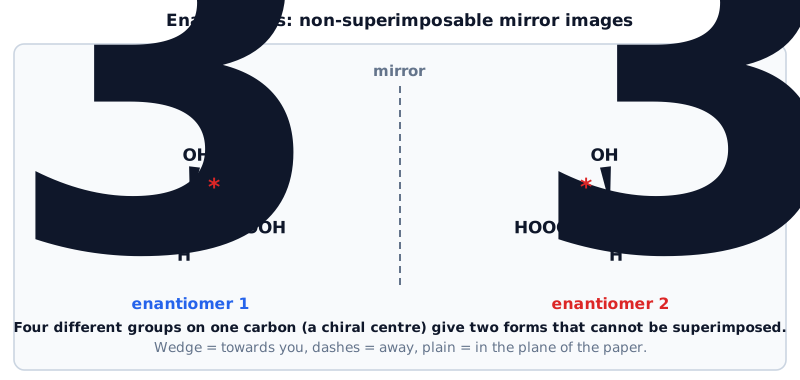
How to draw them. Draw the chiral carbon with two bonds in the plane of the paper, one bond on a wedge and one on dashes. The second enantiomer is the mirror image: swap the positions of any two groups.
Finding chiral centres.
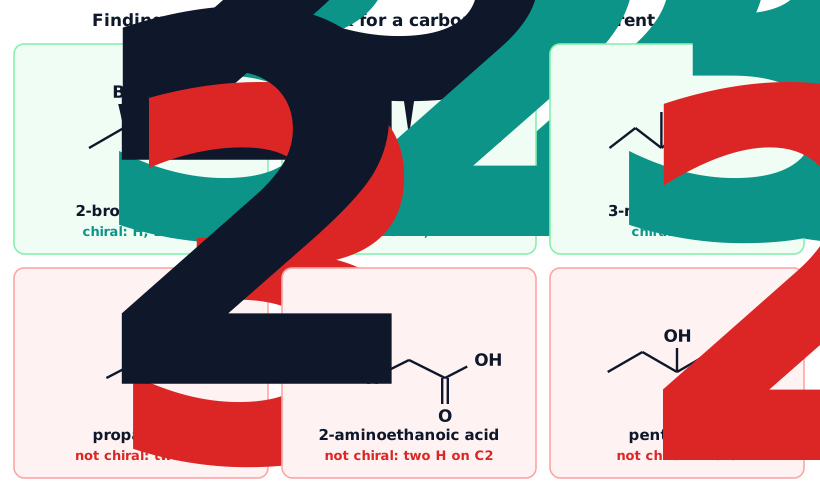
- Look at each sp3 carbon (carbons in C=C or C=O are never chiral).
- List the four groups. If any two are the same, the carbon is not chiral.
- Mark each chiral carbon with an asterisk. In a molecule with n chiral centres there are up to 2n stereoisomers (you do not need to name them or consider meso forms).
Worked example. How many chiral centres are in CH3CH(OH)CH(Cl)CH3?
C2 has H, OH, CH3 and CH(Cl)CH3: four different groups, chiral. C3 has H, Cl, CH3 and CH(OH)CH3: chiral. C1 and C4 are CH3 groups. There are two chiral centres, so up to 22 = 4 stereoisomers.
Properties of enantiomers. Enantiomers have identical physical properties (melting point, boiling point, density, solubility) and identical chemical properties with ordinary (achiral) reagents. They differ in two ways only:
- they rotate the plane of plane-polarised light in opposite directions, by the same angle;
- they may have different biological activity, because enzymes and receptors in the body are themselves chiral and fit one enantiomer better than the other.
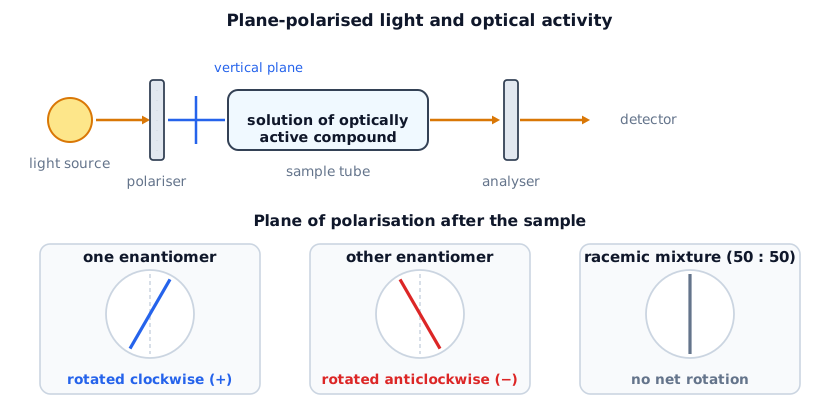
Optically active. A substance is optically active if it rotates the plane of plane-polarised light. One enantiomer rotates it clockwise (the + or d form) and the other rotates it anticlockwise by the same angle (the − or l form).
Racemic mixture. A racemic mixture (racemate) is an equimolar mixture of two enantiomers. The rotations cancel, so it is not optically active.
Why do racemic mixtures form? In many reactions the chiral centre is made from a planar group, which the reagent can attack from either face with equal probability. In the nucleophilic addition of HCN to ethanal, the C=O carbon is trigonal planar. The cyanide ion attacks from above or below the plane equally, so the two enantiomers of 2-hydroxypropanenitrile form in equal amounts and the product is racemic.

7. Chirality and Medicines
Most drug molecules are chiral, and they work by fitting into a chiral protein (an enzyme or a receptor). The two enantiomers therefore behave differently in the body.
- (a) Different biological activity. One enantiomer may be the effective drug while the other is inactive, less active or harmful. The pain-relief drug ibuprofen has one chiral centre; the (S)-enantiomer is the active one. Thalidomide, sold as a racemic mixture in the 1960s, is the classic case: one enantiomer is associated with the sedative effect and the other with the severe birth defects, although the two forms interconvert in the body, which is one reason the story is a warning rather than a simple lesson. In levodopa (L-DOPA), used for Parkinson’s disease, only one enantiomer is used as the medicine.

Many laboratory reactions give racemic products, so a chemist who wants a single enantiomer has two main options.

- (b) Separate the racemic mixture into two pure enantiomers. This is difficult, because the enantiomers have identical physical properties, so special methods (for example chromatography on a chiral column, or reaction with a pure chiral reagent) are needed. It is also wasteful: at best only 50 % of the product is the wanted enantiomer.
- (c) Use a chiral catalyst (including an enzyme) so that the reaction produces mainly one enantiomer. The catalyst is not used up, and no half of the product is wasted.
Medicines made as a single enantiomer can be given at a lower dose (no inactive half), have fewer side effects, and avoid the risk from the unwanted form. That is why pharmaceutical companies invest in chiral synthesis.
Worked example. A reaction produces a drug as a racemic mixture. Suggest two reasons why a manufacturer might want only one enantiomer.
(1) The two enantiomers may have different biological activity: one may be inactive or cause harmful side effects. (2) Giving only the active enantiomer means a smaller dose is needed, and no half of the material is wasted.
8. Quick Sheet and Checklist
| Topic | Statement to learn |
|---|---|
| functional group | the atom or group that determines a compound’s characteristic properties |
| new families | arene, halogenoarene, phenol, acyl chloride, secondary and tertiary amine, amide, amino acid |
| aliphatic names | highest group gives the suffix; others are prefixes in alphabetical order; acid, acyl chloride, amide, nitrile and aldehyde carbons are always C1 |
| aromatic names | phenol, benzoic acid, phenylamine give C1; methylbenzene is the parent for 2-chloromethylbenzene; 2 and 6 equivalent |
| electrophilic substitution | electrophile attacks π ring; H replaced; arenes |
| addition–elimination | nucleophile adds to δ+ C=O carbon, then Cl− is eliminated; acyl chlorides |
| benzene shape | planar hexagon; sp2; 120°; σ by head-on overlap; delocalised π by sideways p overlap; C–C 0.139 nm |
| chiral centre | carbon with four different groups |
| enantiomers | non-superimposable mirror images; same properties except rotation of polarised light and biological activity |
| racemic mixture | equimolar mixture of two enantiomers; no net optical rotation |
| drug synthesis | enantiomers can act differently; separate the racemate or use a chiral catalyst |
Checklist. Before the exam you should be able to:
- [ ] name and draw the new families from the list of seven, and recognise them in skeletal formulae
- [ ] name aliphatic compounds including acyl chlorides, amides, amino acids and cyclic compounds of up to six carbons
- [ ] name aromatic compounds such as 3-nitrobenzoic acid and 2,4,6-tribromophenol, and draw them from the name
- [ ] define electrophilic substitution and addition–elimination and say which compounds use each
- [ ] state the hybridisation, bond angles and σ and π bonding in benzene, and describe its shape
- [ ] explain why Kekulé’s structure is wrong, using bond lengths and stability
- [ ] count sp, sp2 and sp3 carbons in a structure
- [ ] identify chiral centres in a skeletal formula and draw a pair of enantiomers with wedges and dashes
- [ ] state what is the same and what is different about two enantiomers, and define optically active and racemic mixture
- [ ] explain why a racemic mixture forms from a planar group
- [ ] explain why chirality matters for drugs, and describe separating a racemate and using a chiral catalyst