 Score
Hydroxy Compounds (A Level)
0. What Examiners Want
This guide covers Topic 32 of Cambridge International AS & A Level Chemistry 9701 (2025–27) and follows the learning outcomes below, word for word. The right-hand column shows where each one is taught. It builds on Topic 16 (alcohols), Topic 29 (electrophilic substitution) and Topic 30 (arenes). The acidity of carboxylic acids compared with phenol, and the reactions of acyl chlorides in general, are the subject of Topic 33; the formation of azo dyes from phenylamine is part of Topic 34.
| 32 Hydroxy compounds. Candidates should be able to: | Section |
|---|---|
| 32.1 Alcohols | |
| 1 describe the reaction with acyl chlorides to form esters using ethyl ethanoate | 1, 2 |
| 32.2 Phenol | |
| 1 recall the reactions (reagents and conditions) by which phenol can be produced: (a) reaction of phenylamine with HNO2 or NaNO2 and dilute acid below 10 °C to produce the diazonium salt; further warming of the diazonium salt with H2O to give phenol | 3 |
| 2 recall the chemistry of phenol, as exemplified by the following reactions: (a) with bases, for example NaOH(aq) to produce sodium phenoxide (b) with Na(s) to produce sodium phenoxide and H2(g) (c) in NaOH(aq) with diazonium salts, to give azo compounds (d) nitration of the aromatic ring with dilute HNO3(aq) at room temperature to give a mixture of 2-nitrophenol and 4-nitrophenol (e) bromination of the aromatic ring with Br2(aq) to form 2,4,6-tribromophenol | 5 |
| 3 explain the acidity of phenol | 4 |
| 4 describe and explain the relative acidities of water, phenol and ethanol | 4 |
| 5 explain why the reagents and conditions for the nitration and bromination of phenol are different from those for benzene | 5, 6 |
| 6 recall that the hydroxyl group of a phenol directs to the 2-, 4- and 6-positions | 6 |
| 7 apply knowledge of the reactions of phenol to those of other phenolic compounds, e.g. naphthol | 7 |
- Reagents and conditions: NaNO2 + HCl below 10 °C, then warm with water; Br2(aq); dilute HNO3; NaOH(aq) and below 10 °C for coupling. The temperature is usually a mark.
- Products and observations: 2,4,6-tribromophenol (white precipitate), 2- and 4-nitrophenol, sodium phenoxide, an azo compound, ethyl ethanoate with HCl.
- Explanations of acidity: the delocalisation of the phenoxide charge into the ring, and the electron-donating alkyl group in ethoxide.
- Explanations of reactivity: the oxygen lone pair delocalised into the ring, which activates it and directs to the 2-, 4- and 6-positions.
- Applying the pattern: predicting the reactions of an unfamiliar phenol, such as naphthol, from the phenol reactions.
1. Recap: Reactions of Alcohols
An alcohol has an –OH group on a saturated carbon atom. It is primary, secondary or tertiary according to the number of alkyl groups on the carbon that carries the –OH. At AS you met the reactions in the figure below. Ethanol is the example.

- With sodium, the O–H bond breaks: 2CH3CH2OH + 2Na → 2CH3CH2ONa + H2.
- Primary alcohols oxidise (acidified K2Cr2O7, heat) to aldehydes (distil off) and then carboxylic acids (reflux); secondary alcohols give ketones; tertiary alcohols do not oxidise.
- Heating with concentrated H2SO4 at about 170 °C dehydrates an alcohol to an alkene.
- Alcohols form halogenoalkanes with HBr, PCl5 or SOCl2.
- With a carboxylic acid and a strong acid catalyst under reflux, an alcohol forms an ester in a reversible reaction: CH3COOH + CH3CH2OH ⇌ CH3COOCH2CH3 + H2O. This reaction is slow, and the mixture at equilibrium still contains reactants, so the yield is not high.
Esters are named with the alcohol part first: the alkyl group comes from the alcohol, and the “-oate” part from the acid. Ethanol and ethanoic acid give ethyl ethanoate; ethanol and propanoic acid give ethyl propanoate.
2. Alcohols and Acyl Chlorides
An acyl chloride has the group –COCl. Ethanoyl chloride is CH3COCl. The carbonyl carbon is bonded to two highly electronegative atoms (O and Cl), so it carries a large δ+ charge and is attacked very readily by nucleophiles, including the lone pair on the oxygen of an alcohol. The reaction forms an ester and hydrogen chloride.
Conditions: room temperature, no catalyst. The reaction is vigorous and gives steamy fumes of HCl. It goes to completion (one direction only).
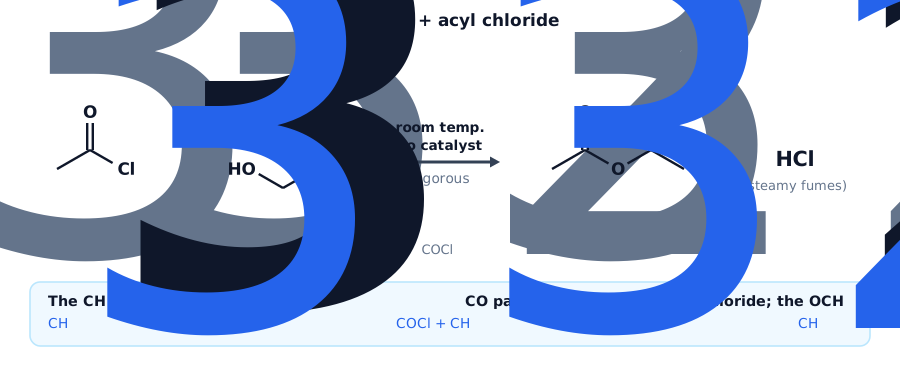
Why use an acyl chloride? Compare the two ways of making ethyl ethanoate.
| Carboxylic acid + alcohol | Acyl chloride + alcohol | |
|---|---|---|
| Reagents | CH3COOH + CH3CH2OH | CH3COCl + CH3CH2OH |
| Catalyst | concentrated H2SO4 | none |
| Conditions | heat under reflux | room temperature |
| Rate | slow | fast, vigorous |
| Extent | reversible; equilibrium mixture | irreversible; goes to completion |
| Other product | H2O | HCl (a gas) |
The mechanism: addition–elimination. The reaction is a nucleophilic substitution of Cl by OR, which happens in two stages (the pattern is introduced in Topic 29).
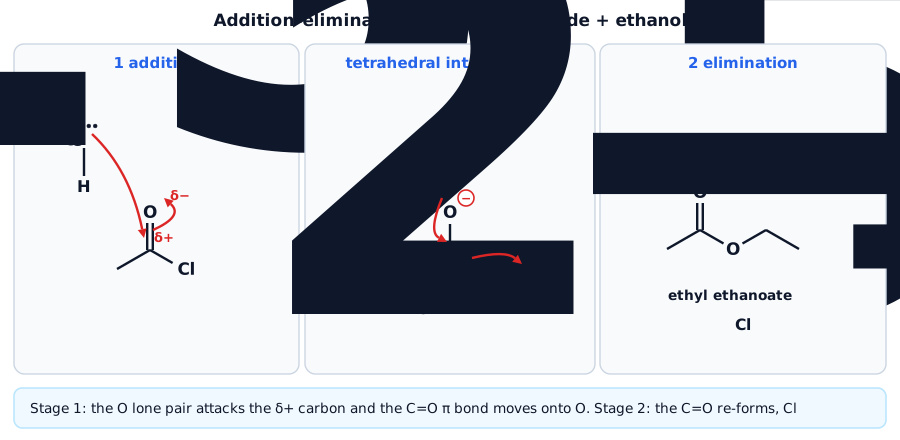
- Addition: a lone pair on the alcohol oxygen attacks the δ+ carbonyl carbon. The C=O π bond breaks and its electrons go onto the oxygen. This gives a tetrahedral intermediate with O− and O+(H).
- Elimination: the lone pair on O− re-forms the C=O bond, and the C–Cl bond breaks to release Cl−. The O+–H loses H+, which combines with Cl− to give HCl.
Worked example. Ethanoyl chloride reacts with ethanol. Name the ester formed, write the equation and state two advantages over using ethanoic acid. [4]
Ethyl ethanoate [1]. CH3COCl + CH3CH2OH → CH3COOCH2CH3 + HCl [1]. The reaction is fast at room temperature with no catalyst [1], and it is not reversible, so the yield is higher [1].
3. Making Phenol
Phenol, C6H5OH, has the –OH group bonded directly to a benzene ring. It is made from phenylamine (the amine from Topic 34) in two stages.
- Diazotisation. Phenylamine is treated with nitrous acid, HNO2, below 10 °C. Nitrous acid is unstable, so it is made in the mixture from NaNO2 and dilute HCl. The product is the benzenediazonium salt, C6H5N2+Cl−.
- Hydrolysis. The diazonium salt solution is warmed with water. Nitrogen gas is given off and phenol forms.
C6H5N2+ + H2O → C6H5OH + N2 + H+ (warm)

Benzenediazonium salts are unstable and decompose when warm, so the first step must be kept cold. In the second step the same instability is used on purpose: warming replaces the N2+ group by OH.
Worked example. Give the reagents and conditions for the conversion of phenylamine into phenol in two steps, and name the intermediate. [4]
Step 1: NaNO2 and dilute HCl (or HNO2) [1] below 10 °C [1]; intermediate: benzenediazonium chloride [1]. Step 2: warm with water [1].
4. The Acidity of Phenol
Phenol is a weak acid. In water it dissociates to a small extent:
C6H5OH ⇌ C6H5O− + H+
It is a stronger acid than water and ethanol but a weaker acid than carboxylic acids. The order is:
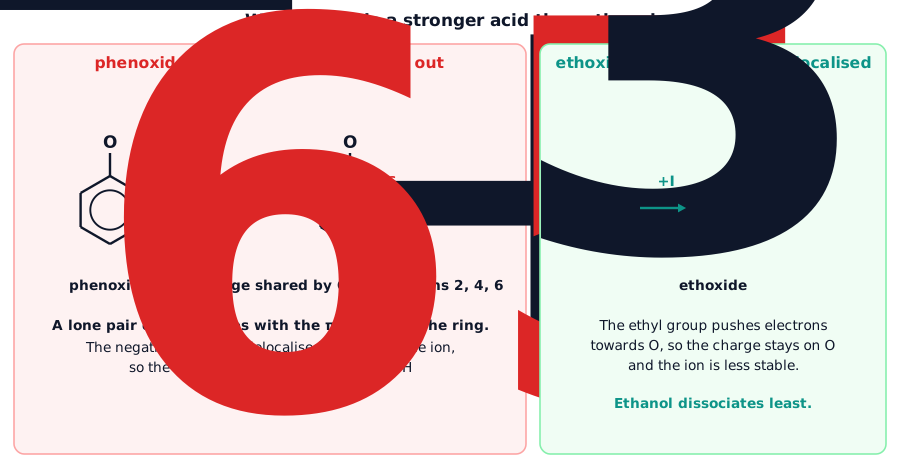
Why is phenol more acidic than ethanol? The strength of an acid depends on how stable its conjugate base is. The more stable the anion, the more readily the acid releases H+.
- In the phenoxide ion, a lone pair on the oxygen overlaps with the π system of the ring. The negative charge is delocalised over the oxygen and the ring carbons (positions 2, 4 and 6). Spreading the charge makes the ion more stable.
- In the ethoxide ion, the ethyl group is electron-donating (positive inductive effect). It pushes electron density towards the oxygen, which already carries the negative charge. The charge is localised on O, and the ion is less stable.
- Water is in between: in OH− there is no alkyl group to destabilise the ion, so water is a stronger acid than ethanol. But the charge is not delocalised, so water is a weaker acid than phenol.
The difference shows in simple reactions.
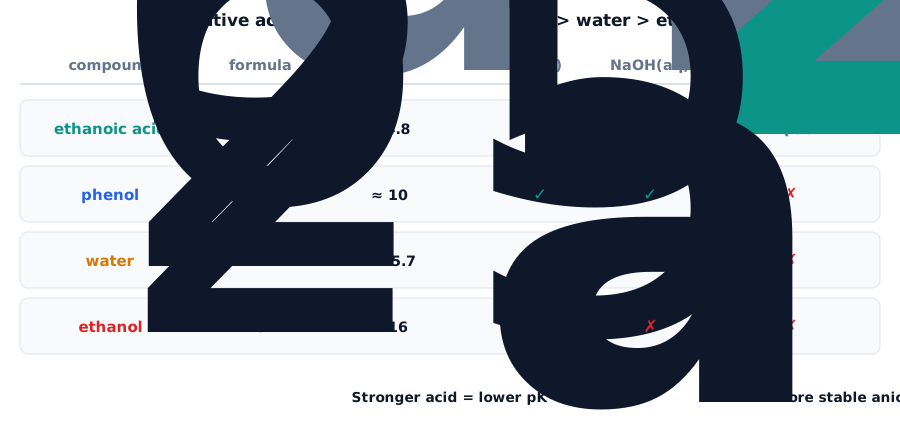
- With sodium: all four give hydrogen. 2C6H5OH + 2Na → 2C6H5ONa + H2. (The reaction of ethanol is slower than that of water; phenol reacts less violently than water.)
- With NaOH(aq): phenol reacts and ethanol does not. C6H5OH + NaOH → C6H5ONa + H2O. Phenol is only slightly soluble in water, but the ionic salt sodium phenoxide dissolves, so a cloudy mixture of phenol and water turns clear when NaOH(aq) is added.
- With Na2CO3(aq): phenol does not react; it is too weak an acid to release CO2. A carboxylic acid does.
Worked example. Explain why phenol is a stronger acid than ethanol. [3]
In the phenoxide ion, a lone pair on O is delocalised into the π system of the ring [1], so the negative charge is spread over the ion and it is stabilised [1]. In ethoxide the alkyl group is electron-donating, so the charge stays on O and the ion is less stable [1].
5. Reactions of Phenol
The figure shows the five reactions you must recall. The first two use the O–H bond (acid properties); the last three use the ring (electrophilic substitution).
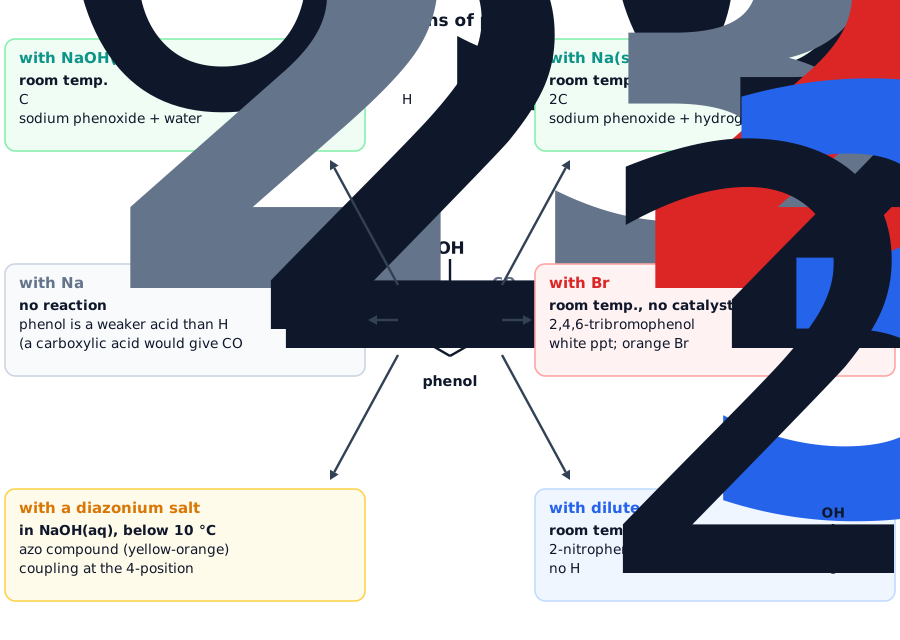
(a) With bases and (b) with sodium. Phenol forms sodium phenoxide, C6H5ONa, with NaOH(aq) (water is the other product) or with sodium metal (hydrogen is the other product).
(c) With diazonium salts: azo coupling. When a benzenediazonium salt is added to a solution of phenol in NaOH(aq) kept below 10 °C, an azo compound forms. The –N=N– group joins the two rings. The product, 4-hydroxyazobenzene, is yellow-orange.
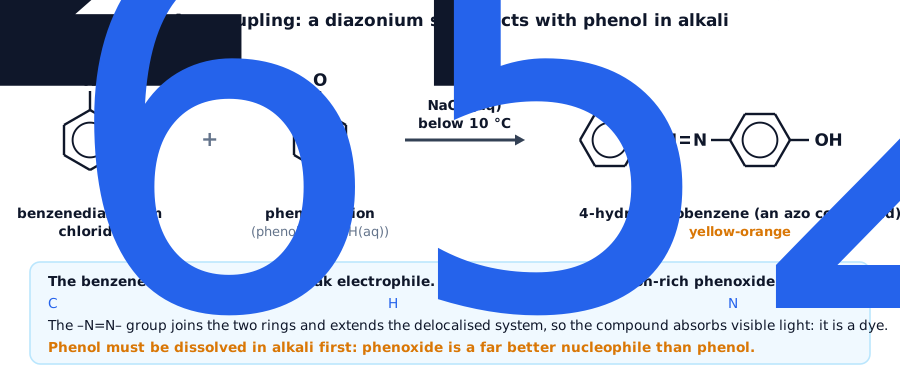
The diazonium ion is a weak electrophile. It reacts only with very electron-rich rings, such as phenoxide (and phenylamine, Topic 34). The –N=N– link extends the delocalised system, so azo compounds absorb visible light and are used as dyes.
(d) Nitration. Phenol reacts with dilute HNO3 at room temperature to give a mixture of 2-nitrophenol and 4-nitrophenol. C6H5OH + HNO3 → HOC6H4NO2 + H2O. No concentrated sulfuric acid is needed.
(e) Bromination. Phenol reacts with Br2(aq) (bromine water) at room temperature with no catalyst. The orange colour of the bromine disappears and a white precipitate of 2,4,6-tribromophenol forms. C6H5OH + 3Br2 → C6H2Br3OH + 3HBr. This is a good test: ethanol gives no reaction with bromine water.
| Reaction | Reagents and conditions | Product(s) | Observation |
|---|---|---|---|
| with base | NaOH(aq), room temp. | sodium phenoxide + H2O | phenol dissolves |
| with sodium | Na(s) | sodium phenoxide + H2 | bubbles of gas |
| coupling | diazonium salt, NaOH(aq), below 10 °C | 4-hydroxyazobenzene | yellow-orange colour or precipitate |
| nitration | dilute HNO3, room temp. | 2-nitrophenol + 4-nitrophenol | yellow-orange oil or solid |
| bromination | Br2(aq), room temp. | 2,4,6-tribromophenol | orange colour lost; white precipitate |
6. Why Phenol Is So Reactive
Benzene needs a halogen carrier for bromination, and concentrated nitric and sulfuric acids for nitration. Phenol reacts with bromine water and with dilute nitric acid. The difference lies in the –OH group.

A lone pair on the oxygen is delocalised into the π system of the ring. This increases the electron density of the ring, especially at the 2-, 4- and 6-positions. A more electron-rich ring:
- attracts and reacts with weaker electrophiles, so no halogen carrier is needed (the ring itself polarises Br2 so that one Br becomes δ+), and dilute HNO3 gives enough NO2+;
- reacts at room temperature, because the activation energy is lower;
- is substituted at all three activated positions with bromine water, giving 2,4,6-tribromophenol.
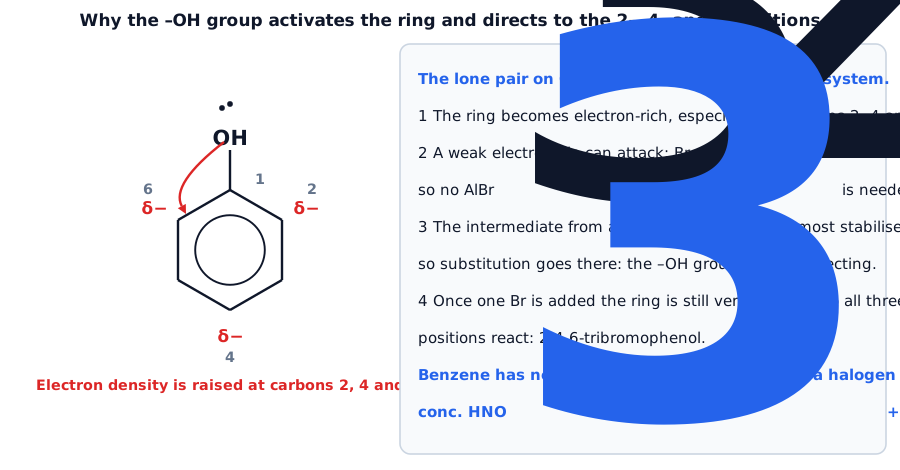
The hydroxyl group of a phenol directs to the 2-, 4- and 6-positions. The intermediate formed by attack at these positions is stabilised by the O lone pair, so those routes have the lowest activation energy.
Worked example. Explain why phenol reacts with bromine water without a catalyst but benzene does not. [3]
A lone pair on the oxygen is delocalised into the ring [1], so the electron density of the ring is higher than in benzene [1], and the ring can polarise Br2 and attack it without a halogen carrier [1].
7. Other Phenolic Compounds: Naphthol
A phenolic compound has an –OH group bonded directly to an aromatic ring. 2-Naphthol has the –OH group on a naphthalene ring (two fused benzene rings). The syllabus asks you to apply your phenol knowledge to such compounds, so predict their reactions by analogy.
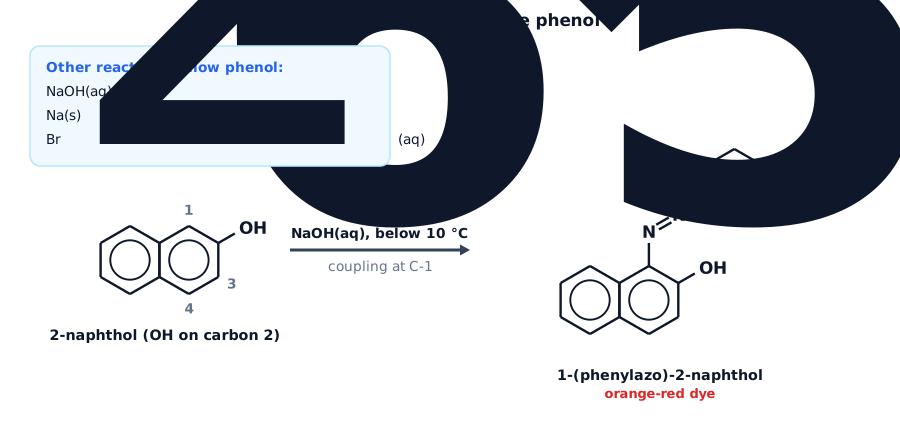
- With NaOH(aq): sodium 2-naphthoxide and water (the –OH is acidic, like phenol).
- With Na(s): sodium 2-naphthoxide and hydrogen.
- With a diazonium salt in NaOH(aq), below 10 °C: an azo compound, an orange-red dye. The azo group adds at carbon 1, next to the –OH.
- With Br2(aq), or dilute HNO3: ring substitution under mild conditions, with no catalyst, because the –OH group activates the ring.
Worked example. 2-Naphthol is added to NaOH(aq) and the mixture is cooled below 10 °C; benzenediazonium chloride is then added. State what you would observe and name the type of compound formed. [3]
2-Naphthol dissolves in NaOH(aq) to give the 2-naphthoxide ion [1]. On adding the diazonium salt an orange-red colour (or precipitate) forms [1]. The product is an azo compound (an azo dye) [1].
8. Quick Sheet and Checklist
| Topic | What to remember |
|---|---|
| Alcohol + acyl chloride | CH3COCl + ROH → ester + HCl; room temp.; no catalyst; goes to completion |
| Phenol from phenylamine | NaNO2 + HCl, below 10 °C; then warm with H2O (N2 given off) |
| Acidity | ethanoic acid > phenol > water > ethanol |
| Phenol + NaOH / Na | sodium phenoxide (+ H2O / H2) |
| Phenol + Br2(aq) | 2,4,6-tribromophenol, white precipitate, room temp., no catalyst |
| Phenol + dilute HNO3 | 2-nitrophenol + 4-nitrophenol, room temp. |
| Phenol + diazonium | azo compound, NaOH(aq), below 10 °C |
| Directing effect | –OH: 2-, 4-, 6-directing and activating |
| Naphthol | reacts like phenol; couples at carbon 1 |
- [ ] I can write the equation and conditions for ethanoyl chloride reacting with an alcohol, and say why it is better than using the acid.
- [ ] I can draw the addition–elimination mechanism of an acyl chloride with an alcohol.
- [ ] I can give the reagents and temperatures for making phenol from phenylamine.
- [ ] I can explain the order of acidity of ethanoic acid, phenol, water and ethanol.
- [ ] I can write equations for phenol with NaOH, Na, Br2(aq) and dilute HNO3.
- [ ] I can describe azo coupling and state the conditions.
- [ ] I can explain why phenol reacts under milder conditions than benzene and why it directs to 2, 4 and 6.
- [ ] I can predict the reactions of 2-naphthol.