 Score
Hydrocarbons: Arenes
0. What Examiners Want
This guide covers Topic 30 of Cambridge International AS & A Level Chemistry 9701 (2025–27) and follows the learning outcomes below, word for word. The right-hand column shows where each one is taught. It builds on Topic 29 (the shape and stability of benzene) and prepares you for Topic 31 (halogenoarenes), Topic 32 (phenol) and Topic 34 (phenylamine).
| 30.1 Arenes. Candidates should be able to: | Section |
|---|---|
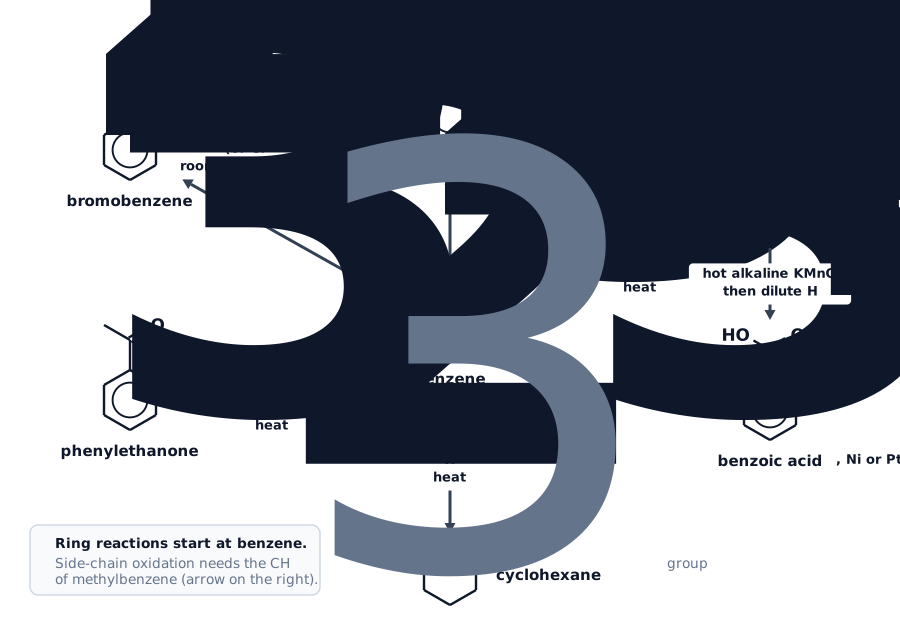
| 1 describe the chemistry of arenes as exemplified by the following reactions of benzene and methylbenzene: (a) substitution reactions with Cl2 and with Br2 in the presence of a catalyst, AlCl3 or AlBr3, to form halogenoarenes (aryl halides) (b) nitration with a mixture of concentrated HNO3 and concentrated H2SO4 at a temperature between 25 °C and 60 °C (c) Friedel–Crafts alkylation by CH3Cl and AlCl3 and heat (d) Friedel–Crafts acylation by CH3COCl and AlCl3 and heat (e) complete oxidation of the side-chain using hot alkaline KMnO4 and then dilute acid to give a benzoic acid (f) hydrogenation of the benzene ring using H2 and Pt/Ni catalyst and heat to form a cyclohexane ring | (a) 2 (b) 3 (c), (d) 4 (e), (f) 5 |
| 2 describe the mechanism of electrophilic substitution in arenes: (a) as exemplified by the formation of nitrobenzene and bromobenzene (b) with regards to the effect of delocalisation (aromatic stabilisation) of electrons in arenes to explain the predomination of substitution over addition | (a) 2, 3 (b) 1 |
| 3 predict whether halogenation will occur in the side-chain or in the aromatic ring in arenes depending on reaction conditions | 6 |
| 4 describe that in the electrophilic substitution of arenes, different substituents direct to different ring positions (limited to the directing effects of –NH2, –OH, –R, –NO2, –COOH and –COR) | 7 |
- Reagents and conditions: the exact reagents (formulae or names), the catalyst, the temperature or light, and the order of steps in a synthesis.
- The electrophile: an equation that shows how it forms, for example NO2+ from the two acids or R+ from RCl and AlCl3.
- The mechanism: curly arrow from the π ring to the electrophile, a correct intermediate with its positive charge and the H still attached, then the arrow from the C–H bond back into the ring.
- Explanations: why substitution beats addition (delocalisation energy is kept), and why a group directs ortho/para or meta.
- Products: correct names and positions, including the pair of isomers when a 2,4-directing group is present.
1. Arenes at a Glance: Why Substitution?
An arene is a hydrocarbon that contains a benzene ring. In Topic 29 you saw that every carbon in benzene is sp2 hybridised and that the six p electrons form one delocalised π ring above and below the plane. That ring is the key to all the chemistry in this topic. The figure below is a map of the reactions you must know. Benzene sits in the middle; each arrow gives the reagents and conditions.
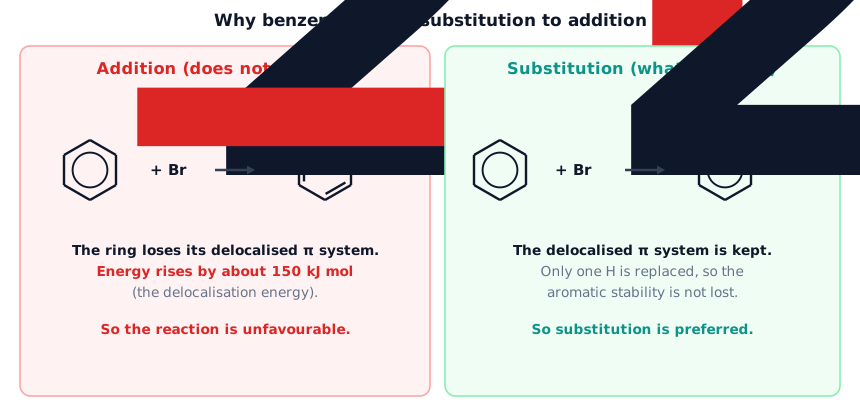
Why does benzene substitute instead of add? An alkene such as cyclohexene is attacked by electrophiles such as Br2 and adds across the C=C bond. If benzene did the same, the product would lose the delocalised π system. From Topic 29, the enthalpy change of hydrogenation of benzene is −208 kJ mol−1, but three isolated C=C bonds would give 3 × (−120) = −360 kJ mol−1. The difference, 152 kJ mol−1, is the delocalisation (aromatic stabilisation) energy. An addition reaction would give this up. In substitution, an H atom is replaced and the ring is restored, so the stabilisation is kept.
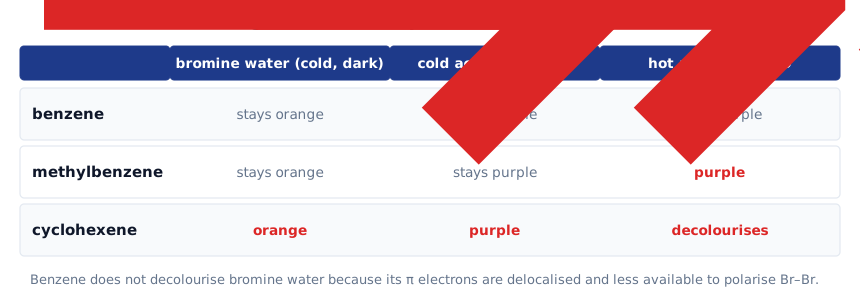
Why does benzene react more slowly than an alkene? The π electrons in benzene are spread over six carbons, so the electron density at any one carbon is lower than in a localised C=C bond. Benzene cannot polarise a non-polar molecule such as Br2 strongly enough, and it does not decolourise bromine water. It needs a stronger electrophile, which is why each reaction below begins by making one.
The general mechanism: electrophilic substitution. All the ring reactions in sections 2 to 4 follow the same two steps. (Electrophile = a species that accepts a pair of electrons.)
- Attack. A pair of π electrons from the ring forms a bond to the electrophile E+. This is the slow step. The ring now has a positive charge spread over five carbons (the intermediate), and the delocalisation is broken, with one carbon bonded to both E and H.
- Loss of H+. The electrons of the C–H bond return to the ring, H+ leaves, and the delocalised ring is restored. The overall change is that H is replaced by E.
Worked example. Explain why benzene reacts with bromine by substitution, not addition. [3]
(1) Benzene has a delocalised π system that makes it unusually stable (aromatic stabilisation). (2) Addition would destroy the delocalisation, so the product would be much less stable. (3) In substitution the ring is restored after H+ is lost, so the stabilisation is kept.
2. Halogenation of the Ring
Benzene reacts with chlorine or bromine in the presence of a halogen carrier, which is anhydrous aluminium chloride (AlCl3) or aluminium bromide (AlBr3). Iron(III) halides, FeCl3 and FeBr3, work in the same way and are accepted in examination answers; iron filings added to bromine make FeBr3 in the flask.
Chlorination: C6H6 + Cl2 → C6H5Cl + HCl (AlCl3 or FeCl3, anhydrous, room temperature)
Making the electrophile. A bromine molecule is non-polar and is not a strong enough electrophile for benzene. The Lewis acid AlBr3 has an empty orbital and accepts a lone pair from one bromine atom. This polarises the Br–Br bond so strongly that the reaction behaves as if Br+ were produced:
Br2 + AlBr3 → Br+ + AlBr4−
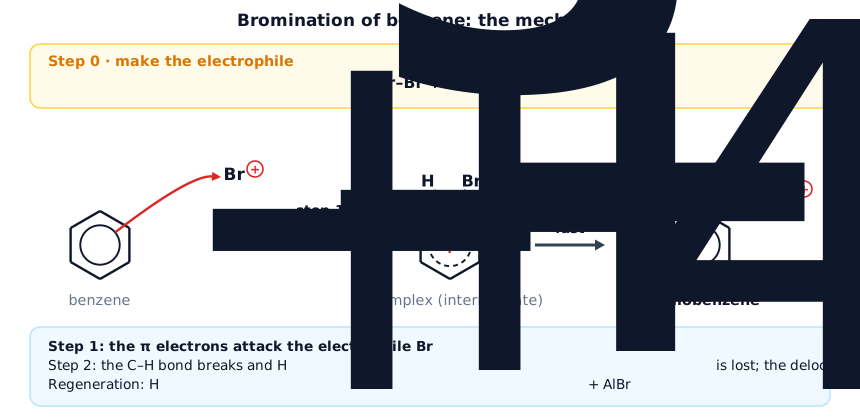
Drawing the mechanism (what earns the marks).
- A curly arrow from the π ring (the circle) to the electrophile.
- The intermediate: a hexagon with a partial circle (horseshoe) covering five carbons, a + sign, and Br and H both on the same carbon.
- A curly arrow from the C–H bond back into the ring, giving H+ and bromobenzene.
- H+ reacts with AlBr4−: H+ + AlBr4− → HBr + AlBr3. The catalyst is regenerated.
Methylbenzene. Under the same conditions the CH3 group is already on the ring, and the bromine enters at positions 2 and 4 (Section 7), giving a mixture of 2-bromomethylbenzene and 4-bromomethylbenzene. Methylbenzene reacts faster than benzene.
Worked example. Write an equation for the formation of the electrophile in the chlorination of benzene and state the role of AlCl3. [2]
Cl2 + AlCl3 → Cl+ + AlCl4− [1]. AlCl3 is a halogen carrier (Lewis acid catalyst): it accepts a lone pair from chlorine to make a stronger electrophile and is regenerated [1].
3. Nitration
Benzene reacts with a mixture of concentrated nitric acid and concentrated sulfuric acid at a temperature between 25 °C and 60 °C to form nitrobenzene, a pale yellow liquid.
Making the electrophile. Sulfuric acid is the stronger acid and protonates nitric acid, which then loses water to give the nitronium ion, NO2+:
HNO3 + 2H2SO4 → NO2+ + 2HSO4− + H3O+
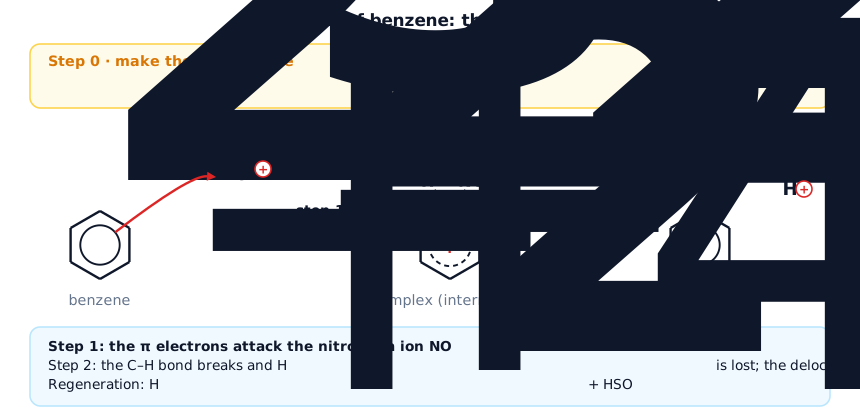
The mechanism has the same two steps as in Section 1: NO2+ accepts a pair of π electrons to give the intermediate, then H+ is lost. The H+ combines with HSO4− to regenerate H2SO4.
Why keep the temperature below 60 °C? The nitro group deactivates the ring, but at higher temperatures a second NO2 group can still enter, giving 1,3-dinitrobenzene (the second group goes to the 3-position, Section 7). Controlling the temperature keeps the product mainly mononitro.
Methylbenzene is nitrated more easily than benzene because the CH3 group activates the ring. The product is a mixture of 2-nitromethylbenzene and 4-nitromethylbenzene. With more forcing conditions the ring takes three nitro groups to give 2,4,6-trinitromethylbenzene (TNT).
Worked example. State the reagents and conditions for converting benzene into nitrobenzene, and write an equation for the formation of the electrophile. [3]
Concentrated HNO3 and concentrated H2SO4 [1], at a temperature between 25 °C and 60 °C [1]. HNO3 + 2H2SO4 → NO2+ + 2HSO4− + H3O+ [1].
4. Friedel–Crafts Alkylation and Acylation
The Friedel–Crafts reactions form a new carbon–carbon bond to the ring. Both need anhydrous AlCl3 as the catalyst and heat.
| Alkylation | Acylation | |
|---|---|---|
| reagents | halogenoalkane, e.g. CH3Cl | acyl chloride, e.g. CH3COCl |
| catalyst and conditions | anhydrous AlCl3, heat | anhydrous AlCl3, heat |
| electrophile | CH3+ (R+) | CH3CO+ (RCO+) |
| equation for the electrophile | CH3Cl + AlCl3 → CH3+ + AlCl4− | CH3COCl + AlCl3 → CH3CO+ + AlCl4− |
| product from benzene | methylbenzene, C6H5CH3 | phenylethanone, C6H5COCH3 |
| by-product | HCl | HCl |


The two mechanisms have three stages: (1) AlCl3 removes Cl− from the halogenoalkane or acyl chloride to make the electrophile; (2) the electrophile attacks the ring, giving the intermediate, and H+ is lost; (3) H+ + AlCl4− → HCl + AlCl3.
The same idea works for other halogenoalkanes and other halogen carriers. For example, BrCH2CH2CH2CH2Br with FeBr3 gives the electrophile BrCH2CH2CH2CH2+ (and FeBr4−), which can attack a ring in the same two-step way.
Alkylation can go on too long. An alkyl group activates the ring, so the product (methylbenzene) reacts faster than benzene and some dimethylbenzenes form. Using an excess of benzene keeps this small. Acylation does not have this problem: the C=O group deactivates the ring, so only one acyl group is added.
Methylbenzene. Alkylation or acylation of methylbenzene puts the new group at positions 2 and 4 (Section 7).
Worked example. Name the organic product when benzene reacts with CH3COCl and AlCl3 on heating, and write an equation for the formation of the electrophile. [2]
Phenylethanone [1]. CH3COCl + AlCl3 → CH3CO+ + AlCl4− [1].
5. Side-Chain Oxidation and Hydrogenation
Oxidation of the side chain. An alkyl side chain on the ring is oxidised to a carboxylic acid group by hot alkaline KMnO4, followed by dilute acid. Whatever the length of the chain, the product is benzoic acid, because the whole chain except the carbon nearest the ring is lost (as carbon dioxide or carbonate). The ring is not affected.
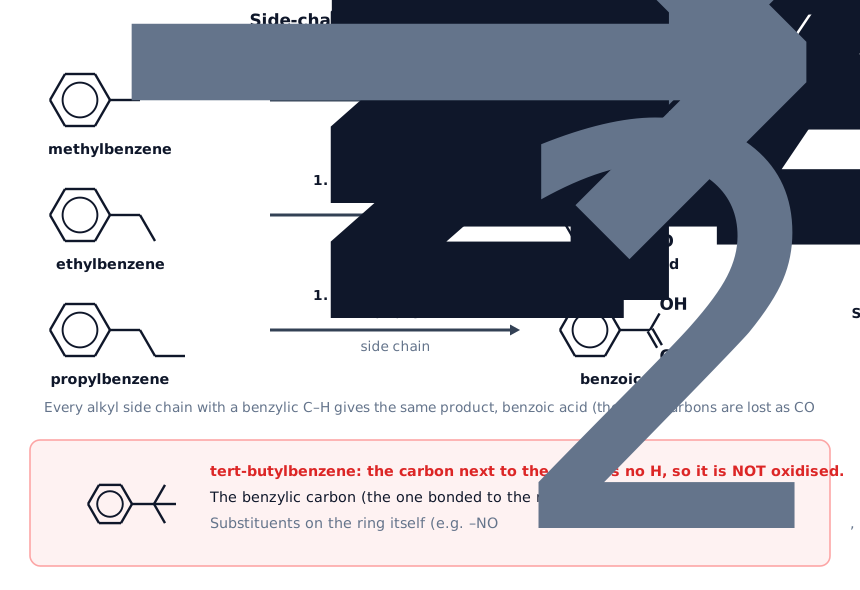
For methylbenzene: C6H5CH3 + 2KMnO4 → C6H5COOK + 2MnO2 + KOH + H2O. The purple solution turns to a brown precipitate of MnO2. Adding dilute acid then converts the benzoate into benzoic acid, a white solid: C6H5COO− + H+ → C6H5COOH.
Condition for oxidation: the carbon bonded to the ring must carry at least one hydrogen.
Worked example. 4.60 g of methylbenzene is oxidised to benzoic acid and 4.20 g of benzoic acid is obtained. Calculate the percentage yield. [3]
Mr(C6H5CH3) = 92.13 and Mr(C6H5COOH) = 122.12. Amount of methylbenzene = 4.60 / 92.13 = 0.0499 mol [1]. The mole ratio is 1 : 1, so the theoretical mass of benzoic acid = 0.0499 × 122.12 = 6.10 g [1]. Percentage yield = 4.20 / 6.10 × 100 = 68.9 % [1].
Hydrogenation of the ring. Benzene adds hydrogen when heated with hydrogen gas and a nickel or platinum catalyst. All three π bonds are saturated and the product is cyclohexane. Methylbenzene gives methylcyclohexane.
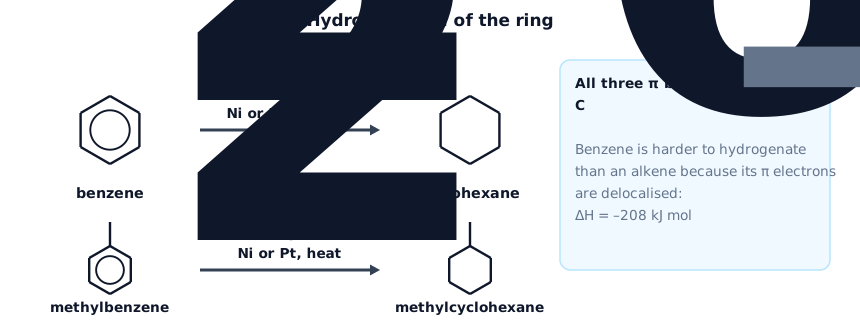
C6H6 + 3H2 → C6H12 (H2, Ni or Pt, heat). One mole of benzene needs three moles of H2.
6. Ring or Side Chain?
Methylbenzene has two places for a halogen to react: the ring hydrogens and the CH3 hydrogens. The conditions decide which, because the two reactions use different mechanisms.
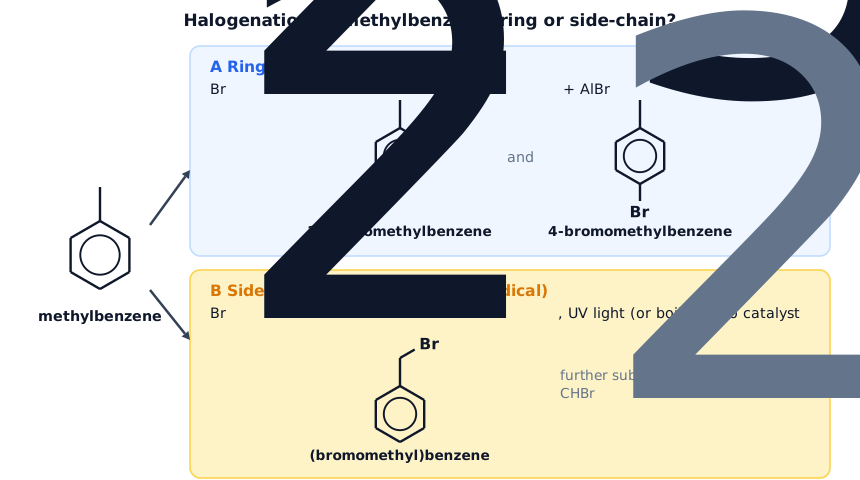
| Ring substitution | Side-chain substitution | |
|---|---|---|
| conditions | halogen carrier (AlBr3 or AlCl3), room temperature, in the dark | UV light or boiling, no halogen carrier |
| type of mechanism | electrophilic substitution | free-radical substitution |
| particle that attacks | Br+ (electrophile) | Br• (radical) |
| product from methylbenzene and Br2 | 2- and 4-bromomethylbenzene | (bromomethyl)benzene, C6H5CH2Br |
| by-product | HBr | HBr |
The side-chain reaction is the same free-radical substitution you met for alkanes (Topic 14), with the benzene ring as a large substituent:
- Initiation: Br2 → 2Br• (UV light)
- Propagation: C6H5CH3 + Br• → C6H5CH2• + HBr, then C6H5CH2• + Br2 → C6H5CH2Br + Br•
- Termination: two radicals combine, for example 2Br• → Br2
If bromine is in excess, further H atoms on the side chain can also be replaced, giving C6H5CHBr2 and C6H5CBr3.
Worked example. Methylbenzene is mixed with bromine. Predict the main product (a) with AlBr3 in the dark, and (b) in sunlight with no catalyst. [2]
(a) Ring substitution: 2-bromomethylbenzene and 4-bromomethylbenzene [1]. (b) Side-chain substitution: (bromomethyl)benzene, C6H5CH2Br [1].
7. Directing Effects
When a benzene ring already has one substituent, the second group does not go in at random. The first group directs the new group to particular positions. We number the carbon holding the first group as C1.
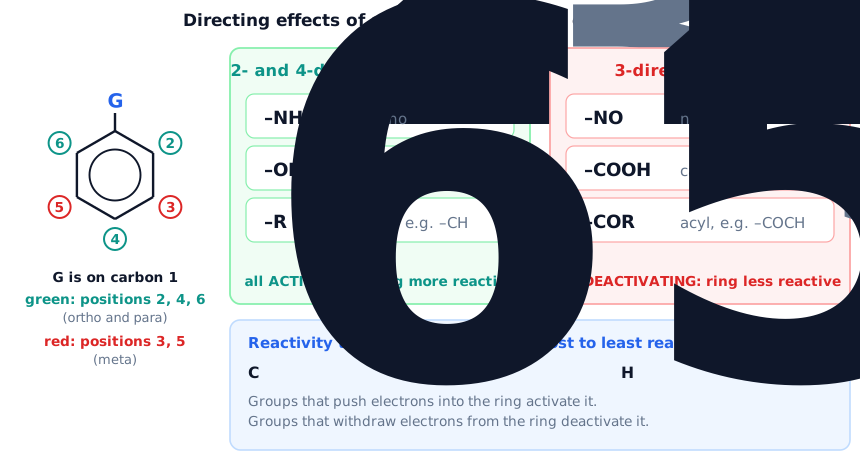
| 2,4-directing (ortho/para) | 3-directing (meta) | |
|---|---|---|
| groups | –NH2, –OH, –R (alkyl) | –NO2, –COOH, –COR |
| effect on the electron density of the ring | increases it | decreases it |
| effect on reactivity | activating: reacts faster than benzene | deactivating: reacts slower than benzene |
| products of a second substitution | a mixture of the 2- and 4-isomers (and the 6-isomer is the same as the 2-isomer) | mainly the 3-isomer (and the 5-isomer is the same) |
| examples | methylbenzene → 2- and 4-nitromethylbenzene | nitrobenzene → 1,3-dinitrobenzene; benzoic acid → 3-nitrobenzoic acid |

Why do they direct differently? The –NH2 and –OH groups have a lone pair on the atom bonded to the ring, which can be donated into the π system. An alkyl group pushes electrons into the ring through the sigma bond. In each case the electron density is increased, especially at positions 2, 4 and 6, so electrophiles attack there and the ring is more reactive than benzene. The –NO2, –COOH and –COR groups have a C=O or N=O bond or a positively polarised atom next to the ring. They withdraw electrons, mostly from positions 2, 4 and 6, so the electron-poor ring reacts more slowly, and the electrophile attacks at positions 3 and 5, where the ring is least depleted of electrons.
Reactivity order. The reactivity of a ring towards electrophiles follows the activating or deactivating effect of the substituent: C6H5OH > C6H5CH3 > C6H6 > C6H5COOH. This is why phenol is nitrated with dilute nitric acid at room temperature (Topic 32), while benzene needs concentrated acids and a higher temperature.
Worked example. Predict the structure of the main product when each compound is nitrated with concentrated HNO3 and H2SO4 at 50 °C: (a) phenylethanone, (b) ethylbenzene. [2]
(a) –COCH3 is a 3-directing group, so the product is 3-nitrophenylethanone (NO2 on carbon 3) [1]. (b) The ethyl group is 2,4-directing, so the product is a mixture of 2-nitroethylbenzene and 4-nitroethylbenzene [1].
8. Planning a Synthesis
Directing effects control the order in which reactions must be carried out. If you want a particular isomer, ask: which group should go on first so that it directs the second group to the right place?

The method is the same every time:
- Draw the target and the starting material.
- Decide which group is added by substitution and which is made by a side-chain reaction (for example, the COOH group by oxidation of CH3).
- Choose the order so that the first group directs the second to the position needed. For a 1,3-relationship that means a 3-directing group goes on first; for a 1,2 or 1,4 relationship, a 2,4-directing group goes on first.
- Write the reagents and conditions at each step, and name the intermediates.
A typical three-step route from benzene is alkylation, then nitration, then reduction: benzene + RCl/AlCl3 gives an alkylbenzene; conc. HNO3/conc. H2SO4 puts NO2 at the 4-position (and the 2-position); Sn with concentrated HCl, then NaOH(aq), reduces NO2 to NH2 (Topic 34). The alkyl group must go first, because it directs the nitro group to positions 2 and 4; the nitro group is then reduced after it has done its job. If you reduced first, the amino group would be attacked (oxidised or protonated) by the nitrating mixture, so nitration must come before the reduction.
Worked example. Suggest a two-step synthesis of 3-nitrobenzoic acid from methylbenzene, giving reagents and conditions. [4]
Step 1: oxidise the side chain with hot alkaline KMnO4, then add dilute H2SO4, to give benzoic acid [2]. Step 2: nitrate with concentrated HNO3 and concentrated H2SO4 [1]; the COOH group is 3-directing, so the NO2 goes to position 3 [1]. (If nitration were done first, the CH3 group would direct to the 2- and 4-positions, so the wrong isomers would form.)
9. Quick Sheet and Checklist
| Reaction | Reagents and conditions | Product from benzene (or methylbenzene) |
|---|---|---|
| halogenation | Cl2 or Br2; AlCl3 or AlBr3 (or FeX3); anhydrous, room temperature | chlorobenzene or bromobenzene (2- and 4-isomers from methylbenzene) |
| nitration | conc. HNO3 + conc. H2SO4; 25–60 °C | nitrobenzene (2- and 4-nitromethylbenzene) |
| Friedel–Crafts alkylation | CH3Cl; anhydrous AlCl3; heat | methylbenzene |
| Friedel–Crafts acylation | CH3COCl; anhydrous AlCl3; heat | phenylethanone |
| side-chain oxidation | hot alkaline KMnO4, then dilute acid | benzoic acid |
| hydrogenation | H2; Ni or Pt; heat | cyclohexane (methylcyclohexane) |
| side-chain halogenation | Br2; UV light; no catalyst | (bromomethyl)benzene |
| electrophiles | Br+, Cl+, NO2+, R+, RCO+ | made by the catalyst or the mixed acids |
| directing | 2,4: –NH2, –OH, –R (activating). 3: –NO2, –COOH, –COR (deactivating) | order of steps decides the isomer |
Checklist. Before the exam you should be able to:
- [ ] explain why benzene undergoes substitution rather than addition, using delocalisation energy
- [ ] give the reagents and conditions for halogenation, nitration, Friedel–Crafts alkylation and acylation, side-chain oxidation and hydrogenation
- [ ] write the equation for forming each electrophile (Br+, NO2+, R+, RCO+)
- [ ] draw the mechanism of electrophilic substitution with curly arrows, the intermediate and the regeneration of H+ or the catalyst
- [ ] state what is formed from methylbenzene in each reaction, including the 2- and 4-isomers
- [ ] state which side chains are oxidised to benzoic acid and which are not
- [ ] predict ring or side-chain halogenation from the conditions
- [ ] state the directing effects of –NH2, –OH, –R, –NO2, –COOH and –COR, and predict the product of a second substitution
- [ ] plan a two- or three-step synthesis, giving the reagents, the intermediates and the reason for the order