 Score
Organic Synthesis (A Level)
0. What Examiners Want
This guide covers Topic 36 of Cambridge International AS & A Level Chemistry 9701 (2025–27) and follows the learning outcomes below, word for word. The right-hand column shows where each one is taught. It uses every reaction in Topics 15–18 and 25–35, and section 5 adds the coursebook material on chirality and single-enantiomer drugs, which explains why synthesis matters in the pharmaceutical industry.
| 36 Organic synthesis. Candidates should be able to: | Section |
|---|---|
| 36.1 Organic synthesis | |
| 1 for an organic molecule containing several functional groups: (a) identify organic functional groups using the reactions in the syllabus (b) predict properties and reactions | 1, 2 |
| 2 devise multi-step synthetic routes for preparing organic molecules using the reactions in the syllabus | 3 |
| 3 analyse a given synthetic route in terms of type of reaction and reagents used for each step of it, and possible by-products | 4 |
- Reagent and condition together: for example “KCN in ethanol, heat under reflux”; each step is marked separately.
- Intermediates: the correct name or structure of every compound between start and target.
- Few steps: the shortest route that uses syllabus reactions; extra steps lose the later marks.
- Type of reaction: the correct name (electrophilic substitution, nucleophilic substitution, reduction, and so on) for each step.
- By-products and order: the isomer or second product that forms, and why the order of steps matters.
- Functional groups: the tests and reactions that show each group, and which groups a reagent will leave untouched.
1. Identifying Functional Groups
Most molecules in Paper 4 carry more than one functional group. To identify them you use test reagents, each of which gives a visible result with one group (or a few). To predict the reactions you ask of each group in turn: what does it do with this reagent?

| Group | Tests that show it | Result |
|---|---|---|
| alkene | Br2(aq); acidified KMnO4 | decolourised |
| halogenoalkane | warm AgNO3(aq) in ethanol | white (Cl), cream (Br), yellow (I) precipitate |
| primary or secondary alcohol | K2Cr2O7 / H+, heat | orange → green |
| alcohol (any), carboxylic acid | sodium; PCl5 | H2 bubbles; steamy HCl fumes |
| aldehyde or ketone | 2,4-DNPH | orange precipitate |
| aldehyde only | Tollens’; Fehling’s | silver mirror; red precipitate |
| CH3CO– or CH3CH(OH)– | I2 + NaOH(aq), warm | pale yellow CHI3 |
| carboxylic acid | Na2CO3(aq) | CO2 effervescence |
| phenol | neutral FeCl3(aq) | violet colour |
Predicting the reactions of a molecule with several groups. Treat each group separately and ask whether the reagent can attack it. Some reagents are selective: LiAlH4 reduces C=O, –COOH and –CN but not C=C or a benzene ring; NaBH4 reduces aldehydes and ketones but not a carboxylic acid; Na2CO3 reacts with a carboxylic acid but not with a phenol; H2/Ni reduces C=C and C=O.

Worked example. The compound HOC6H4CH=CHCOOH is shown above. Describe how you would show that it contains a carboxylic acid group but that the phenol group is also present. [4]
Add Na2CO3(aq): effervescence of CO2 shows the –COOH group [1]; a phenol alone would not react [1]. Add neutral FeCl3(aq) to a separate sample: a violet colour shows the phenol [1]. Br2(aq) would not distinguish, because the C=C and the phenol ring both decolourise or react with it [1].
Worked example. State the product when HOC6H4CH=CHCOOH reacts with (i) H2 and Ni, (ii) LiAlH4 in dry ether, (iii) excess aqueous NaOH. [3]
(i) HOC6H4CH2CH2COOH (the C=C is reduced; the ring is not reduced under mild conditions) [1]. (ii) HOC6H4CH=CHCH2OH (only the –COOH is reduced) [1]. (iii) −OC6H4CH=CHCOO− (both acidic groups give sodium salts) [1].
2. The Reaction Maps
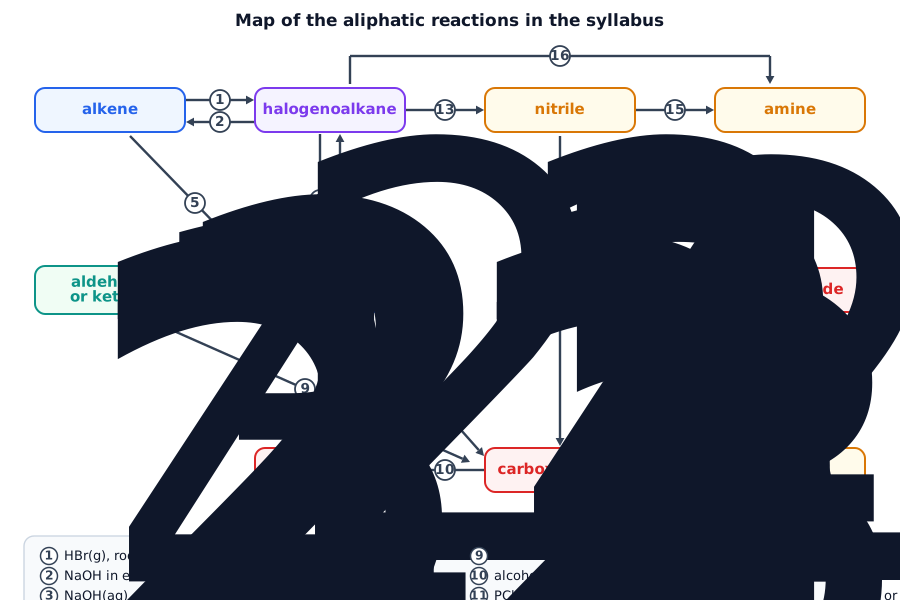
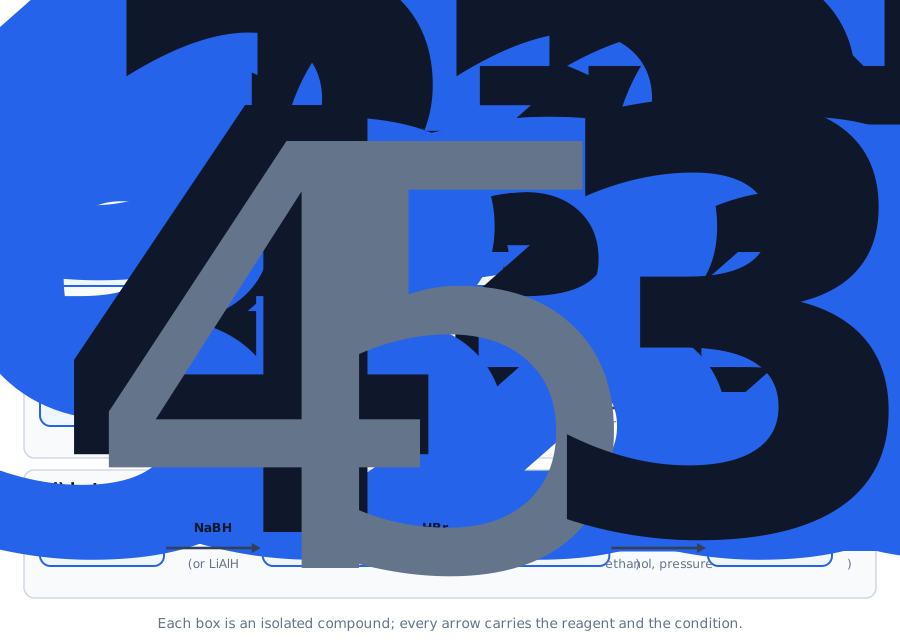
A synthesis uses reactions you already know. The two maps below join them up: each numbered arrow carries a reagent and condition listed underneath the map. Learn them as a network, not as a list; the best way to do so is to redraw each map from memory.

| Change | Reagents and conditions |
|---|---|
| halogenoalkane → alcohol | NaOH(aq), heat under reflux |
| alcohol → aldehyde / ketone | K2Cr2O7 / H+, heat, distil off the product |
| alcohol (1°) or aldehyde → carboxylic acid | K2Cr2O7 / H+, heat under reflux |
| carbonyl → alcohol | NaBH4 (or LiAlH4 in dry ether) |
| carboxylic acid → ester | alcohol + conc. H2SO4, heat under reflux |
| carboxylic acid → acyl chloride | PCl5 or SOCl2 |
| acyl chloride → amide | NH3 (or amine), room temperature |
| halogenoalkane → nitrile | KCN in ethanol, heat under reflux |
| nitrile → carboxylic acid / amine | dilute HCl, reflux / LiAlH4 in dry ether or H2/Ni |
| halogenoalkane → amine | excess NH3 in ethanol, heat under pressure |
| benzene → nitrobenzene → phenylamine | conc. HNO3 + conc. H2SO4, 25–60 °C; then Sn + conc. HCl, heat, then NaOH(aq) |
| phenylamine → diazonium → azo dye | NaNO2 + HCl(aq), below 10 °C; then phenol in NaOH(aq), below 10 °C |
3. Devising a Synthetic Route
To devise a route you work backwards from the target and use as few steps as possible, because some material is lost at each step and the yield of every reaction is below 100%. The overall yield is the product of the individual yields.
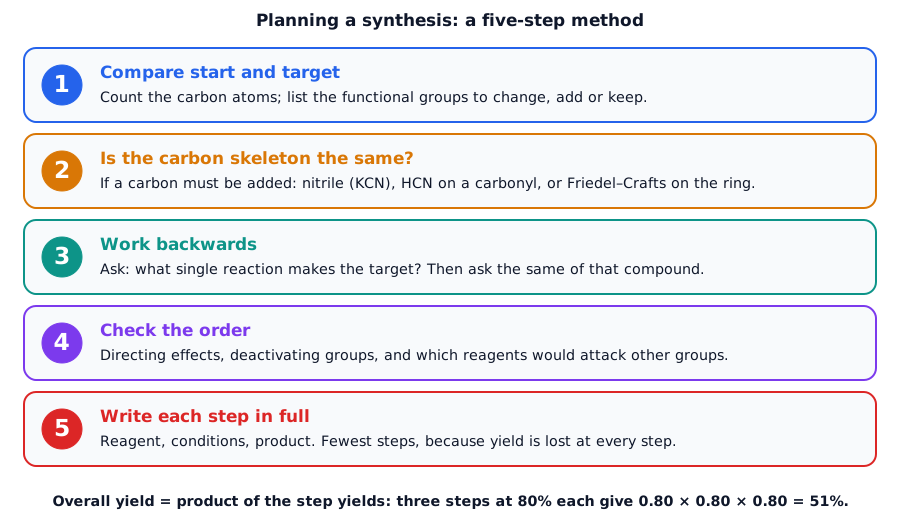
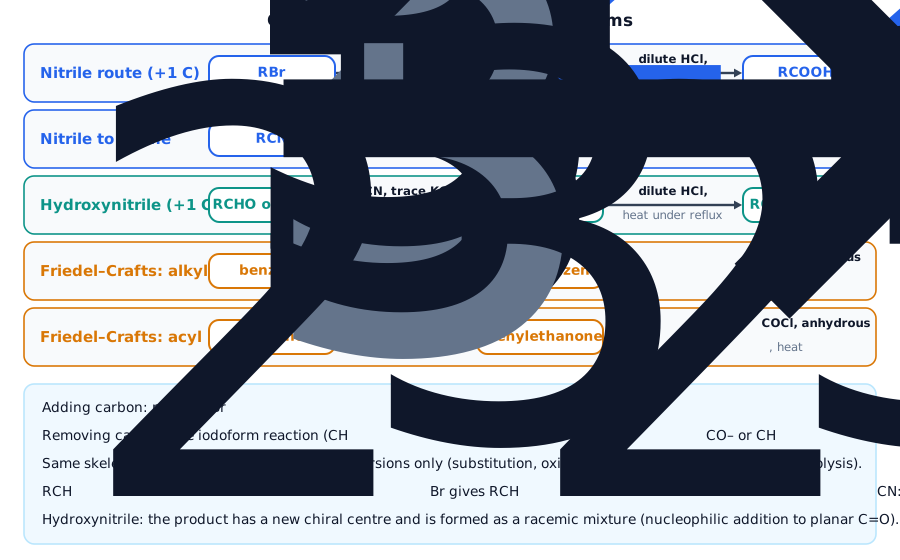
Changing the carbon skeleton. If the target has more carbon atoms than the starting material you must add one. The syllabus gives three ways: the nitrile route (halogenoalkane → nitrile, which hydrolyses to an acid or reduces to an amine), HCN addition to an aldehyde or ketone (a hydroxynitrile, which hydrolyses to a hydroxy acid), and the Friedel–Crafts reaction on a benzene ring. Shortening a chain is rare: only the iodoform reaction removes a carbon.
| Start | Target | Route |
|---|---|---|
| ethene | ethanoic acid | steam, H3PO4 → ethanol; K2Cr2O7/H+, reflux (2 steps, not 3 via bromoethane) |
| ethene | propanoic acid | HBr → bromoethane; KCN, ethanol, reflux → propanenitrile; dilute HCl, reflux (3 steps) |
| benzene | phenylamine | conc. HNO3/H2SO4 → nitrobenzene; Sn/conc. HCl, then NaOH |
| benzene | phenol | as above to phenylamine; NaNO2/HCl below 10 °C; warm with water |
| methylbenzene | benzoic acid | hot alkaline KMnO4, then dilute acid (1 step) |
Worked example. Devise a route from ethene to propylamine, CH3CH2CH2NH2. Give reagents and conditions, and name the intermediates. [5]
Propylamine has one more carbon than ethene, so the nitrile route is needed. Step 1: HBr, room temperature, gives bromoethane [2: reagent, intermediate]. Step 2: KCN in ethanol, heat under reflux, gives propanenitrile, CH3CH2CN [2]. Step 3: LiAlH4 in dry ether (or H2/Ni) gives propylamine [1].
Worked example. Devise a route to convert benzene into phenol. [5]
Step 1: conc. HNO3 + conc. H2SO4, 25–60 °C: nitrobenzene [1]. Step 2: Sn + conc. HCl, heat under reflux, then NaOH(aq): phenylamine [2]. Step 3: NaNO2 + HCl(aq), below 10 °C: benzenediazonium chloride [1]. Step 4: warm with water: phenol (N2 is lost) [1].
Worked example. 2.80 g of ethene is converted into ethylamine in two steps with yields of 80% and 75%. Calculate the mass of ethylamine formed. (Mr: C2H4 = 28.0, C2H5NH2 = 45.0) [3]
Amount of ethene = 2.80 ÷ 28.0 = 0.100 mol [1]. Overall yield = 0.80 × 0.75 = 0.60, so amount of amine = 0.060 mol [1]. Mass = 0.060 × 45.0 = 2.70 g [1].
4-Nitromethylbenzene: alkylate first, then nitrate. 3-Nitrobenzoic acid: oxidise methylbenzene first, then nitrate. Friedel–Crafts does not work on a strongly deactivated ring.
4. Analysing a Given Route
When a route is given you must say, for each step, the type of reaction, the reagent and condition, and (when asked) the possible by-products. A systematic approach is to compare the formula before and after, find which group changed, and name the reaction from that change.

| Type of reaction | Typical by-product or side-product |
|---|---|
| electrophilic substitution (nitration, halogenation, Friedel–Crafts) | an isomer (2-, 4-); more than one group added; HCl or H2O |
| addition of HBr to propene | the minor isomer, 1-bromopropane |
| nucleophilic substitution of a halogenoalkane | an alkene (elimination, if ethanolic and hot) |
| halogenoalkane + NH3 | secondary and tertiary amines (if NH3 is not in excess) |
| oxidation of a 1° alcohol | the aldehyde if distilled; the acid if refluxed |
| esterification | water; reaction is reversible, so some acid and alcohol remain |
| diazotisation, coupling | phenol (if the diazonium salt warms above 10 °C) |
Worked example. Propene is converted to propanone in three steps: (1) HBr; (2) NaOH(aq), heat; (3) K2Cr2O7/H2SO4, heat. Name the type of reaction in each step and give a possible by-product of step 1. [5]
Step 1: electrophilic addition [1]. Step 2: nucleophilic substitution (hydrolysis) [1]. Step 3: oxidation [1]. By-product of step 1: 1-bromopropane [1], formed through the less stable primary carbocation, so it is the minor product [1].
Worked example. In the route benzene → methylbenzene → 4-nitromethylbenzene → 4-methylphenylamine, explain why 2-nitromethylbenzene is also formed in step 2, and state the type of reaction in step 3. [3]
–CH3 is 2,4-directing, so the NO2+ electrophile also attacks the 2-position [1]; the isomers must be separated [1]. Step 3 is reduction [1].
5. Chirality and Single-Enantiomer Drugs
Many drugs are chiral. A chiral centre is a carbon bonded to four different groups, and the molecule exists as two non-superimposable mirror images, enantiomers. They have identical physical and chemical properties, except that they rotate plane-polarised light in opposite directions, and they differ in their biological effect because enzymes and receptors are chiral.
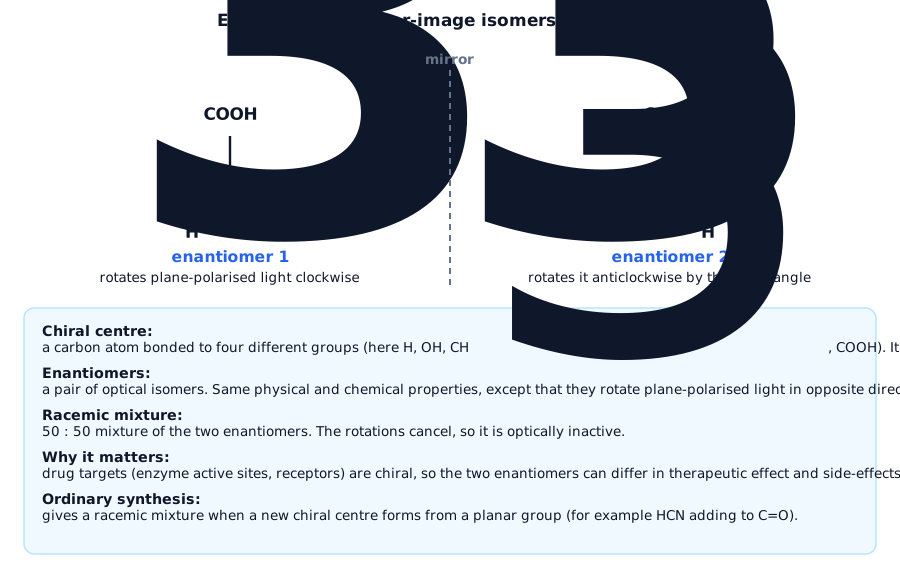
An ordinary laboratory synthesis that creates a new chiral centre from a planar group gives a racemic mixture (50 : 50) because the reagent attacks either face of the planar group equally. For a drug, one enantiomer may be effective and the other harmful: one enantiomer of naproxen treats arthritis while the other can damage the liver, and one enantiomer of a tuberculosis drug causes blindness. A pure enantiomer therefore means a lower dose (about half), better therapeutic activity, fewer side-effects for the patient and less risk of legal action for the manufacturer. About 80% of new patented drugs are single enantiomers.

- Optical resolution. The racemic mixture reacts with a pure chiral compound (chiral auxiliary). The new compounds differ in solubility, so they are separated by fractional crystallisation, and the wanted one is converted back (for example with dilute alkali). The process is slow, uses extra reagents and discards half the material. HPLC with an optically active stationary phase can also separate the enantiomers.
- Chiral pool. Start from a natural compound that already has the required configuration (L-amino acids, carbohydrates) and keep it unchanged through the route.
- Chiral catalyst or enzyme. A catalyst with a chiral shape (for example a ruthenium organometallic catalyst in the manufacture of naproxen) gives only one enantiomer. Enzymes have a stereospecific active site; they are often fixed on inert supports so they can be reused. They need fewer steps, so the process is greener.
Worked example. Ethanal reacts with HCN, with a trace of KCN, to give 2-hydroxypropanenitrile, which is hydrolysed to lactic acid. Explain why the lactic acid formed is optically inactive. [3]
The C=O group is planar, so the −CN nucleophile can attack the δ+ carbon from either side with equal probability [1]. The two enantiomers are formed in equal amounts (a racemic mixture) [1]. The rotations of plane-polarised light cancel, so the product is optically inactive [1].
Worked example. State two benefits of using a single enantiomer rather than a racemic mixture of a drug. [2]
A lower dose is needed because all the material is active, so cost falls [1]; the other enantiomer cannot cause side-effects, so patients are safer and the manufacturer faces less risk of legal action [1].
6. Quick Sheet and Checklist
| Topic | What to remember |
|---|---|
| tests | Br2(aq), KMnO4, dichromate, 2,4-DNPH, Tollens’, Fehling’s, I2/NaOH, Na2CO3, FeCl3, AgNO3, Na, PCl5 |
| add one carbon | nitrile (KCN, ethanol, reflux); HCN on C=O; Friedel–Crafts on the ring |
| nitrile products | dilute HCl reflux: acid; LiAlH4 or H2/Ni: amine |
| halogenoalkane | NaOH(aq): alcohol; ethanolic NaOH: alkene; excess NH3: amine; KCN: nitrile |
| alcohol | 1°: distil gives aldehyde, reflux gives acid; 2°: ketone; 3°: no oxidation |
| ring order | alkylate before nitrating; oxidise a methyl group before nitrating if the 3-isomer is wanted |
| diazonium | NaNO2/HCl below 10 °C; warm with water: phenol; phenol/NaOH below 10 °C: azo dye |
| overall yield | multiply the step yields |
| chiral centre | C with four different groups; racemic: 50 : 50, optically inactive |
| pure enantiomer | resolution, chiral pool, chiral catalyst or enzyme |
- [ ] I can identify each functional group in a molecule from the tests and predict what each reagent does to each group.
- [ ] I can redraw the aliphatic and aromatic reaction maps with reagents and conditions.
- [ ] I can devise a route of two to four steps, working backwards, with intermediates, reagents and conditions.
- [ ] I know three ways to add a carbon atom and the one syllabus reaction that removes one.
- [ ] I can state the type of reaction for each step of a given route and a possible by-product.
- [ ] I can explain why the order of steps matters on a benzene ring.
- [ ] I can explain chirality, enantiomers, racemic mixtures and why drugs need a single enantiomer, with three ways to make one.