 Score
Carboxylic Acids and Derivatives (A Level)
0. What Examiners Want
This guide covers Topic 33 of Cambridge International AS & A Level Chemistry 9701 (2025–27) and follows the learning outcomes below, word for word. The right-hand column shows where each one is taught. It builds on Topic 18 (carboxylic acids and esters at AS), Topic 30 (side-chain oxidation of arenes), Topic 31 (halogenoarenes) and Topic 32 (phenol and the first acyl chloride reaction). The acyl chloride reaction with amines is met again in Topic 34.
| 33 Carboxylic acids and derivatives. Candidates should be able to: | Section |
|---|---|
| 33.1 Carboxylic acids | |
| 1 recall the reaction by which benzoic acid can be produced: (a) reaction of an alkylbenzene with hot alkaline KMnO4 and then dilute acid, exemplified by methylbenzene | 1 |
| 2 describe the reaction of carboxylic acids with PCl3 and heat, PCl5 or SOCl2 to form acyl chlorides | 4 |
| 3 recognise that some carboxylic acids can be further oxidised: (a) the oxidation of methanoic acid, HCOOH, with Fehling’s reagent or Tollens’ reagent or acidified KMnO4 or acidified K2Cr2O7 to carbon dioxide and water (b) the oxidation of ethanedioic acid, HOOCCOOH, with warm acidified KMnO4 to carbon dioxide | 3 |
| 4 describe and explain the relative acidities of carboxylic acids, phenols and alcohols | 2 |
| 5 describe and explain the relative acidities of chlorine-substituted carboxylic acids | 2 |
| 33.2 Esters | |
| 1 recall the reaction by which esters can be produced: (a) reaction of alcohols with acyl chlorides using the formation of ethyl ethanoate and phenyl benzoate as examples | 7 |
| 33.3 Acyl chlorides | |
| 1 recall the reactions (reagents and conditions) by which acyl chlorides can be produced: (a) reaction of carboxylic acids with PCl3 and heat, PCl5 or SOCl2 | 4 |
| 2 describe the following reactions of acyl chlorides: (a) hydrolysis on addition of water at room temperature to give the carboxylic acid and HCl (b) reaction with an alcohol at room temperature to produce an ester and HCl (c) reaction with phenol at room temperature to produce an ester and HCl (d) reaction with ammonia at room temperature to produce an amide and HCl (e) reaction with a primary or secondary amine at room temperature to produce an amide and HCl | 5 |
| 3 describe the addition–elimination mechanism of acyl chlorides in reactions in 33.3.2(a)–(e) | 6 |
| 4 explain the relative ease of hydrolysis of acyl chlorides, alkyl chlorides and halogenoarenes (aryl chlorides) | 8 |
- Reagents and observations: PCl5, PCl3 (heat) or SOCl2; Fehling’s, Tollens’ and KMnO4 colour changes; white fumes of HCl.
- Products: the acid, ester or amide, plus HCl (or the ammonium salt with NH3 and amines).
- Explanations of acidity: delocalisation in the carboxylate ion, and the electron-withdrawing or electron-donating effect of the groups on the next carbon.
- The mechanism: the lone pair attacks the δ+ carbon, the tetrahedral intermediate, then loss of Cl− and H+, with correct curly arrows.
- Comparison of reactivity: acyl chloride > chloroalkane > chloroarene, with a reason for each.
1. Carboxylic Acids and Benzoic Acid
A carboxylic acid contains the group –COOH. At AS you met three routes to a carboxylic acid: oxidation of a primary alcohol or an aldehyde (acidified K2Cr2O7, reflux), hydrolysis of a nitrile (dilute HCl, reflux), and the reactions of the acid shown in the figure. At A Level there is one more route, and it makes benzoic acid.

Benzoic acid from methylbenzene. An alkylbenzene is oxidised by hot alkaline KMnO4; the whole side chain (as long as it has a C–H on the carbon next to the ring) is oxidised to –COOH. In alkali the product is the carboxylate salt, sodium benzoate. Dilute acid is then added to release the free acid, which is a white solid.
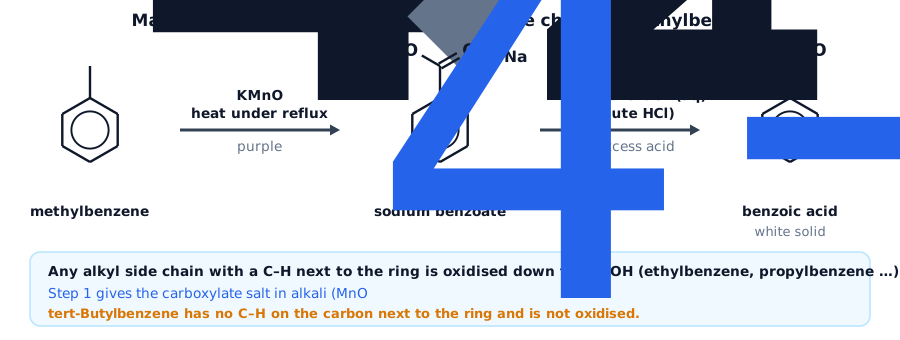
Step 2: C6H5COO−Na+ + H+ → C6H5COOH + Na+
Worked example. State the reagents and conditions for the conversion of methylbenzene into benzoic acid, and describe what you see in the first step. [4]
Hot (heated under reflux) alkaline KMnO4 [1], then dilute acid [1]. The purple solution turns colourless / forms a brown precipitate of MnO2 [1]; adding acid gives a white precipitate of benzoic acid [1].
Like every carboxylic acid, benzoic acid reacts with bases (NaOH), reactive metals (Mg, Na) and carbonates (effervescence of CO2) to form carboxylate salts, for example sodium ethanoate, CH3COO−Na+.
2. Relative Acidity
All carboxylic acids are weak acids: their molecules are mostly undissociated in water. The dissociation constant Ka measures the strength: the larger the Ka (the smaller the pKa), the stronger the acid. For ethanoic acid Ka = 1.7 × 10⁻⁵ mol dm−3. The order you must explain is:
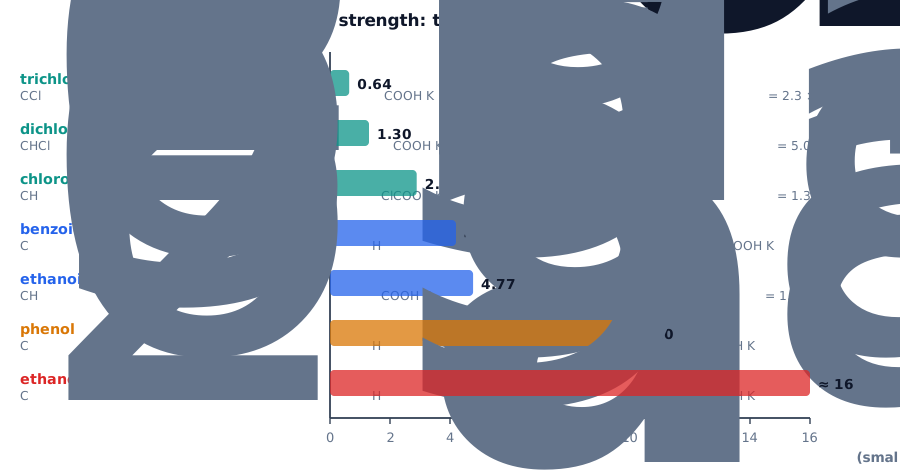
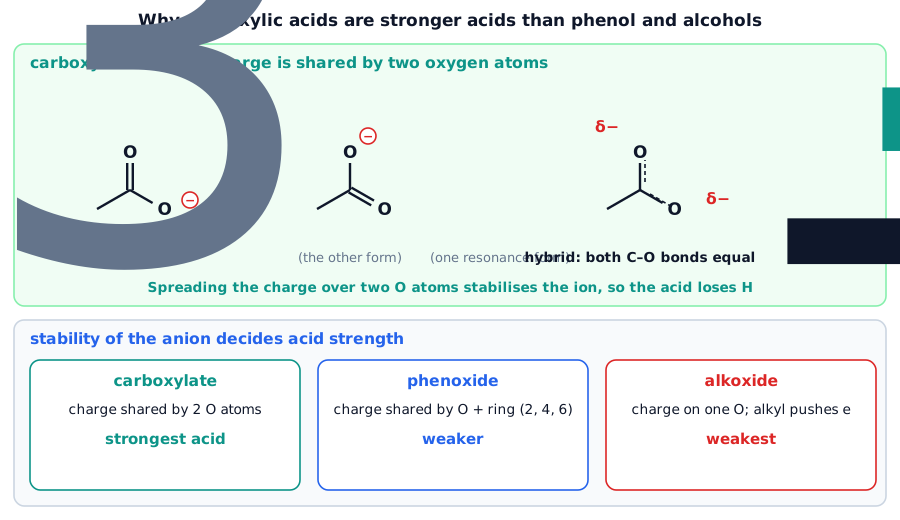
Carboxylic acids are stronger than phenols and alcohols. The reason is the stability of the anion (and the weaker O–H bond, because the C=O group pulls electrons away).
- In the carboxylate ion, the negative charge is delocalised over two oxygen atoms through the –COO− group. Both C–O bonds are the same length. The ion is very stable.
- In the phenoxide ion, the charge is delocalised into the ring (Topic 32), but the ring has to share it with carbon atoms, which are far less able to hold it. It is less stable than carboxylate.
- In an alkoxide ion the charge stays on one oxygen, and the electron-donating alkyl group makes it worse.
Chlorine-substituted acids. An electron-withdrawing atom on the carbon next to the –COOH group makes the acid stronger. Chlorine is electronegative, so it withdraws electrons through the σ bonds (a negative inductive effect, −I). This weakens the O–H bond and spreads out the charge on the carboxylate ion, so the ion is more stable and less likely to take H+ back. An electron-donating alkyl group does the opposite.
| Acid | Ka at 25 °C / mol dm−3 |
|---|---|
| ethanoic acid, CH3COOH | 1.7 × 10⁻⁵ |
| chloroethanoic acid, CH2ClCOOH | 1.3 × 10⁻³ |
| dichloroethanoic acid, CHCl2COOH | 5.0 × 10⁻² |
| trichloroethanoic acid, CCl3COOH | 2.3 × 10⁻¹ |
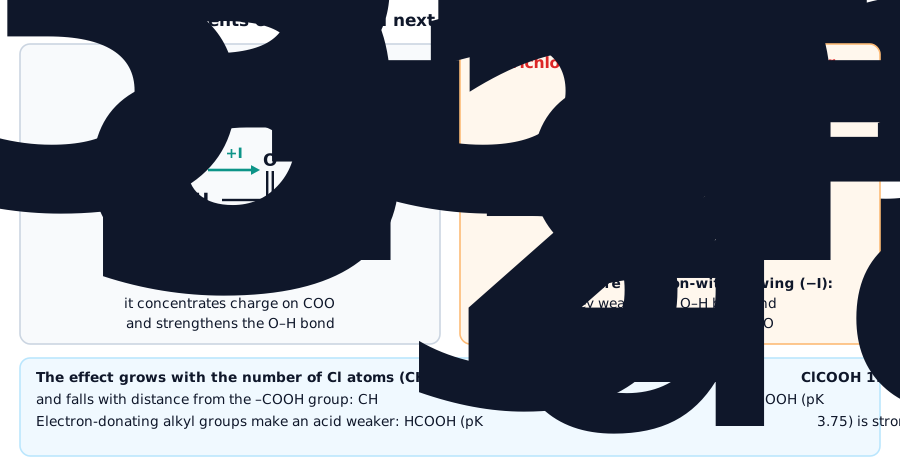
The effect depends on how many chlorine atoms there are and how close they are to the –COOH group. 2-Chlorobutanoic acid is stronger than butanoic acid; 2,2-dichlorobutanoic acid is stronger still; 4-chlorobutanoic acid is only slightly stronger than butanoic acid because the Cl is far away.
Worked example. Place CH3CH2COOH, CH3CHClCOOH and CH3CCl2COOH in order of acid strength, strongest first, and explain. [3]
CH3CCl2COOH > CH3CHClCOOH > CH3CH2COOH [1]. Chlorine is electron-withdrawing [1], so it spreads the negative charge on the carboxylate ion and weakens the O–H bond; two Cl atoms do this more than one, and the ethyl group is electron-donating [1].
Worked example. Explain why ethanoic acid is a stronger acid than ethanol. [3]
In the ethanoate ion the negative charge is delocalised over two oxygen atoms through the –COO− group [1], so the ion is stabilised [1]. In ethoxide the charge is localised on one oxygen and the alkyl group is electron-donating, so the ion is less stable [1].
3. Two Acids That Can Be Oxidised
Carboxylic acids are the end of oxidation: a primary alcohol is oxidised to an aldehyde, then to the acid, and the acid is not oxidised further by the same reagents. There are two exceptions.
Methanoic acid, HCOOH. The molecule has an H atom on the carbonyl carbon, so it has an aldehyde-like C–H and is a reducing agent. It is oxidised to carbon dioxide and water: HCOOH + [O] → CO2 + H2O.
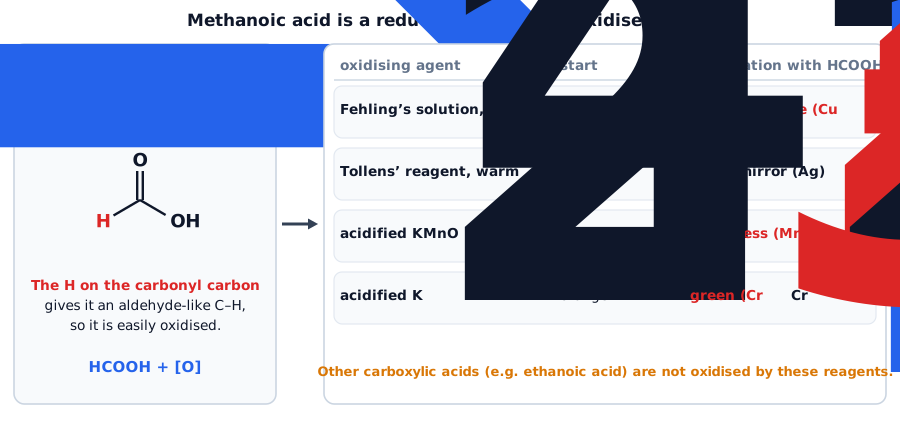
Ethanedioic acid, HOOC–COOH. It is oxidised by warm acidified KMnO4 to carbon dioxide. The purple permanganate is decolourised. This is the standard reaction for standardising KMnO4.
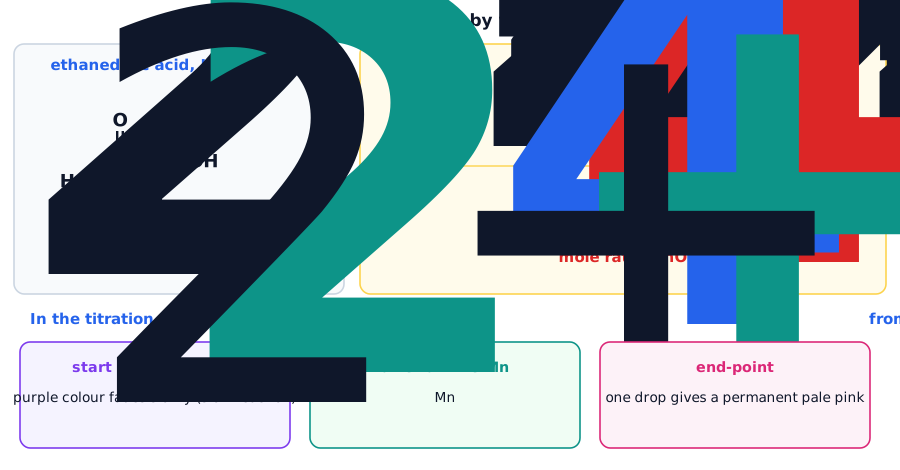
The reaction is slow at room temperature, so the ethanedioic acid solution is warmed before the titration. The Mn2+ ions that form act as a catalyst, so the reaction is slow at first and then fast (autocatalysis). The end-point is the first permanent pale pink.
Worked example. 25.0 cm3 of 0.0400 mol dm−3 ethanedioic acid, acidified, requires 13.4 cm3 of KMnO4(aq) for complete oxidation. Calculate the concentration of the KMnO4. [3]
Amount of H2C2O4 = 0.0250 × 0.0400 = 1.00 × 10⁻³ mol [1]. Ratio 2MnO4− : 5H2C2O4, so amount of MnO4− = 1.00 × 10−3 × 2/5 = 4.00 × 10⁻⁴ mol [1]. Concentration = 4.00 × 10⁻⁴ / 0.0134 = 0.0299 mol dm−3 [1].
4. Making Acyl Chlorides
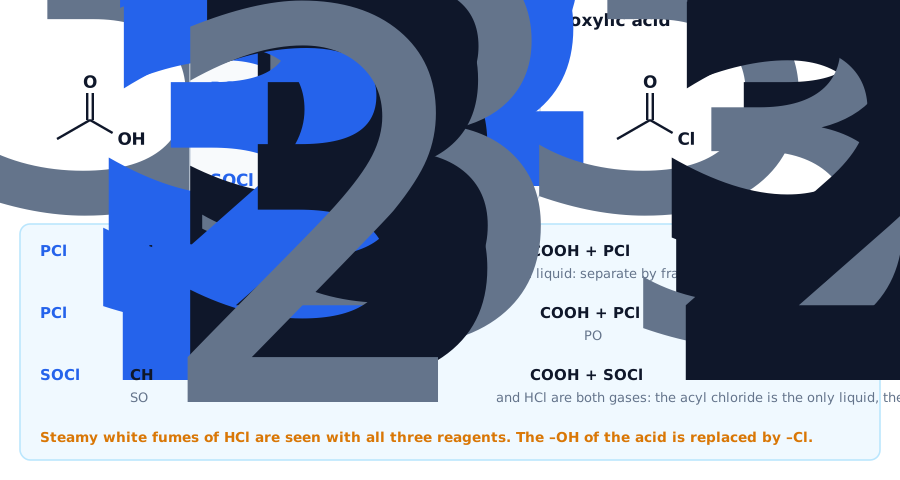
An acyl chloride has the group –COCl: it is a carboxylic acid with the –OH replaced by –Cl. The general formula is RCOCl. Ethanoyl chloride is CH3COCl and benzoyl chloride is C6H5COCl. Carboxylic acids are fairly unreactive, so they are first converted into acyl chlorides, which are far more reactive. Three reagents are used.
| Reagent | Conditions | Equation (ethanoic acid) |
|---|---|---|
| PCl5 | room temperature | CH3COOH + PCl5 → CH3COCl + POCl3 + HCl |
| PCl3 | heat | 3CH3COOH + PCl3 → 3CH3COCl + H3PO3 |
| SOCl2 | room temperature | CH3COOH + SOCl2 → CH3COCl + SO2 + HCl |
Steamy white fumes of HCl are seen. The reaction with SOCl2 is the cleanest because SO2 and HCl are both gases and escape, leaving the acyl chloride as the only liquid. With PCl5 the liquid POCl3 has to be separated by distillation.
Worked example. Write an equation for the reaction of propanoic acid with SOCl2, and state one observation. [2]
CH3CH2COOH + SOCl2 → CH3CH2COCl + SO2 + HCl [1]. Steamy white fumes (HCl) / a gas is given off [1].
5. Reactions of Acyl Chlorides
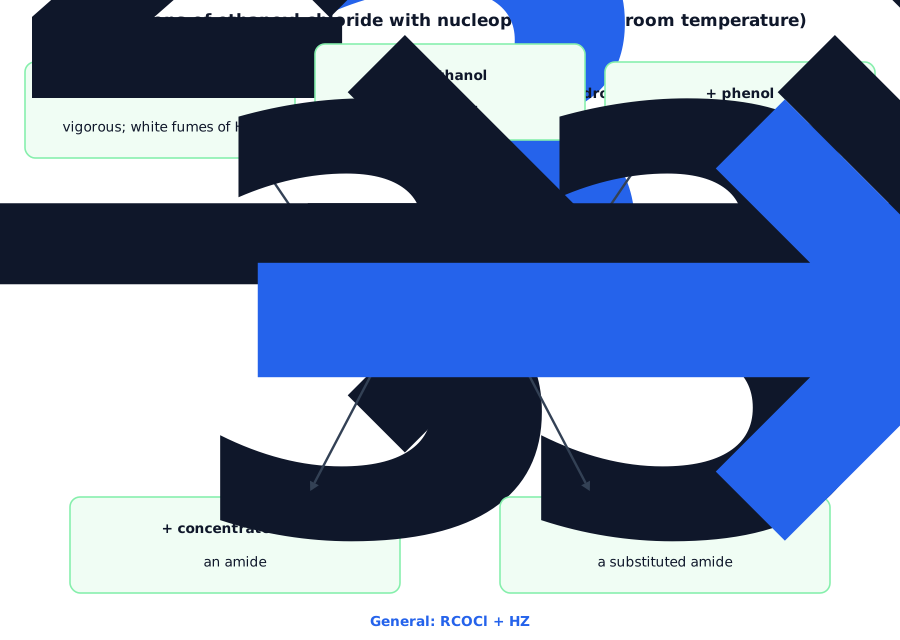
The carbonyl carbon in an acyl chloride is bonded to two very electronegative atoms, O and Cl. It carries a large δ+ charge and is attacked quickly by nucleophiles, which donate a lone pair. When a nucleophile reacts, the C–Cl bond breaks and HCl is released (white fumes). The general reaction is:
| Nucleophile | Product from CH3COCl | Notes |
|---|---|---|
| H2O | ethanoic acid + HCl | vigorous at room temperature; white fumes of HCl |
| ethanol, CH3CH2OH | ethyl ethanoate + HCl | an ester; goes to completion |
| phenol, C6H5OH | phenyl ethanoate + HCl | an ester; phenol is a weaker nucleophile (see Section 7) |
| NH3 (concentrated) | ethanamide, CH3CONH2 + HCl | the HCl reacts with a second NH3 to give NH4Cl |
| CH3NH2 (primary amine) | N-methylethanamide, CH3CONHCH3 + HCl | HCl forms CH3NH3+Cl− |
| (CH3)2NH (secondary amine) | N,N-dimethylethanamide, CH3CON(CH3)2 + HCl | HCl forms (CH3)2NH2+Cl− |
With ammonia and amines, the HCl made is a gas that immediately reacts with unreacted NH3 or amine, which is a base. So the equations use two moles of ammonia or amine:
CH3COCl + 2NH3 → CH3CONH2 + NH4Cl
CH3COCl + 2CH3NH2 → CH3CONHCH3 + CH3NH3+Cl−
For this reason you see much less white HCl fume with ammonia and amines than with water or alcohols.
Worked example. Write an equation for the reaction of propanoyl chloride with propylamine and name the organic product. [2]
CH3CH2COCl + CH3CH2CH2NH2 → CH3CH2CONHCH2CH2CH3 + HCl [1] (or with 2 mol amine and the ammonium salt). The product is N-propylpropanamide [1].
The acyl chloride reactions are much faster than the corresponding reactions of the carboxylic acid, and they go to completion. They are the best routes to esters and amides in the laboratory and in industry.
6. The Addition–Elimination Mechanism
All five reactions follow the same two-stage pattern, called nucleophilic addition–elimination (sometimes called a condensation reaction, because a small molecule, HCl, is lost).
- Addition. A lone pair on the nucleophile (O or N) attacks the δ+ carbonyl carbon. The C=O π bond breaks and the electrons move onto oxygen, giving a tetrahedral intermediate with O−.
- Elimination. The lone pair on O− re-forms the C=O bond and the C–Cl bond breaks, so Cl− leaves. The positively charged atom (O+ or N+) loses H+, and H+ + Cl− form HCl.
Hydrolysis (water as the nucleophile).

Reaction with a primary amine (nitrogen as the nucleophile). The mechanism is the same. The amine has a lone pair on N. After Cl− leaves, a second molecule of amine removes H+ from N+, giving the substituted amide and an alkylammonium chloride.

Worked example. Describe, with curly arrows, the mechanism for the reaction of ethanoyl chloride with ammonia. [4]
Dipoles Cδ+=Oδ− and curly arrow from the N lone pair of NH3 to the carbonyl carbon [1]; curly arrow from the C=O π bond to O [1]; intermediate with O−, Cl, CH3 and N+H3 on the central carbon [1]; curly arrow from O− back to form C=O and curly arrow from C–Cl to Cl, giving CH3CONH2 (after loss of H+) and Cl− [1].
7. Esters from Acyl Chlorides
An acyl chloride reacts with an alcohol or a phenol to give an ester and HCl. The name of the ester has the alkyl or aryl group from the alcohol or phenol first, and the part from the acid second.
Ethyl ethanoate. CH3COCl + CH3CH2OH → CH3COOCH2CH3 + HCl. Room temperature, no catalyst, vigorous, complete (Topic 32). Compared with making the ester from ethanoic acid (concentrated H2SO4, reflux, reversible), the acyl chloride route is faster, needs no catalyst and gives a higher yield.
Phenyl benzoate. An acyl chloride is the only practical route to the ester of a phenol, because phenol does not form an ester directly with a carboxylic acid. Benzoyl chloride reacts with phenol to give phenyl benzoate.

Conditions: room temperature (the syllabus condition). Phenol is less nucleophilic than an alcohol because its lone pair is partly delocalised into the ring, so adding NaOH(aq) (to give the phenoxide ion) speeds the reaction up.
Worked example. Name the two reactants and the product when phenyl benzoate is made, and state the conditions. [3]
Benzoyl chloride and phenol [1]; product phenyl benzoate [1]; room temperature (with NaOH(aq) to make the phenoxide ion if needed) [1].
8. Ease of Hydrolysis
Acyl chlorides, chloroalkanes and chloroarenes all contain a C–Cl bond, but their reactivity towards water is very different. The order of ease of hydrolysis is:
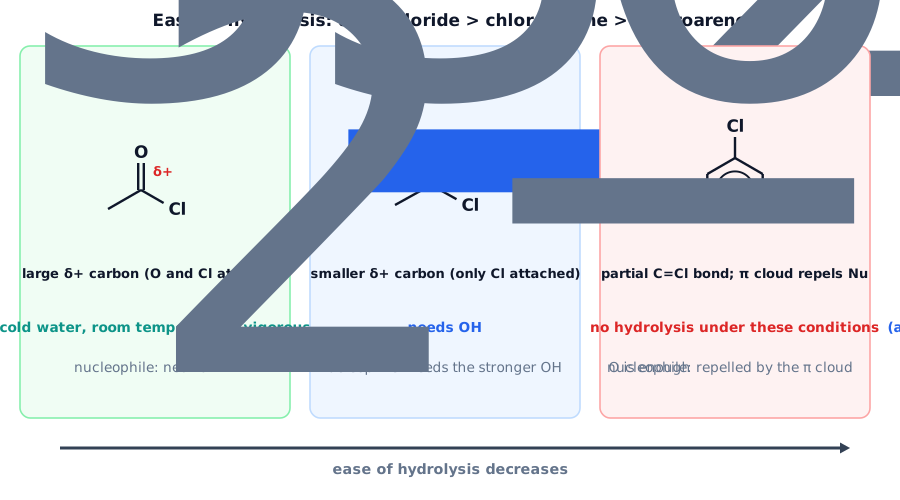
- Acyl chloride (e.g. CH3COCl): the carbon is bonded to O and Cl, so it has a large δ+ charge. Even a neutral water molecule attacks it. The reaction is vigorous with cold water and produces HCl fumes.
- Chloroalkane (e.g. CH3CH2Cl): the carbon is bonded to one Cl only, so the δ+ charge is smaller. Water is too weak; the stronger nucleophile OH− (NaOH(aq)) and heating under reflux are needed.
- Chloroarene (e.g. C6H5Cl): a lone pair on Cl overlaps with the ring π system, so the C–Cl bond has partial double-bond character and is stronger, and the electron-rich ring repels nucleophiles (Topic 31). It does not hydrolyse under these conditions.
A simple test shows the order. Add AgNO3(aq) to each: the acyl chloride gives an immediate white precipitate of AgCl (it hydrolyses at once and releases Cl−); the chloroalkane gives no precipitate until it has been warmed with alkali; the chloroarene gives none at all.
Worked example. Explain the relative ease of hydrolysis of chlorobenzene, butanoyl chloride and 1-chlorobutane. [4]
Butanoyl chloride is hydrolysed most easily [1]: the carbon is bonded to both O and Cl, so it has a large δ+ charge and is attacked by water [1]. 1-Chlorobutane is hydrolysed more slowly [1]: its carbon is bonded to Cl only, so the δ+ is smaller. Chlorobenzene is not hydrolysed [1]: a Cl lone pair is delocalised into the ring, so the C–Cl bond has partial double-bond character and is stronger, and the ring repels the nucleophile.
9. Quick Sheet and Checklist
| Topic | What to remember |
|---|---|
| Benzoic acid | methylbenzene + hot alkaline KMnO4, then dilute acid |
| Acyl chloride from acid | PCl5 (room temp.), PCl3 (heat) or SOCl2 (gaseous by-products); fumes of HCl |
| Acidity order | carboxylic acid > phenol > alcohol; more Cl on the α carbon = stronger acid |
| Methanoic acid | oxidised to CO2 + H2O by Fehling’s, Tollens’, KMnO4 or K2Cr2O7 |
| Ethanedioic acid | oxidised to CO2 by warm acidified KMnO4; 2MnO4− : 5H2C2O4 |
| RCOCl + H2O | RCOOH + HCl |
| RCOCl + ROH or phenol | ester + HCl (phenyl benzoate from benzoyl chloride + phenol) |
| RCOCl + NH3 / amine | amide + HCl (as NH4Cl or alkylammonium chloride) |
| Mechanism | addition (lone pair to δ+ C) then elimination (Cl− leaves, H+ lost) |
| Ease of hydrolysis | acyl chloride > chloroalkane > chloroarene |
- [ ] I can state the reagents and conditions for making benzoic acid from methylbenzene.
- [ ] I can explain why carboxylic acids are stronger than phenols and alcohols.
- [ ] I can explain the effect of chlorine atoms on the strength of a carboxylic acid.
- [ ] I can write equations and give observations for the oxidation of methanoic and ethanedioic acids, and use the 2 : 5 ratio.
- [ ] I can give the three reagents that make an acyl chloride and write each equation.
- [ ] I can write the products of an acyl chloride with water, an alcohol, phenol, ammonia, and primary and secondary amines.
- [ ] I can draw the addition–elimination mechanism with curly arrows.
- [ ] I can explain why acyl chlorides hydrolyse more easily than chloroalkanes and chloroarenes.