 Score
Chemistry of Transition Elements
0. What Examiners Want
This guide covers Topic 28 of Cambridge International AS & A Level Chemistry 9701 (2025–27) and follows the learning outcomes below, word for word. The right-hand column shows where each one is taught. It builds on Topic 24 (electrode potentials), Topic 26 (catalysis) and Topic 27 (the idea of polarisation).
| 28.1 General physical and chemical properties of the first row of transition elements, titanium to copper. Candidates should be able to: | Section |
|---|---|
| 1 define a transition element as a d-block element which forms one or more stable ions with incomplete d orbitals | 1 |
| 2 sketch the shape of a 3dxy orbital and 3dz² orbital | 2 |
| 3 understand that transition elements have the following properties: (a) they have variable oxidation states (b) they behave as catalysts (c) they form complex ions (d) they form coloured compounds | 3 |
| 4 explain why transition elements have variable oxidation states in terms of the similarity in energy of the 3d and the 4s sub-shells | 3 |
| 5 explain why transition elements behave as catalysts in terms of having more than one stable oxidation state, and vacant d orbitals that are energetically accessible and can form dative bonds with ligands | 3 |
| 6 explain why transition elements form complex ions in terms of vacant d orbitals that are energetically accessible | 3 |
| 28.2 General characteristic chemical properties of the first set of transition elements, titanium to copper. Candidates should be able to: | Section |
|---|---|
| 1 describe and explain the reactions of transition elements with ligands to form complexes, including the complexes of copper(II) and cobalt(II) ions with water and ammonia molecules and hydroxide and chloride ions | 6 |
| 2 define the term ligand as a species that contains a lone pair of electrons that forms a dative covalent bond to a central metal atom / ion | 4 |
| 3 understand and use the terms: (a) monodentate ligand including as examples H2O, NH3, Cl– and CN– (b) bidentate ligand including as examples 1,2-diaminoethane, en, H2NCH2CH2NH2 and the ethanedioate ion, C2O42– (c) polydentate ligand including as an example EDTA4– | 4 |
| 4 define the term complex as a molecule or ion formed by a central metal atom / ion surrounded by one or more ligands | 4 |
| 5 describe the geometry (shape and bond angles) of transition element complexes which are linear, square planar, tetrahedral or octahedral | 5 |
| 6 (a) state what is meant by coordination number (b) predict the formula and charge of a complex ion, given the metal ion, its charge or oxidation state, the ligand and its coordination number or geometry | 4, 5 |
| 7 explain qualitatively that ligand exchange can occur, including the complexes of copper(II) ions and cobalt(II) ions with water and ammonia molecules and hydroxide and chloride ions | 6 |
| 8 predict, using E° values, the feasibility of redox reactions involving transition elements and their ions | 7 |
| 9 describe the reactions of, and perform calculations involving: (a) MnO4– / C2O42– in acid solution given suitable data (b) MnO4– / Fe2+ in acid solution given suitable data (c) Cu2+ / I– given suitable data | 7 |
| 10 perform calculations involving other redox systems given suitable data | 7 |
| 28.3 Colour of complexes. Candidates should be able to: | Section |
|---|---|
| 1 define and use the terms degenerate and non-degenerate d orbitals | 8 |
| 2 describe the splitting of degenerate d orbitals into two non-degenerate sets of d orbitals of higher energy, and use of ΔE in: (a) octahedral complexes, two higher and three lower d orbitals (b) tetrahedral complexes, three higher and two lower d orbitals | 8 |
| 3 explain why transition elements form coloured compounds in terms of the frequency of light absorbed as an electron is promoted between two non-degenerate d orbitals | 8 |
| 4 describe, in qualitative terms, the effects of different ligands on ΔE, frequency of light absorbed, and hence the complementary colour that is observed | 8 |
| 5 use the complexes of copper(II) ions and cobalt(II) ions with water and ammonia molecules and hydroxide and chloride ions as examples of ligand exchange affecting the colour observed | 6, 8 |
- Definitions: transition element, ligand, complex, coordination number, degenerate orbitals, each in exact words.
- Explanations: variable oxidation states, catalysis, complex formation and colour, each as a short chain of reasons.
- Formulae and colours: the complex ions of Cu2+ and Co2+, with their charges, shapes and colours.
- Equations: ligand-exchange equations that balance for atoms and charge, and redox equations built from half-equations.
- Calculations: mole ratio from the equation, concentration, mass or percentage, and ΔE = hν.
- Diagrams: shapes with bond angles, d-orbital energy-level diagrams and orbital sketches.
1. What Is a Transition Element?
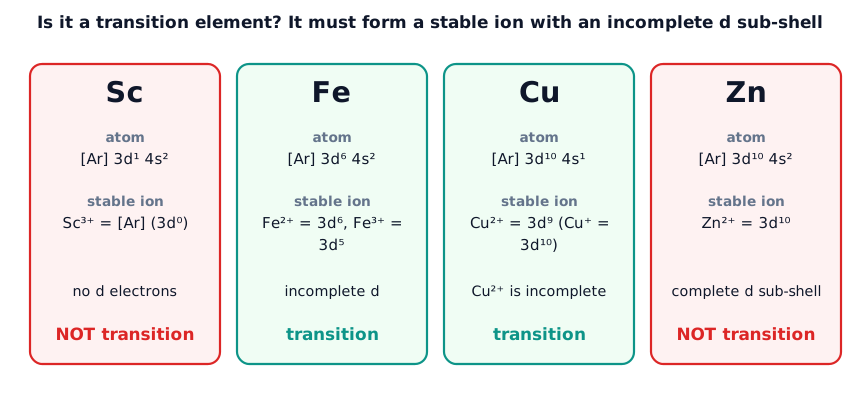
The transition elements are found in the d block, between Groups 2 and 13. Not every d-block element is a transition element.
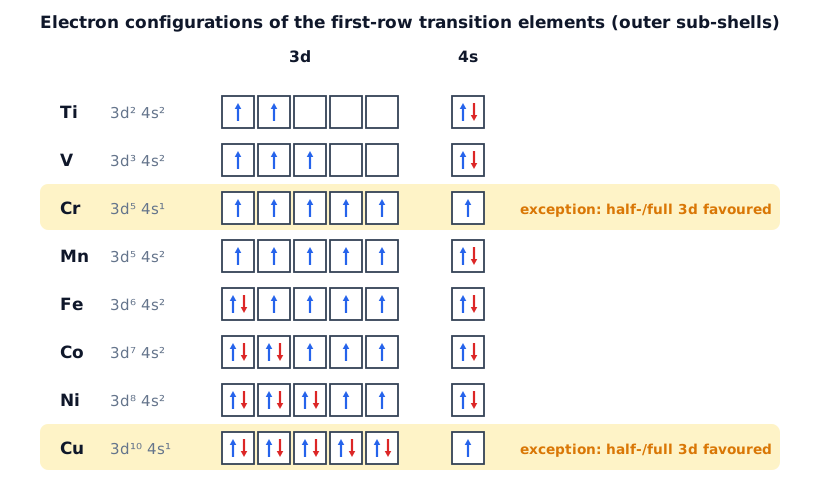
Electronic configurations. In atoms, the 4s sub-shell fills before the 3d sub-shell, except in chromium and copper, where the half-filled (3d5) and completely filled (3d10) arrangements are slightly more stable.
Ions. When a transition element forms a positive ion, the 4s electrons are lost first, then the 3d electrons:
- Fe: [Ar] 3d64s2 → Fe2+: [Ar] 3d6 → Fe3+: [Ar] 3d5
- Cu: [Ar] 3d104s1 → Cu+: [Ar] 3d10 and Cu2+: [Ar] 3d9
- Ti: [Ar] 3d24s2 → Ti3+: [Ar] 3d1
Worked example. Write the full electronic configurations of Co2+ and Cr3+, and decide whether each is the ion of a transition element.
Co: 1s22s22p63s23p63d74s2; Co2+: 1s22s22p63s23p63d7. Cr: …3d54s1; Cr3+: …3s23p63d3. Both have an incomplete 3d sub-shell, so cobalt and chromium are transition elements.
2. The 3d Orbitals
There are five 3d orbitals. In an isolated atom or ion they are degenerate, meaning they have the same energy. The syllabus asks you to sketch the shape of two of them:
- 3dxy: four lobes lying between the x and y axes (pointing along the diagonals, in the xy plane);
- 3dz²: two lobes along the z axis plus a doughnut-shaped ring around the middle, in the xy plane.

When you sketch, draw and label the axes, make the lobes of equal size and say which orbital it is. A 3dxy sketch with lobes on the axes would be the 3dx²−y² orbital, which scores nothing.
3. Four Characteristic Properties
Transition elements are metals with high melting points and densities. Chemically, four properties set them apart, and each follows from the 3d sub-shell.
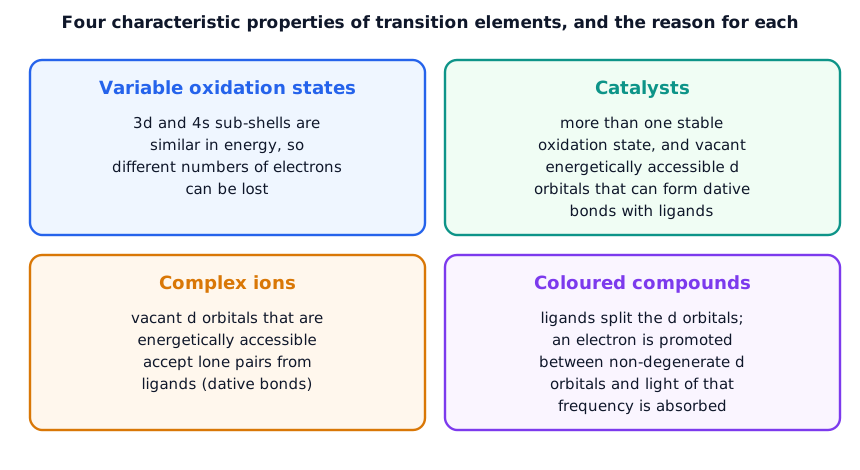
(a) Variable oxidation states. The 3d and 4s sub-shells are similar in energy, so after the 4s electrons have been lost, the 3d electrons can also be lost with only a small extra energy cost. Successive ionisation energies rise steadily, with no huge jump, so several oxidation states are possible. Compare calcium, where the third ionisation energy is enormous because it breaks into a full inner shell.


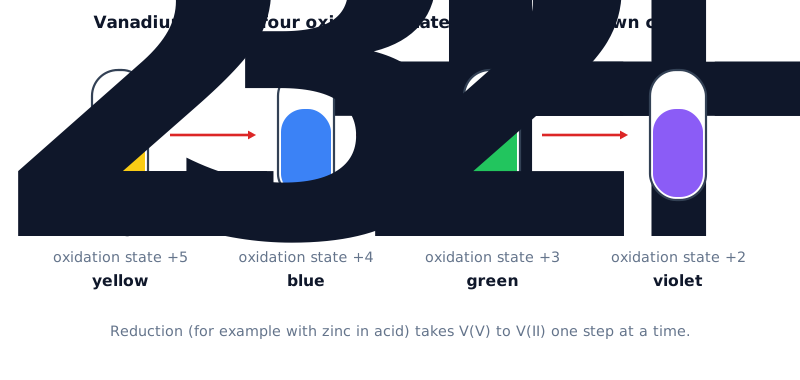
Because the oxidation state varies, compound names include it: iron(II) sulfate, manganese(IV) oxide, chromium(VI) oxide.
(b) Catalysts. Transition elements and their compounds make good catalysts because they have more than one stable oxidation state (so they can accept and give back electrons in the course of a reaction) and vacant d orbitals that are energetically accessible and can form dative bonds with ligands (so they can bind reactants). Examples from Topic 26: Fe in the Haber process; V2O5 in the Contact process; Pt, Pd and Rh in catalytic converters; and Fe2+ / Fe3+ in the I− / S2O82− reaction.
(c) Complex ions. Their ions have vacant d orbitals that are energetically accessible, which can accept lone pairs from ligands as dative bonds. They also have a high charge density (small, highly charged ions), which attracts ligands.
(d) Coloured compounds. Ligands split the d orbitals into two sets of different energy. An electron is promoted from the lower to the upper set, absorbing light of a particular frequency, and the complementary colour is seen (section 8).
| Property | Because |
|---|---|
| variable oxidation states | 3d and 4s sub-shells are similar in energy |
| catalytic behaviour | more than one stable oxidation state, and vacant d orbitals that are energetically accessible and form dative bonds with ligands |
| complex ions | vacant d orbitals that are energetically accessible |
| coloured compounds | d-orbital splitting; electron promotion between non-degenerate d orbitals |
4. Ligands and Complex Ions
Ligand: a species that contains a lone pair of electrons that forms a dative covalent bond to a central metal atom / ion.
Complex: a molecule or ion formed by a central metal atom / ion surrounded by one or more ligands.
Coordination number: the number of coordinate (dative) bonds formed by the central metal ion.
Ligands are classified by the number of dative bonds each one forms:

| Type | Dative bonds per ligand | Examples |
|---|---|---|
| monodentate | 1 | H2O, NH3, Cl−, CN−, OH−, SCN− |
| bidentate | 2 | 1,2-diaminoethane (en), H2NCH2CH2NH2; ethanedioate, C2O42− |
| polydentate | more than 2 | EDTA4− (hexadentate: six) |
The formula and charge of a complex. The charge is the sum of the charge on the metal ion and the charges on the ligands (neutral ligands such as H2O and NH3 contribute nothing).
| Metal ion | Ligands | Complex | Charge working |
|---|---|---|---|
| Fe2+ | 6 H2O | [Fe(H2O)6]2+ | +2 + 0 = +2 |
| Co3+ | 6 NH3 | [Co(NH3)6]3+ | +3 + 0 = +3 |
| Cu2+ | 4 Cl− | [CuCl4]2− | +2 + 4(−1) = −2 |
| Fe3+ | 3 C2O42− | [Fe(C2O4)3]3− | +3 + 3(−2) = −3 |
| Ni2+ | 4 CN− | [Ni(CN)4]2− | +2 + 4(−1) = −2 |
| Ag+ | 2 NH3 | [Ag(NH3)2]+ | +1 + 0 = +1 |
To find the oxidation state of the metal from the complex, work backwards. In [Ni(CN)4]2−: x + 4(−1) = −2, so x = +2.
Worked example. Predict the formula and charge of the complex formed by Cr3+ with six hydroxide ions, and state the coordination number.
Charge = +3 + 6(−1) = −3, so [Cr(OH)6]3−. The coordination number is 6, because each OH− forms one dative bond.
5. Shapes of Complexes
The shape depends on the coordination number (and, for four, on the metal and ligand).
| Coordination number | Shape | Bond angle | Example |
|---|---|---|---|
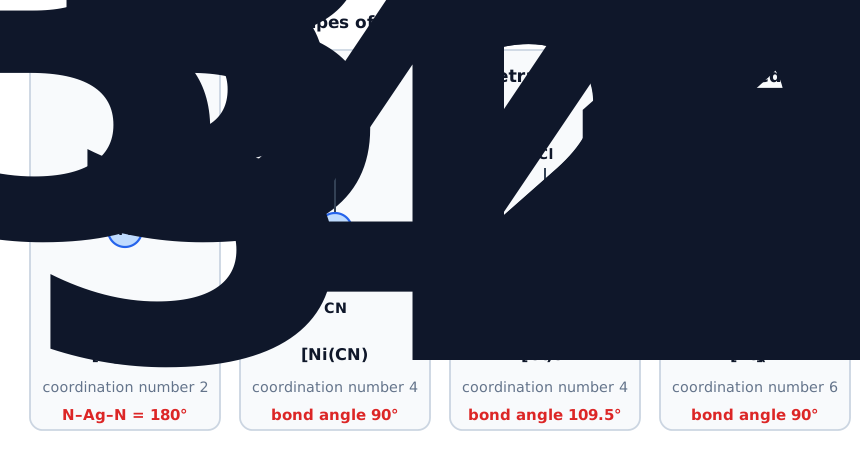
| 2 | linear | 180° | [Ag(NH3)2]+, [CuCl2]− |
| 4 | square planar | 90° | [Ni(CN)4]2−, cis-platin [Pt(NH3)2Cl2] |
| 4 | tetrahedral | 109.5° | [CoCl4]2−, [CuCl4]2− |
| 6 | octahedral | 90° | [Fe(H2O)6]2+, [Cu(NH3)4(H2O)2]2+, [Co(en)3]3+ |
Large ligands such as Cl− give four-coordinate (tetrahedral) complexes, because only four fit around the metal ion. Small ligands such as H2O and NH3 give six-coordinate (octahedral) complexes. Silver(I), copper(I) and gold(I) form linear complexes.
Worked example. In the complex ion [Ag(NH3)2]+, name the shape and state the bond angles at Ag and at N.
Two ligands, so linear, with N–Ag–N = 180°. Each nitrogen has three N–H bonds and the dative bond to silver (four electron pairs, no lone pair), so the bond angle H–N–Ag is about 109.5°.
6. Ligand Exchange: Copper(II) and Cobalt(II)
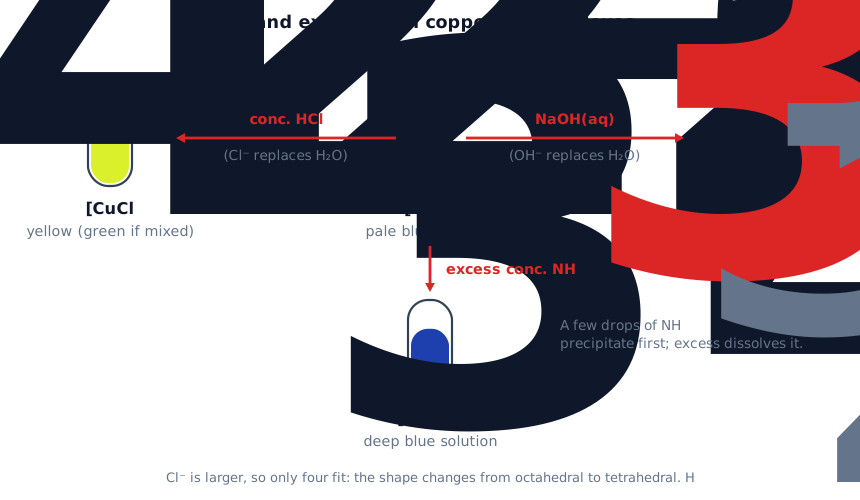
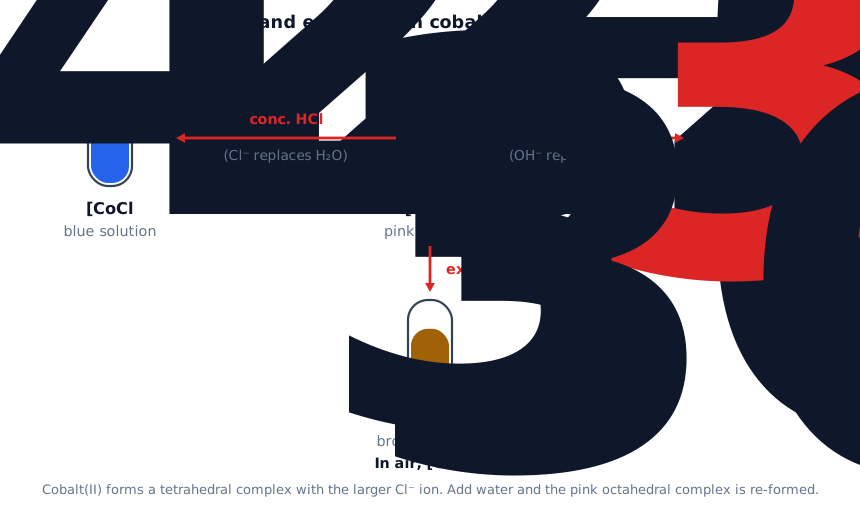
In ligand exchange (ligand substitution), one ligand in a complex is replaced by another. Whenever you write Cu2+(aq) or Co2+(aq), the ion is really the hexaaqua complex, [Cu(H2O)6]2+ or [Co(H2O)6]2+. Water, ammonia and hydroxide ions are similar in size, so substituting them does not change the coordination number. Chloride ions are larger, so only four fit, and the shape changes from octahedral to tetrahedral.
Copper(II)
| Reagent | Observation | Equation |
|---|---|---|
| NaOH(aq) | pale blue precipitate | [Cu(H2O)6]2+ + 2OH− → Cu(OH)2(H2O)4 + 2H2O |
| excess conc. NH3(aq) | precipitate dissolves; deep blue solution | [Cu(H2O)6]2+ + 4NH3 → [Cu(NH3)4(H2O)2]2+ + 4H2O |
| conc. HCl | yellow solution (green when both complexes are present) | [Cu(H2O)6]2+ + 4Cl− ⇄ [CuCl4]2− + 6H2O |
The hydroxide precipitate is also written Cu(OH)2(s). The precipitate dissolves in excess ammonia: Cu(OH)2(H2O)4 + 4NH3 → [Cu(NH3)4(H2O)2]2+ + 2OH− + 2H2O. Add water to the yellow chloro complex and the equilibrium shifts back to pale blue.
Cobalt(II)
| Reagent | Observation | Equation |
|---|---|---|
| NaOH(aq) | blue precipitate | [Co(H2O)6]2+ + 2OH− → Co(OH)2(H2O)4 + 2H2O |
| excess conc. NH3(aq) | brown solution; darkens in air as Co(II) is oxidised to Co(III) | [Co(H2O)6]2+ + 6NH3 → [Co(NH3)6]2+ + 6H2O |
| conc. HCl | blue solution | [Co(H2O)6]2+ + 4Cl− ⇄ [CoCl4]2− + 6H2O |
Blue anhydrous cobalt chloride paper (containing [CoCl4]2−) turns pink in the presence of water, as water ligands replace the chloride ligands: it is a test for water.
Worked example. Concentrated aqueous ammonia is added a little at a time to aqueous copper(II) sulfate until it is in excess. Describe and explain what you see.
At first a pale blue precipitate of Cu(OH)2(H2O)4 forms, because ammonia is a weak base and its hydroxide ions precipitate the hydroxide. With excess ammonia the precipitate dissolves to give a deep blue solution of [Cu(NH3)4(H2O)2]2+ by ligand exchange: four water ligands are replaced by four ammonia ligands.
7. Redox Reactions and Titrations
Predicting feasibility from E° values. A redox reaction is feasible when its standard cell potential is positive:
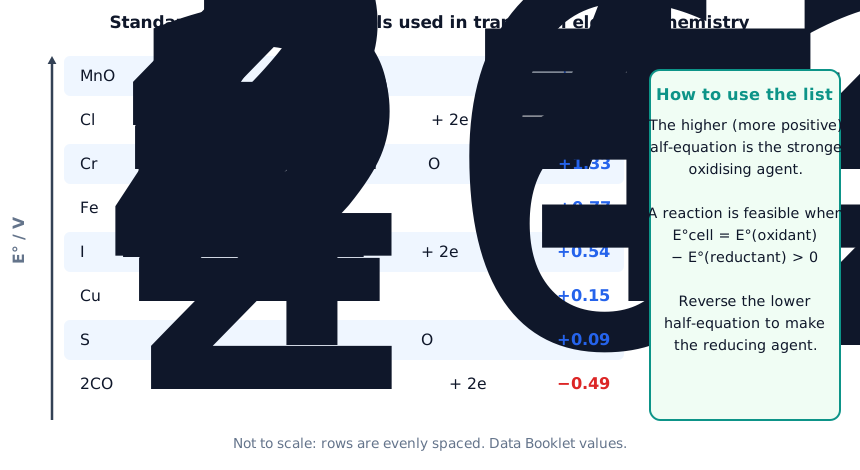
Worked example. Is the oxidation of Fe2+ by acidified dichromate(VI) feasible? Is the oxidation of Cl− by manganate(VII) feasible?
E°(Cr2O72−/Cr3+) = +1.33 V and E°(Fe3+/Fe2+) = +0.77 V, so E°cell = 1.33 − 0.77 = +0.56 V: feasible. E°(MnO4−/Mn2+) = +1.52 V and E°(Cl2/Cl−) = +1.36 V, so E°cell = 1.52 − 1.36 = +0.16 V: feasible. This is why manganate(VII) titrations are done in sulfuric acid: in hydrochloric acid, MnO4− would also oxidise Cl− to Cl2, so the titre would be too large.
A positive E°cell says the reaction is feasible, not that it is fast: a reaction with a large activation energy may not occur at a measurable rate.
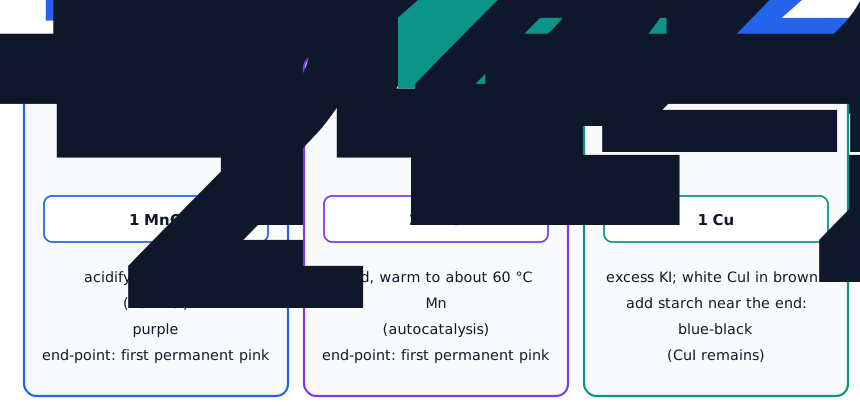
(a) MnO4− / Fe2+. MnO4− + 8H+ + 5e− → Mn2+ + 4H2O and Fe2+ → Fe3+ + e− give MnO4− + 8H+ + 5Fe2+ → Mn2+ + 4H2O + 5Fe3+. Potassium manganate(VII) (purple) goes in the burette. It acts as its own indicator: the end-point is the first permanent pink colour.
Worked example. 25.0 cm3 of an iron(II) solution needs 21.50 cm3 of 0.0200 mol dm−3 KMnO4. Calculate the concentration of Fe2+.
Moles MnO4− = 0.0200 × 21.50 ÷ 1000 = 4.30 × 10⁻⁴. Moles Fe2+ = 5 × 4.30 × 10−4 = 2.15 × 10⁻³. Concentration = 2.15 × 10⁻³ ÷ 0.0250 = 0.0860 mol dm−3.
(b) MnO4− / C2O42−. C2O42− → 2CO2 + 2e−. Multiply by 5 and the manganate half-equation by 2: 2MnO4− + 16H+ + 5C2O42− → 2Mn2+ + 8H2O + 10CO2. The solution is warmed (about 60 °C) because the reaction is slow at first. It is then autocatalysed by the Mn2+ ions that form: the colour fades slowly at the start, then quickly.
Worked example. 25.0 cm3 of sodium ethanedioate solution reacts with 20.00 cm3 of 0.0200 mol dm−3 KMnO4. Calculate the concentration of the ethanedioate.
Moles MnO4− = 0.0200 × 0.02000 = 4.00 × 10⁻⁴. Moles C2O42− = 4.00 × 10−4 × 5/2 = 1.00 × 10⁻³. Concentration = 1.00 × 10⁻³ ÷ 0.0250 = 0.0400 mol dm−3.
(c) Cu2+ / I− / S2O32−. Excess iodide reduces copper(II) to copper(I), forming a white precipitate of CuI, and iodine (brown): 2Cu2+ + 4I− → 2CuI + I2. The iodine is titrated with sodium thiosulfate: I2 + 2S2O32− → 2I− + S4O62−. Starch is added when the iodine colour has faded to pale yellow; the end-point is the loss of the blue-black colour. From the two equations, 2Cu2+ ≡ I2 ≡ 2S2O32−, so moles Cu2+ = moles S2O32−.
Worked example. 25.0 cm3 of copper(II) sulfate solution is added to excess potassium iodide. The iodine formed needs 18.60 cm3 of 0.100 mol dm−3 sodium thiosulfate. Calculate the concentration of the copper(II) sulfate.
Moles S2O32− = 0.100 × 0.01860 = 1.86 × 10−3 = moles Cu2+. Concentration = 1.86 × 10⁻³ ÷ 0.0250 = 0.0744 mol dm−3.
(d) Other redox systems. Any redox titration can be handled the same way: write the two half-equations, balance the electrons, find the mole ratio, then calculate. For example, dichromate(VI) oxidises iron(II): Cr2O72− + 14H+ + 6Fe2+ → 2Cr3+ + 7H2O + 6Fe3+, in the ratio 1 : 6, and it is orange → green. Dichromate needs an indicator for the end-point.
8. Why Complexes Are Coloured
White light contains all visible frequencies. A solution looks coloured when it absorbs part of the spectrum; the colour you see is the complementary colour of the light that is absorbed.
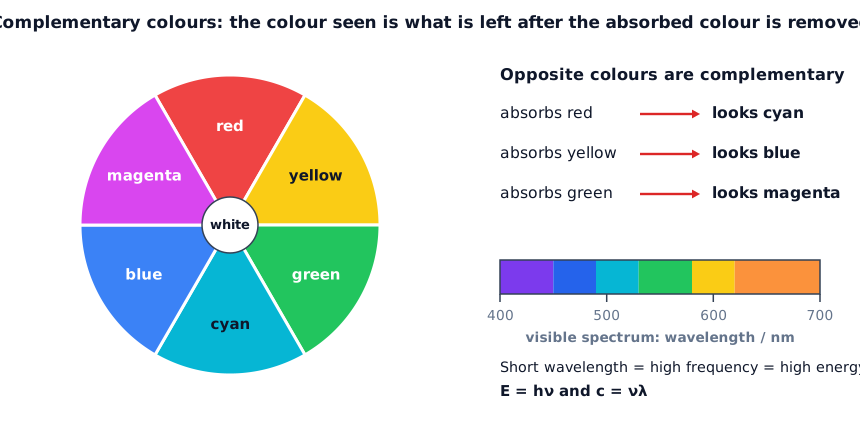
Degenerate and non-degenerate orbitals. In an isolated ion the five d orbitals have the same energy: they are degenerate. When ligands approach, their lone pairs repel the d electrons. The repulsion is not the same for every d orbital, so the d orbitals split into two sets of different energy: they are now non-degenerate.
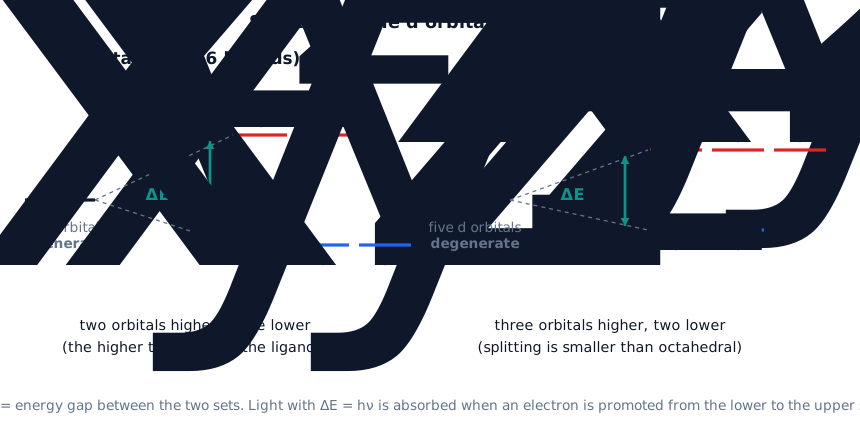
- Octahedral: the dx²−y² and dz² orbitals point towards the six ligands, so they are repelled more and are higher in energy; dxy, dxz and dyz point between the ligands and are lower.
- Tetrahedral: the reverse; dxy, dxz and dyz are nearer the ligands (higher), and dx²−y² and dz² are lower. The splitting is smaller than in octahedral complexes.
Origin of colour. An electron in the lower set absorbs light whose energy equals ΔE and is promoted to the upper set (a d–d transition). The frequency absorbed is given by ΔE = hν. The remaining light, which has had that frequency removed, is the colour seen.
Worked example. A complex absorbs light of wavelength 600 nm. Calculate ΔE in J and in kJ mol−1. (h = 6.63 × 10⁻³⁴ J s, c = 3.00 × 10⁸ m s−1, L = 6.022 × 10²³ mol−1.)
ν = c / λ = 3.00 × 10⁸ ÷ 6.00 × 10−7 = 5.00 × 10¹⁴ Hz. ΔE = 6.63 × 10−34 × 5.00 × 1014 = 3.32 × 10⁻¹⁹ J per ion. Per mole: 3.32 × 10−19 × 6.022 × 1023 = 2.00 × 10⁵ J = 200 kJ mol−1. Light of 600 nm is orange, so the complex looks blue.
Effect of the ligand (qualitative). The size of ΔE depends on the metal ion, its oxidation state and the ligands. Different ligands split the d orbitals by different amounts. A change in ΔE changes the frequency absorbed and so the complementary colour seen. For copper(II), the aqua complex [Cu(H2O)6]2+ is pale blue, but when four NH3 replace four H2O the splitting is larger and the solution is deep blue. A change of shape (octahedral to tetrahedral with Cl−) also changes ΔE, giving yellow [CuCl4]2−.

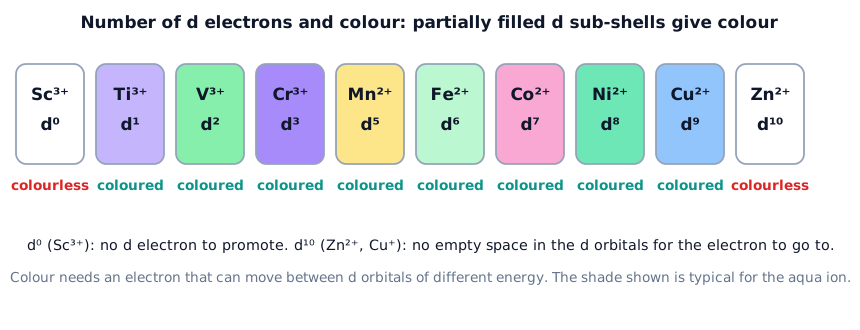
Why some compounds are colourless. Sc3+ (3d0) has no d electrons to promote, and Zn2+ and Cu+ (3d10) have no vacant place in the d orbitals for the electron to move to. Their compounds are colourless (or white).
9. Stereoisomerism and Stability Constants
These two topics are in the coursebook chapter and are examined in the 2023 and 2024 Paper 4 questions on complexes, although they are not listed among the 28.1–28.3 outcomes in the 2025–27 syllabus above. Treat this section as a useful extension.
Stereoisomerism. Complexes with the same formula can differ in the arrangement of ligands in space.
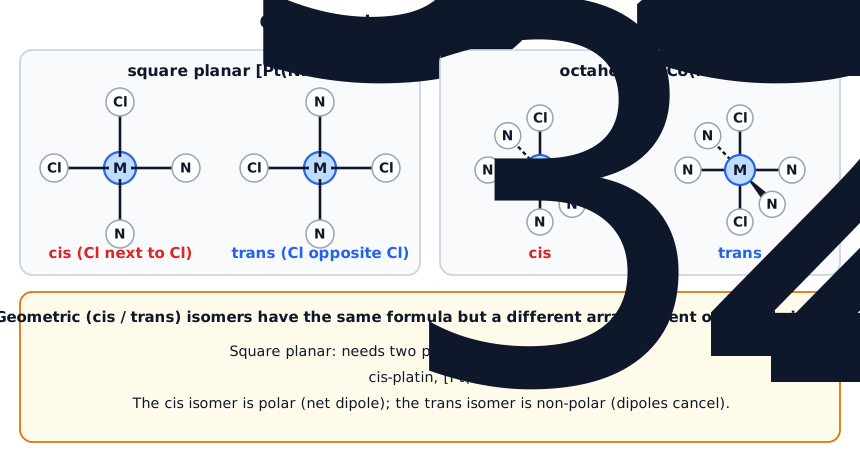
- Geometric (cis / trans) isomerism: in square planar [MA2B2] and octahedral [MA4B2] complexes, the two B ligands are either next to each other (cis) or opposite (trans).
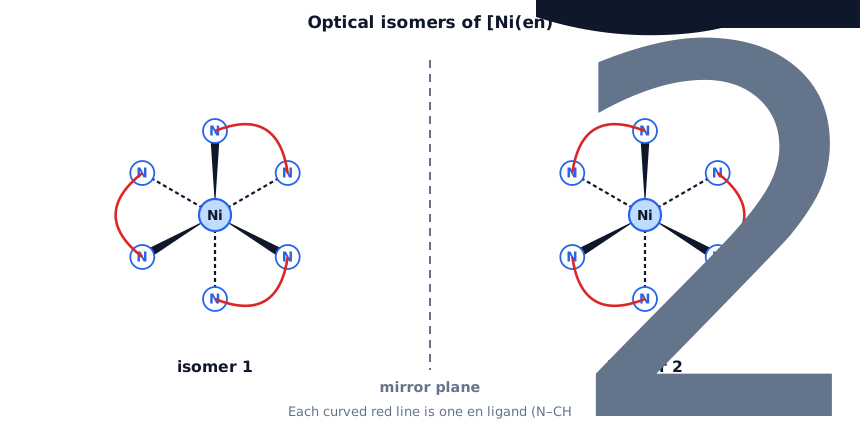
- Optical isomerism: octahedral complexes with bidentate ligands, such as [Ni(en)3]2+, exist as two non-superimposable mirror images. cis-[Ni(en)2(H2O)2]2+ is also optically active, but the trans isomer is not.
Stability constants. The stability constant, Kstab, of a complex ion is the equilibrium constant for the formation of the complex from the aqueous metal ion and the ligand(s). Water is left out of the expression because it is in large excess. For [Cu(H2O)6]2+ + 4NH3 ⇄ [Cu(NH3)4(H2O)2]2+ + 4H2O:
The larger the value of Kstab, the more stable the complex, so a ligand with a larger Kstab replaces one with a smaller value. For copper(II): log10Kstab is about 5.6 for Cl− and 13.1 for NH3, so ammonia displaces chloride from [CuCl4]2−. Chelating (bidentate and polydentate) ligands usually give much larger values than monodentate ones, because replacing several water ligands by one chelating ligand releases more molecules (an increase in entropy). That is why EDTA4− removes toxic metal ions from the body.
Worked example. The equilibrium [Fe(H2O)6]3+ + SCN− ⇄ [Fe(SCN)(H2O)5]2+ + H2O has equilibrium concentrations [Fe(H2O)6]3+ = 1.0 × 10⁻³, SCN− = 2.0 × 10⁻⁴ and complex = 3.0 × 10⁻⁴ mol dm−3. Calculate Kstab.
Kstab = 3.0 × 10⁻⁴ ÷ (1.0 × 10−3 × 2.0 × 10−4) = 1.5 × 10³ dm3 mol−1 (the units are 1 / concentration).
10. Quick Sheet and Checklist
| Topic | Statement to learn |
|---|---|
| transition element | d-block element which forms one or more stable ions with incomplete d orbitals; not Sc or Zn |
| ion configurations | 4s electrons lost first: Fe3+ = [Ar] 3d5, Cu2+ = [Ar] 3d9 |
| variable oxidation states | 3d and 4s similar in energy |
| catalysts | more than one stable oxidation state; vacant accessible d orbitals form dative bonds |
| ligand / complex / coordination number | lone pair donor; central ion + ligands; number of dative bonds |
| shapes | 2 linear 180°; 4 square planar 90° or tetrahedral 109.5°; 6 octahedral 90° |
| copper(II) | pale blue [Cu(H2O)6]2+; pale blue ppt; deep blue [Cu(NH3)4(H2O)2]2+; yellow [CuCl4]2− |
| cobalt(II) | pink [Co(H2O)6]2+; blue ppt; brown [Co(NH3)6]2+; blue [CoCl4]2− |
| feasibility | E°cell = E°(oxidant) − E°(reductant) > 0 |
| titration ratios | MnO4− : Fe2+ = 1 : 5; MnO4− : C2O42− = 2 : 5; Cu2+ : S2O32− = 1 : 1 |
| colour | split d orbitals; electron promoted; ΔE = hν; complementary colour seen |
| octahedral / tetrahedral splitting | 2 up, 3 down / 3 up, 2 down |
Checklist. Before the exam you should be able to:
- [ ] define a transition element and explain why scandium and zinc are not transition elements
- [ ] write the electronic configurations of the atoms and ions of Ti to Cu, including the Cr and Cu exceptions
- [ ] sketch 3dxy and 3dz² with labelled axes
- [ ] explain variable oxidation states, catalysis, complex formation and colour in terms of the 3d sub-shell
- [ ] define ligand, complex, coordination number, monodentate, bidentate and polydentate, with examples
- [ ] predict the formula and charge of a complex and give its shape and bond angle
- [ ] give the formulae, colours and equations for the ligand exchange of copper(II) and cobalt(II) with water, ammonia, hydroxide and chloride ions
- [ ] use E° values to decide whether a redox reaction is feasible
- [ ] write equations and do titration calculations for MnO4− with Fe2+ and C2O42−, and for Cu2+ with I− and S2O32−
- [ ] define degenerate and non-degenerate d orbitals and draw the splitting for octahedral and tetrahedral complexes
- [ ] explain why complexes are coloured, and how a change of ligand changes the colour
- [ ] draw cis / trans and optical isomers of simple complexes, and write a Kstab expression with its units