 Score
Reaction Kinetics (A Level)
0. What Examiners Want
This guide covers Topic 26 of Cambridge International AS & A Level Chemistry 9701 (2025–27) and follows the learning outcomes below, word for word. The right-hand column shows where each one is taught.
| 26.1 Simple rate equations, orders of reaction and rate constants. Candidates should be able to: | Section |
|---|---|
| 1 explain and use the terms rate equation, order of reaction, overall order of reaction, rate constant, half-life, rate-determining step and intermediate | 1, 2, 6 |
| 2 (a) understand and use rate equations of the form rate = k [A]m[B]n (for which m and n are 0, 1 or 2) (b) deduce the order of a reaction from concentration–time graphs or from experimental data relating to the initial rates method and half-life method (c) interpret experimental data in graphical form, including concentration–time and rate–concentration graphs (d) calculate an initial rate using concentration data (e) construct a rate equation | 2, 3 |
| 3 (a) show understanding that the half-life of a first-order reaction is independent of concentration (b) use the half-life of a first-order reaction in calculations | 3, 4 |
| 4 calculate the numerical value of a rate constant, for example by: (a) using the initial rates and the rate equation (b) using the half-life, t½, and the equation k = 0.693 / t½ | 4 |
| 5 for a multi-step reaction: (a) suggest a reaction mechanism that is consistent with the rate equation and the equation for the overall reaction (b) predict the order that would result from a given reaction mechanism and rate-determining step (c) deduce a rate equation using a given reaction mechanism and rate-determining step for a given reaction (d) identify an intermediate or catalyst from a given reaction mechanism (e) identify the rate determining step from a rate equation and a given reaction mechanism | 6 |
| 6 describe qualitatively the effect of temperature change on the rate constant and hence the rate of a reaction | 5 |
| 26.2 Homogeneous and heterogeneous catalysts. Candidates should be able to: | Section |
|---|---|
| 1 explain that catalysts can be homogeneous or heterogeneous | 7 |
| 2 describe the mode of action of a heterogeneous catalyst to include adsorption of reactants, bond weakening and desorption of products, for example: (a) iron in the Haber process (b) palladium, platinum and rhodium in the catalytic removal of oxides of nitrogen from the exhaust gases of car engines | 7 |
| 3 describe the mode of action of a homogeneous catalyst by being used in one step and reformed in a later step, for example: (a) atmospheric oxides of nitrogen in the oxidation of atmospheric sulfur dioxide (b) Fe2+ or Fe3+ in the I–/S2O82– reaction | 7 |
- Definitions: order of reaction, rate constant, half-life, rate-determining step, intermediate and catalyst, each in exact words.
- Order from data: the comparison written out (‘[A] doubled, rate doubled, so first order in A’), not just the answer.
- Rate equation and k: rate equation, substitution, numerical value and units worked out.
- Graphs: reading half-lives, drawing tangents, and sketching the three orders on rate–concentration and concentration–time axes.
- Mechanisms: a rate-determining step that gives the rate equation, steps that add up to the overall equation, and naming intermediates and catalysts.
- Catalysis: adsorption, bond weakening, desorption for heterogeneous; two equations showing the catalyst used then re-formed for homogeneous.
1. Rate of Reaction and the Rate Equation
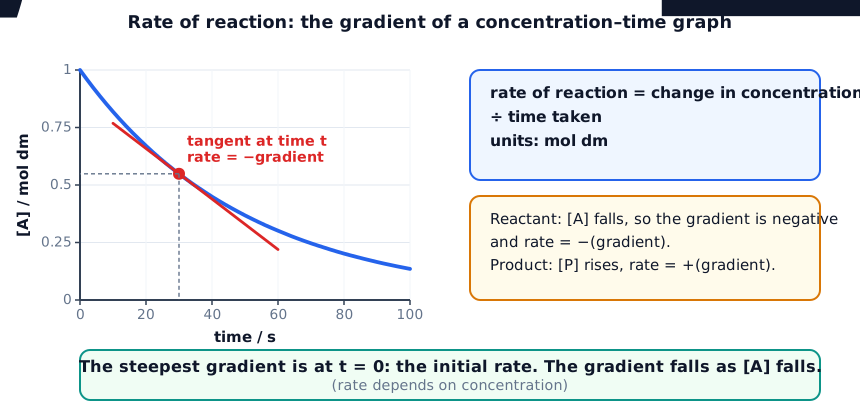
Rate of reaction is the change in concentration of a reactant or product per unit time. Its units are normally mol dm−3 s−1. On a concentration–time graph the rate at any moment is the gradient of the tangent (negative for a reactant, so rate = −gradient). The gradient at t = 0 is the initial rate.
Rate equation. An experimentally determined expression linking the rate of reaction to the concentrations of the reactants (and sometimes catalysts), each raised to a power:
Rate constant, k. The proportionality constant in the rate equation. It has a fixed value for a given reaction at a given temperature, and it changes only when the temperature changes (or when a catalyst is used).
| Reaction | Experimental rate equation |
|---|---|
| H2(g) + I2(g) → 2HI(g) | rate = k[H2][I2] |
| 2H2(g) + 2NO(g) → 2H2O(g) + N2(g) | rate = k[H2][NO]2 |
| NO(g) + CO(g) + O2(g) → NO2(g) + CO2(g) | rate = k[NO]2 |
| CH3COCH3 + I2 → CH3COCH2I + HI | rate = k[CH3COCH3][H+] (no I2, but H+ is in it) |
Two lessons from the table: a reactant may not appear in the rate equation at all, and a substance that is not a reactant (here the H+ catalyst) may appear in it.
2. Order of Reaction and Units of k
Order of reaction with respect to a reactant. The power to which the concentration of that reactant is raised in the rate equation. The overall order is the sum of the individual orders.
For rate = k[H2][NO]2: first order with respect to H2, second order with respect to NO, third order overall (1 + 2). A zero-order reactant does not appear, because [A]0 = 1.
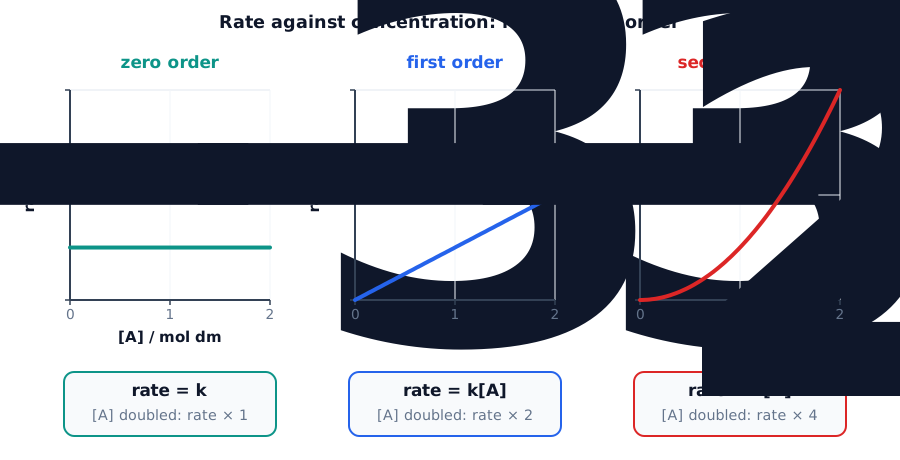
Effect of changing a concentration. If a concentration is multiplied by a factor f, the rate is multiplied by forder. With rate = k[A]2[B], doubling [A] and halving [B] multiplies the rate by 22 × ½ = 2.
Units of k. Rearrange the rate equation for k, substitute the units (rate in mol dm−3 s−1, concentrations in mol dm−3) and cancel.

Worked example. Units of k for rate = k[H2][NO]2: k = rate ÷ ([H2][NO]2) = mol dm−3 s−1 ÷ (mol dm−3)3 = mol−2 dm6 s−1 = dm6 mol−2 s−1.
3. Finding the Order from Data
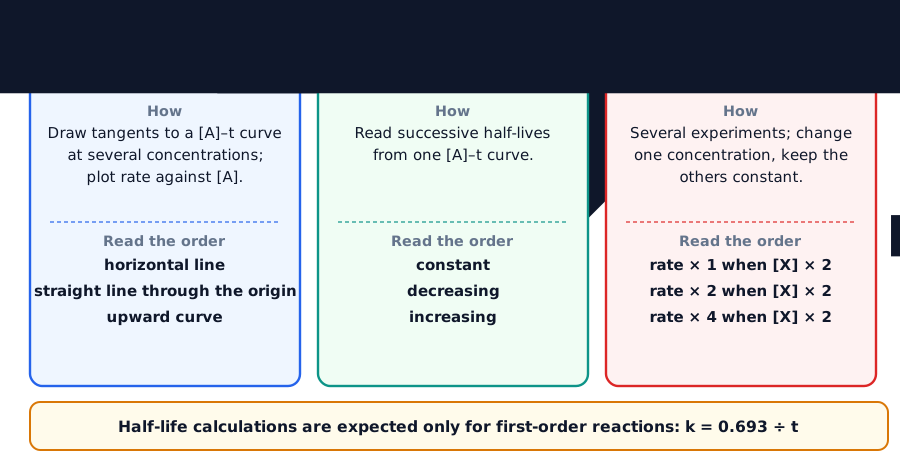
Method 1: concentration–time graphs. The shape shows the order.

To turn a concentration–time curve into a rate–concentration graph, draw tangents at several concentrations, take the gradient of each (rate = −gradient) and plot rate against concentration. The shape of that graph gives the order (previous figure).
Method 2: half-lives. The half-life, t½, is the time for the concentration of a limiting reactant to fall to half its value. Read successive half-lives from one concentration–time curve.
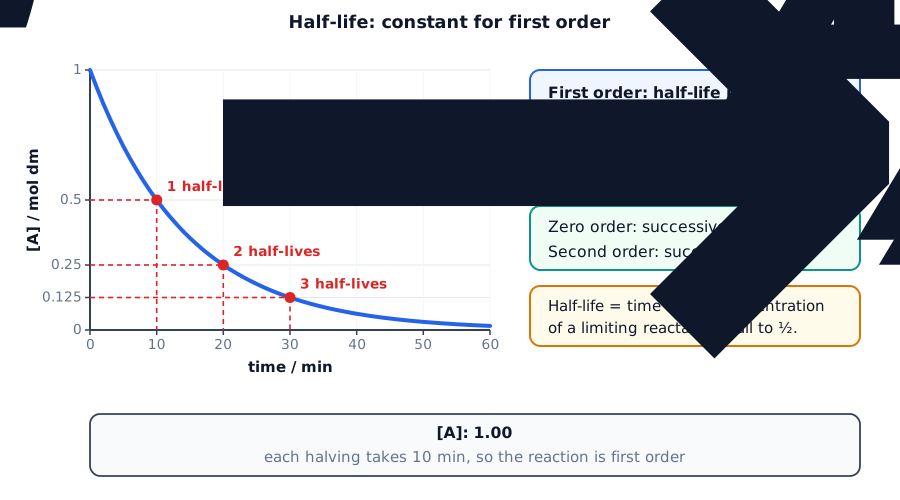
- Constant successive half-lives: first order. (This is how we know the half-life of a first-order reaction is independent of concentration.)
- Half-lives that decrease: zero order. Half-lives that increase: second order.
Worked example 1 (half-life method). The concentration of X is 1.00, 0.50 and 0.25 mol dm−3 at 0, 10 and 20 min. The first half-life is 10 min and the second is 10 min. They are equal, so the reaction is first order with respect to X.
Method 3: initial rates. Do several experiments, varying one concentration at a time, and measure the initial rate of each. For each reactant, compare two experiments in which only that concentration changes.

Worked example 2. For the reaction P + Q + R → products:
| Experiment | [P] / mol dm−3 | [Q] / mol dm−3 | [R] / mol dm−3 | Initial rate / mol dm−3 s−1 |
|---|---|---|---|---|
| 1 | 0.10 | 0.10 | 0.10 | 1.5 × 10⁻⁴ |
| 2 | 0.20 | 0.10 | 0.10 | 3.0 × 10⁻⁴ |
| 3 | 0.10 | 0.20 | 0.10 | 6.0 × 10⁻⁴ |
| 4 | 0.10 | 0.10 | 0.20 | 1.5 × 10⁻⁴ |
- Exp 1 → 2: [P] ×2, rate ×2: first order in P.
- Exp 1 → 3: [Q] ×2, rate ×4: second order in Q.
- Exp 1 → 4: [R] ×2, rate unchanged: zero order in R.
- Rate equation: rate = k[P][Q]2; overall order 3.
- k = 1.5 × 10⁻⁴ ÷ (0.10 × 0.102) = 0.15 dm6 mol−2 s−1.
When the question is on real data the ratios will not be exact (a ratio of 1.9 or 2.1 means ×2, and 3.9 means ×4), so round to the nearest whole number. If two concentrations change together, you must use the rate equation in a combined form: for example if [P] ×2 and [Q] ×2, the rate changes by 2 × 4 = 8.
Worked example 3 (calculating an initial rate). Using the rate equation above with k = 0.15: the initial rate at [P] = 0.30, [Q] = 0.050 and [R] = 0.40 is 0.15 × 0.30 × (0.050)2 = 1.1 × 10⁻⁴ mol dm−3 s−1. [R] is zero order, so its value is ignored.
4. Calculating k and Half-life
k from initial rates. Rearrange the rate equation and substitute any one experiment. Keep the units.
Worked example 1. For rate = k[CH3COCH3][H+] a mixture with [CH3COCH3] = 0.0200 mol dm−3 and [H+] = 0.100 mol dm−3 has an initial rate of 4.0 × 10⁻⁶ mol dm−3 s−1. Then k = 4.0 × 10⁻⁶ ÷ (0.0200 × 0.100) = 2.0 × 10⁻³ dm3 mol−1 s−1. (The I2 concentration is not needed: the reaction is zero order in iodine.)
First-order half-life. For a first-order reaction
Worked example 2. The isomerisation of cyclopropane to propene is first order with a half-life of 17.0 min. Convert to seconds: 17.0 × 60 = 1020 s. k = 0.693 ÷ 1020 = 6.79 × 10⁻⁴ s−1.
Worked example 3. A first-order reaction has k = 9.63 × 10⁻⁵ s−1. t½ = 0.693 ÷ 9.63 × 10−5 = 7.20 × 10³ s (2.00 hours).
Worked example 4 (rate from a half-life). A first-order reaction of X has t½ = 480 s. Find k and the rate when [X] = 0.250 mol dm−3.
- k = 0.693 ÷ 480 = 1.44 × 10⁻³ s−1
- rate = k[X] = 1.44 × 10−3 × 0.250 = 3.6 × 10⁻⁴ mol dm−3 s−1
- The concentration falls to ⅛ of its starting value after 3 half-lives (3 × 480 = 1440 s).
Worked example 5 (from a graph). A concentration–time graph shows 0.80 mol dm−3 falling to 0.40 in 10.0 min and to 0.20 in a further 10.0 min. Equal half-lives mean first order. k = 0.693 ÷ 600 = 1.16 × 10⁻³ s−1, and the initial rate = 1.16 × 10−3 × 0.80 = 9.2 × 10⁻⁴ mol dm−3 s−1.
5. Effect of Temperature on k
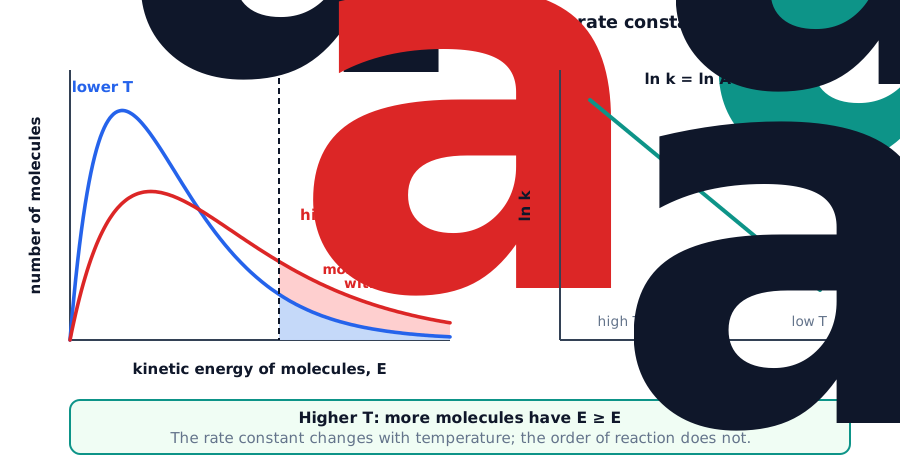
Rate = k[A]m[B]n: when the temperature rises the concentrations do not change, so the rate rises because k increases. The reason is the Boltzmann distribution: at a higher temperature a larger fraction of the molecules has energy equal to or greater than the activation energy, Ea, so a larger fraction of collisions is successful. For many reactions near room temperature k, and so the rate, roughly doubles for every 10 °C rise.
- Raising the temperature increases k; lowering it decreases k.
- The order of reaction does not change with temperature. Neither does the form of the rate equation.
- A catalyst also increases k, by providing a pathway with a lower Ea; it can change the rate equation (for example, the decomposition of HI is second order when uncatalysed but zero order on the surface of hot gold).
6. Mechanisms and the Rate-determining Step
Many reactions take place in several steps, called the reaction mechanism. The steps proceed at different rates.
- Rate-determining step. The slowest step in a reaction mechanism: it determines the overall rate. It has the highest activation energy.
- Intermediate. A species formed in one step and used up in a later step. It does not appear in the overall equation. On an energy profile it lies in a valley between two transition states.
- Catalyst. Used in one step and re-formed in a later step. It also does not appear in the overall equation.
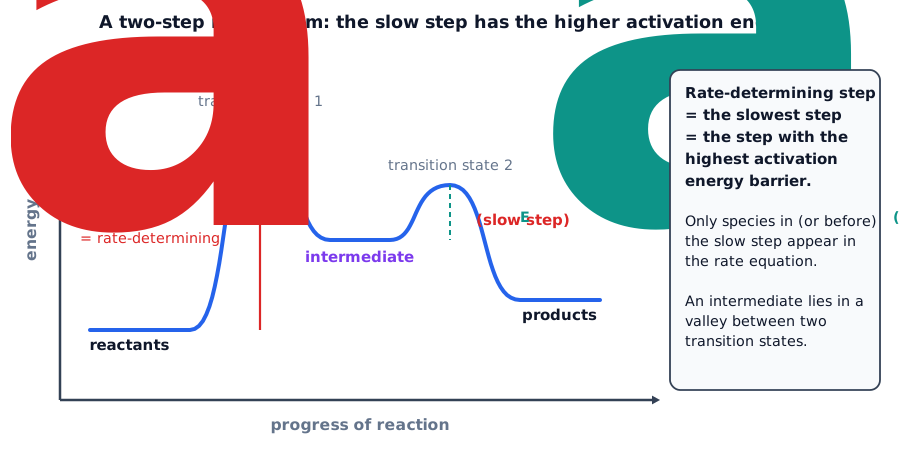
Linking the rate equation to the mechanism. The orders in the rate equation tell you which species are in the rate-determining step (or in steps before it):
- A reactant that appears in the rate equation is in the slow step (or is used to make an intermediate that is). The order is the number of particles of it involved.
- A reactant not in the rate equation reacts after the slow step (in a fast step).
- One particle in the slow step is called unimolecular (first order); two is bimolecular. Three-particle steps are very rare because three-body collisions are improbable.
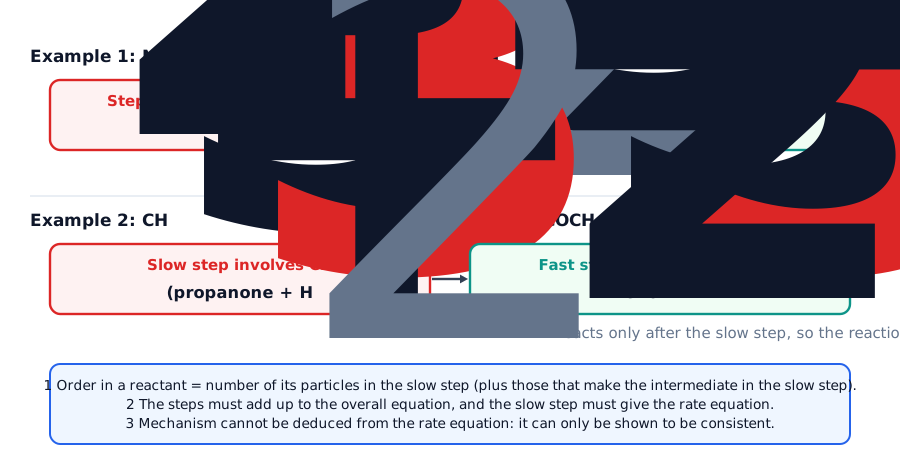
Worked example 1 (predicting the rate equation). For 2NO + Br2 → 2NOBr a proposed mechanism is: step 1 (slow) NO + Br2 → NOBr2; step 2 (fast) NOBr2 + NO → 2NOBr. The slow step involves one NO and one Br2, so rate = k[NO][Br2]. NOBr2 is an intermediate. The two steps add up to the overall equation.
Worked example 2 (an intermediate in the slow step). For H2O2 + 2H+ + 2I− → 2H2O + I2 the rate equation is rate = k[H2O2][I−]. The mechanism H2O2 + I− → H2O + IO− (slow); IO− + H+ → HIO (fast); HIO + H+ + I− → I2 + H2O (fast) is consistent: the slow step contains H2O2 and I− only, and H+ reacts after it. IO− and HIO are intermediates.
Worked example 3 (suggesting a mechanism). The reaction 2A + B → C + D has the rate equation rate = k[A]2. A consistent mechanism is: step 1 (slow) 2A → X; step 2 (fast) X + B → C + D. The slow step contains two A and no B, so rate = k[A]2; the steps add to 2A + B → C + D; X is an intermediate. Whatever you suggest, check both things: the slow step gives the rate equation, and the steps add up to the overall equation.
Link to organic chemistry. The nucleophilic substitutions of halogenoalkanes (Topic 15) show the same idea. For a tertiary halogenoalkane, rate = k[RX]: the slow step is the ionisation of RX alone (SN1, unimolecular). For a primary halogenoalkane, rate = k[RX][OH−]: the slow step involves both (SN2, bimolecular).
7. Homogeneous and Heterogeneous Catalysis
A catalyst increases the rate of a reaction by providing an alternative pathway with a lower activation energy. It is not used up overall.
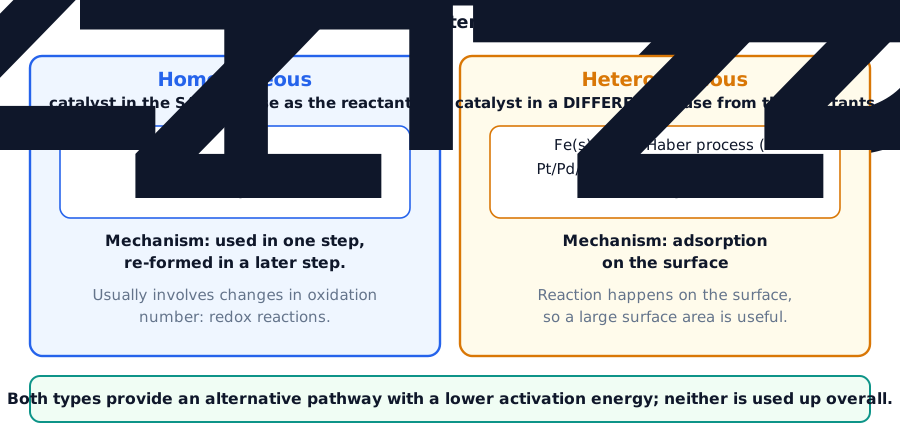
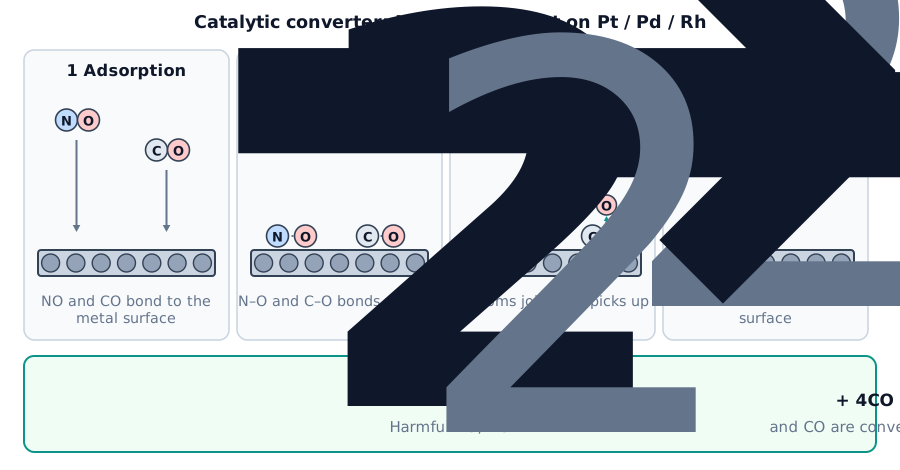
Heterogeneous catalysis: adsorption, reaction, desorption. Gaseous reactants meet at the surface of a solid catalyst. Transition metals are good at this because they have partially filled d orbitals and can form bonds to the reactants.
- The reactants diffuse to the surface and are adsorbed (chemisorbed): they form bonds to atoms in the metal surface.
- These bonds weaken the bonds within the reactant molecules, and hold the reactants close together.
- The adsorbed atoms/molecules react on the surface.
- The product bonds to the surface weaken and the products are desorbed.
The bonds to the surface must be strong enough to weaken the bonds in the reactants, but weak enough to be broken to release the products. (Adsorb means bond to the surface; absorb means soak into the bulk.)

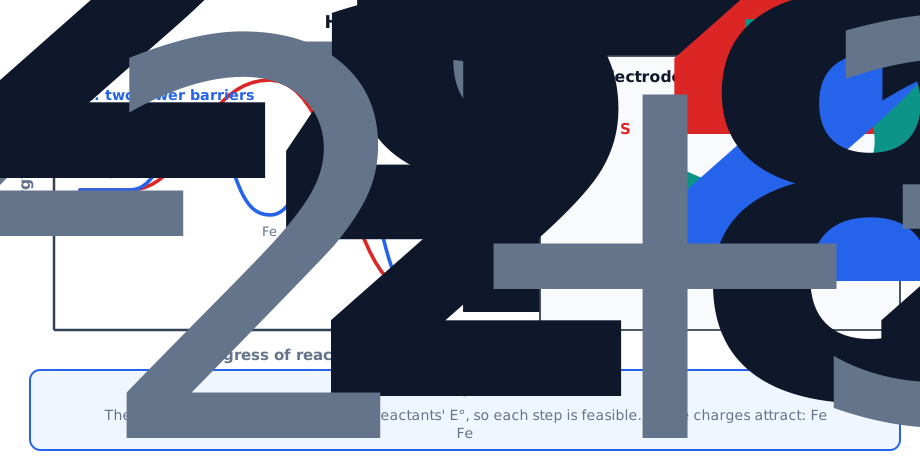
Homogeneous catalysis: used in one step, re-formed in a later step. The catalyst reacts to give an intermediate and is then regenerated. Many examples are redox reactions in which the catalyst (often a transition-metal ion) changes oxidation number and changes back.
(a) Fe2+ or Fe3+ in the S2O82− + I− reaction. The uncatalysed reaction S2O82− + 2I− → 2SO42− + I2 is slow, because two negative ions must collide. With Fe3+:
- 2Fe3+ + 2I− → 2Fe2+ + I2 (Fe3+ is reduced)
- 2Fe2+ + S2O82− → 2Fe3+ + 2SO42− (Fe2+ is oxidised: the catalyst is re-formed)
The two steps can happen in either order, so both Fe2+ and Fe3+ catalyse the reaction. Each step involves ions of opposite charge, which attract, so the activation energy of each step is lower. The catalysis is possible because E°(Fe3+/Fe2+) = +0.77 V lies between E°(I2/I−) = +0.54 V and E°(S2O82−/SO42−) = +2.01 V, so both steps have a positive E°cell.
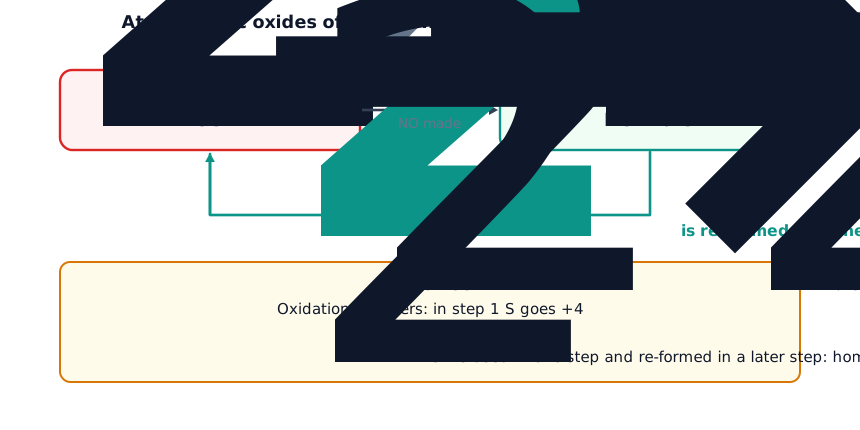
(b) Atmospheric oxides of nitrogen in the oxidation of SO2. Sulfur dioxide from burning fossil fuels is oxidised to SO3, which forms sulfuric acid in acid rain. NO2 catalyses this oxidation:
- SO2 + NO2 → SO3 + NO
- NO + ½O2 → NO2 (the catalyst is re-formed)
Another example. I− catalyses the decomposition of hydrogen peroxide: H2O2 + I− → H2O + IO−, then H2O2 + IO− → H2O + O2 + I−. The catalyst I− is re-formed; IO− is the intermediate.
8. Quick Sheet and Checklist
| Quantity | Statement to learn |
|---|---|
| Rate equation | rate = k[A]m[B]n; from experiment only |
| Order | power of a concentration in the rate equation; overall order = sum |
| Rate × concentration factor | ×f in concentration gives ×forder in rate |
| Units of k | worked out: s−1 (first), dm3 mol−1 s−1 (second), dm6 mol−2 s−1 (third) |
| Half-life | constant for first order; k = 0.693 / t½ |
| Temperature | greater fraction with E ≥ Ea, so k increases |
| Rate-determining step | slowest step; highest activation energy; species in it appear in the rate equation |
| Intermediate / catalyst | intermediate: made then used; catalyst: used then re-formed |
| Heterogeneous catalysis | adsorption, bond weakening, reaction, desorption |
| Homogeneous catalysis | used in one step, re-formed in a later step |
Checklist. Before the exam you should be able to:
- [ ] define rate of reaction, rate equation, order, overall order, rate constant, half-life, rate-determining step and intermediate
- [ ] write a rate equation from orders and state the order with respect to each reactant and overall
- [ ] work out the units of k for any rate equation
- [ ] deduce orders from a concentration–time graph, from successive half-lives and from an initial-rates table
- [ ] sketch rate–concentration and concentration–time graphs for zero, first and second order
- [ ] calculate an initial rate, k from initial rates, and k and t½ for a first-order reaction
- [ ] explain qualitatively why k increases with temperature
- [ ] deduce the rate equation from a mechanism and decide whether a mechanism is consistent with a rate equation
- [ ] identify the rate-determining step, an intermediate and a catalyst from a mechanism or an energy profile
- [ ] describe heterogeneous catalysis (Fe in the Haber process, Pt/Pd/Rh in catalytic converters) and homogeneous catalysis (NO2 with SO2; Fe2+/Fe3+ with I−/S2O82−)