 Score
Equilibria (A Level)
0. What Examiners Want
This guide covers Topic 25 of Cambridge International AS & A Level Chemistry 9701 (2025–27) and follows the learning outcomes below, word for word. The right-hand column shows where each one is taught.
| 25.1 Acids and bases. Candidates should be able to: | Section |
|---|---|
| 1 understand and use the terms conjugate acid and conjugate base | 1 |
| 2 define conjugate acid–base pairs, identifying such pairs in reactions | 1 |
| 3 define mathematically the terms pH, Ka, pKa and Kw and use them in calculations (Kb and the equation Kw = Ka × Kb will not be tested) | 1, 2, 3 |
| 4 calculate [H+(aq)] and pH values for: (a) strong acids (b) strong alkalis (c) weak acids | 2, 3 |
| 5 (a) define a buffer solution (b) explain how a buffer solution can be made (c) explain how buffer solutions control pH; use chemical equations in these explanations (d) describe and explain the uses of buffer solutions, including the role of HCO3– in controlling pH in blood | 4 |
| 6 calculate the pH of buffer solutions, given appropriate data | 5 |
| 7 understand and use the term solubility product, Ksp | 6 |
| 8 write an expression for Ksp | 6 |
| 9 calculate Ksp from concentrations and vice versa | 6 |
| 10 (a) understand and use the common ion effect to explain the different solubility of a compound in a solution containing a common ion (b) perform calculations using Ksp values and concentration of a common ion | 7 |
| 25.2 Partition coefficients. Candidates should be able to: | Section |
|---|---|
| 1 state what is meant by the term partition coefficient, Kpc | 8 |
| 2 calculate and use a partition coefficient for a system in which the solute is in the same physical state in the two solvents | 8 |
| 3 understand the factors affecting the numerical value of a partition coefficient in terms of the polarities of the solute and the solvents used | 8 |
- Definitions and expressions: pH, Kw, Ka, Ksp, Kpc and ‘buffer solution’ written exactly, with the expression for Ka or Ksp written from the balanced equation.
- pH calculations: four separate methods (strong acid, strong alkali, weak acid, buffer). Marks go for choosing the method, for each substitution, and for the final value to the right number of decimal places.
- Buffer explanations: two equations, one for added acid and one for added alkali, and the words ‘ratio of acid to conjugate base changes little’.
- Solubility calculations: Ksp from solubility and solubility from Ksp, with units, and effects of a common ion.
- Partition: calculating the mass extracted into a solvent or a Kpc value, and explaining its size in terms of polarity and intermolecular forces.
1. Conjugate Pairs, Kw and pH
At AS you used the Brønsted–Lowry definitions: an acid is a proton (H+) donor and a base is a proton acceptor. When an acid gives away its proton, what is left can take a proton back, so it is a base. The two species are linked by the transfer of one proton.
Conjugate acid–base pair. An acid and the base formed when the acid loses a proton (or, equivalently, a base and the acid formed when it gains a proton). The acid has one more H+ than its conjugate base.

| Acid | Conjugate base | Equation (acid 1 + base 2) |
|---|---|---|
| HCl | Cl− | HCl + H2O ⇌ Cl− + H3O+ |
| CH3COOH | CH3COO− | CH3COOH + H2O ⇌ CH3COO− + H3O+ |
| NH4+ | NH3 | NH4+ + H2O ⇌ NH3 + H3O+ |
| H2O | OH− | NH3 + H2O ⇌ NH4+ + OH− (water is the acid) |
| H2CO3 | HCO3− | HCO3− is itself the acid of the pair HCO3− / CO32− |
Water can act as an acid or a base. Some ions, such as HCO3− and HC2O4−, can do both, so they belong to two different pairs. The conjugate acid of a strong base is very weak, and the conjugate base of a strong acid (such as Cl−) is too weak to accept a proton in water.
The ionic product of water, Kw. Water ionises very slightly: H2O(l) ⇌ H+(aq) + OH−(aq). Because [H2O] is effectively constant it is included in the constant:
Kw = [H+][OH−] = 1.00 × 10⁻¹⁴ mol2 dm−6 at 298 K
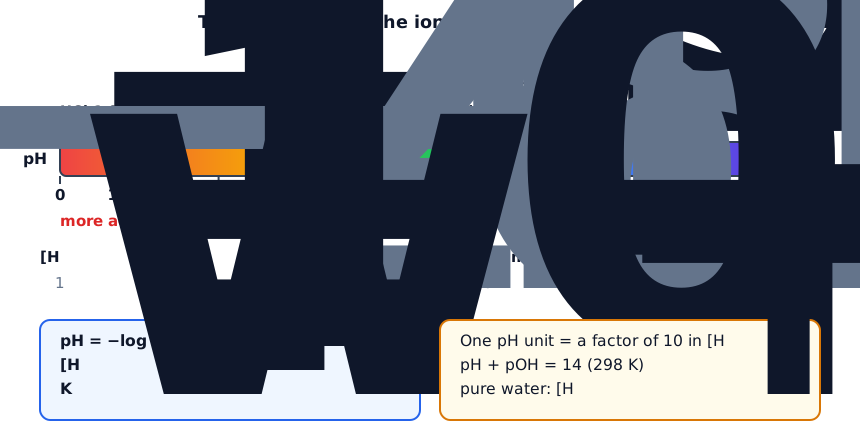
In pure water [H+] = [OH−] = √(1.00 × 10⁻¹⁴) = 1.00 × 10⁻⁷ mol dm−3. This is the neutral solution at 298 K.
pH. pH is the negative logarithm (base 10) of the hydrogen ion concentration:
pH = −log10[H+] and [H+] = 10−pH
The same ‘p’ notation applies to the other constants: pKa = −log10 Ka, and so Ka = 10−pKa. Each pH unit is a factor of 10 in [H+].
2. pH of Strong Acids and Alkalis
A strong acid or strong alkali is completely ionised in water, so [H+] or [OH−] is found directly from the concentration. The H+ from the ionisation of water is negligible next to the H+ from the acid and is ignored.
Strong acid (monobasic). [H+] = concentration of the acid.
Worked example 1. Calculate the pH of 0.0250 mol dm−3 HCl. [H+] = 0.0250 mol dm−3; pH = −log(0.0250) = 1.60.
Worked example 2. A 10.0 cm3 sample of 0.100 mol dm−3 HCl is diluted to 1.00 dm3. [H+] = 0.100 × 10.0 / 1000 = 1.00 × 10⁻³ mol dm−3, so pH = 3.00. A 100-fold dilution raises the pH by 2.
Strong alkali. [OH−] = concentration × (number of OH− in the formula). Then [H+] = Kw / [OH−].
Worked example 3. Calculate the pH of 0.0500 mol dm−3 NaOH (Kw = 1.00 × 10⁻¹⁴ mol2 dm−6).
- [OH−] = 0.0500 mol dm−3
- [H+] = 1.00 × 10⁻¹⁴ ÷ 0.0500 = 2.00 × 10⁻¹³ mol dm−3
- pH = −log(2.00 × 10⁻¹³) = 12.70
Short cut. pOH = −log[OH−] = 1.30, and pH = 14.00 − 1.30 = 12.70, because pH + pOH = 14 at 298 K. Use this only when the question says 298 K or gives Kw = 1.00 × 10⁻¹⁴.
Worked example 4 (a strong base with two OH−). 0.0100 mol dm−3 Ba(OH)2 gives [OH−] = 2 × 0.0100 = 0.0200 mol dm−3, so pOH = 1.70 and pH = 12.30.
Worked example 5 (from pH to mass). What mass of Ba(OH)2 is needed to make 100.0 cm3 of solution of pH 12.80? [Mr = 171.3]
- [H+] = 10−12.80 = 1.585 × 10⁻¹³ mol dm−3
- [OH−] = 1.00 × 10⁻¹⁴ ÷ 1.585 × 10−13 = 0.0631 mol dm−3
- [Ba(OH)2] = 0.0631 ÷ 2 = 0.03155 mol dm−3
- moles = 0.03155 × 0.1000 = 3.155 × 10⁻³ mol; mass = 3.155 × 10−3 × 171.3 = 0.540 g
3. Weak Acids: Ka and pKa
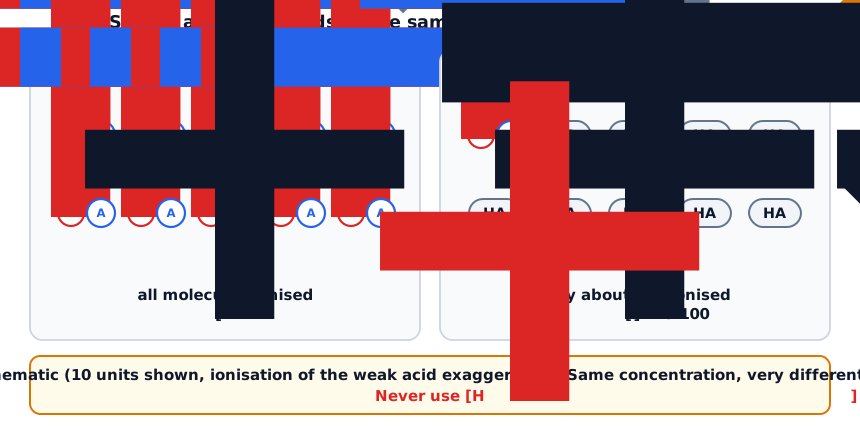
A weak acid is only partly ionised. For a monobasic acid HA the equilibrium is HA(aq) ⇌ H+(aq) + A−(aq), and the equilibrium law gives the acid dissociation constant:
Ka = [H+][A−] / [HA] units: mol dm−3 pKa = −log10 Ka
A large Ka (small pKa) means a stronger acid. Write the expression from the balanced equation for the specific acid, for example for butanoic acid Ka = [CH3CH2CH2COO−][H+] / [CH3CH2CH2COOH].

The two assumptions. For a solution of a weak acid HA of concentration c:
- The H+ from the ionisation of water is negligible, so [H+] = [A−].
- The acid is so slightly ionised that [HA]equilibrium ≈ c, the starting concentration.
Then Ka = [H+]2 / c, which gives three calculation types.
Worked example 1: pH from Ka. Calculate the pH of 0.100 mol dm−3 ethanoic acid (Ka = 1.74 × 10⁻⁵ mol dm−3).
- [H+]2 = Ka × c = 1.74 × 10−5 × 0.100 = 1.74 × 10⁻⁶
- [H+] = 1.32 × 10⁻³ mol dm−3
- pH = 2.88
Worked example 2: Ka from pH. A 0.0100 mol dm−3 solution of methanoic acid has pH 2.90.
- [H+] = 10−2.90 = 1.26 × 10⁻³ mol dm−3
- Ka = (1.26 × 10⁻³)2 / 0.0100 = 1.59 × 10⁻⁴ mol dm−3; pKa = 3.80
Worked example 3: concentration from pH and pKa. A solution of benzoic acid (pKa = 4.20) has pH 2.85. Find its concentration.
- Ka = 10−4.20 = 6.31 × 10⁻⁵ mol dm−3; [H+] = 10−2.85 = 1.41 × 10⁻³ mol dm−3
- [HA] = [H+]2 / Ka = (1.41 × 10⁻³)2 / 6.31 × 10−5 = 0.0316 mol dm−3
- Check: the acid is about 4.5 % ionised (1.41 × 10⁻³ / 0.0316), so the approximation [HA] ≈ c is reasonable.
4. Buffer Solutions
Buffer solution. A solution that resists changes in pH when small amounts of acid or alkali are added. It contains a weak acid and its conjugate base (a weak base and its conjugate acid also works).
Ways to make an acidic buffer (the same ideas apply to basic buffers):
- Mix a weak acid with a salt of the weak acid, for example CH3COOH with CH3COONa. The salt supplies the conjugate base.
- Add a limited amount of strong alkali to an excess of the weak acid. This converts part of the acid to its conjugate base: CH3COOH + OH− → CH3COO− + H2O. The acid must be in excess.
- For an alkaline buffer, mix a weak base with its conjugate acid (NH3 with NH4Cl), or add a limited amount of strong acid to excess weak base.
How it works. In a mixture of ethanoic acid and sodium ethanoate there are two reserve supplies. The acid is mostly un-ionised and the salt is fully ionised, so the solution has a large reserve of CH3COOH and a large reserve of CH3COO−.
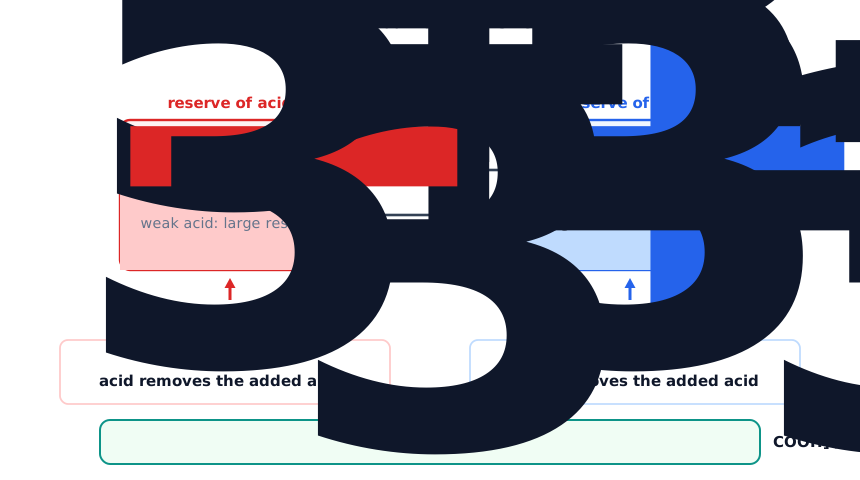
- Add H+: CH3COO− + H+ → CH3COOH. The equilibrium CH3COOH ⇌ CH3COO− + H+ shifts left, removing the added H+. The concentration of the conjugate base falls slightly and the acid rises slightly, but both are large, so the ratio changes little.
- Add OH−: CH3COOH + OH− → CH3COO− + H2O. The added alkali removes H+, so the equilibrium shifts right and more acid ionises to replace it.
- For an ammonia buffer: NH4+ + OH− → NH3 + H2O and NH3 + H+ → NH4+.
- For a solution containing HC2O4− (an amphiprotic ion): HC2O4− + H+ → H2C2O4 and HC2O4− + OH− → C2O42− + H2O.
Limits. A buffer works best when [acid] = [conjugate base] (then pH = pKa) and within about 1 pH unit of the pKa. A large amount of acid or alkali uses up one of the reserves and the pH then changes sharply. The more concentrated the buffer, the more acid or alkali it can absorb.
Uses of buffers. Buffers keep the pH constant in many industrial processes (electroplating, dye manufacture, leather treatment), in culture media for bacteria, in shampoos and eye drops, and in the calibration of pH meters. Living things also depend on them.
The CO2 / HCO3− buffer in blood. Human blood is held between pH 7.35 and 7.45. Respiration produces CO2, which dissolves in blood plasma (catalysed by the enzyme carbonic anhydrase):
CO2(aq) + H2O(l) ⇌ H+(aq) + HCO3−(aq)
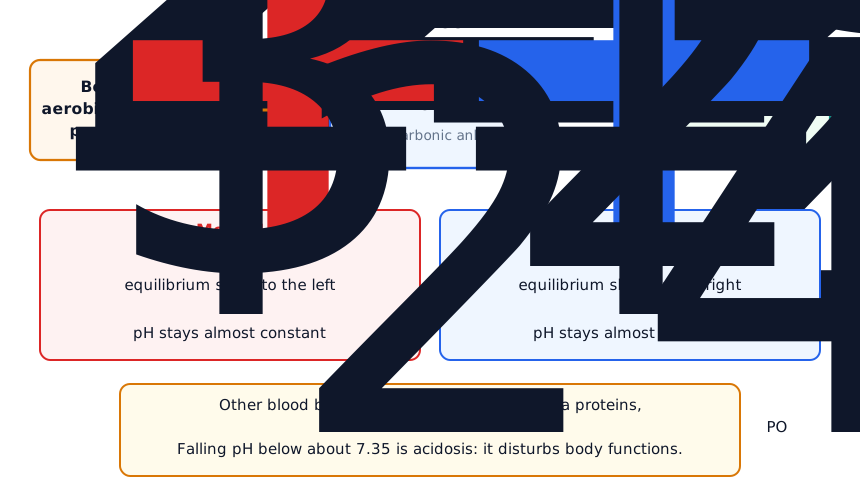
- If [H+] rises, the equilibrium shifts left: HCO3− + H+ → CO2 + H2O. The CO2 is lost through the lungs, so the extra H+ is removed and the pH stays almost constant.
- If [H+] falls, the equilibrium shifts right: more CO2 reacts with water to give H+ and HCO3−.
- Other buffers in blood include haemoglobin and plasma proteins (HPr ⇌ H+ + Pr−) and H2PO4− / HPO42−.
- If the pH of blood falls too far (acidosis) body functions are disturbed. Rain water is similarly buffered by H2CO3 / HCO3− but acidic pollution overwhelms the small reserves.
5. Buffer Calculations
For a buffer of a weak acid HA and its conjugate base A−, the equilibrium expression is rearranged for [H+]:
[H+] = Ka × [HA] / [A−] or pH = pKa + log([A−] / [HA])
[HA] and [A−] are the concentrations in the buffer, taken as equal to the amounts added (the acid is only slightly ionised and the salt supplies the base). Because both are in the same volume, the ratio of the amounts (in mol) can replace the ratio of concentrations.
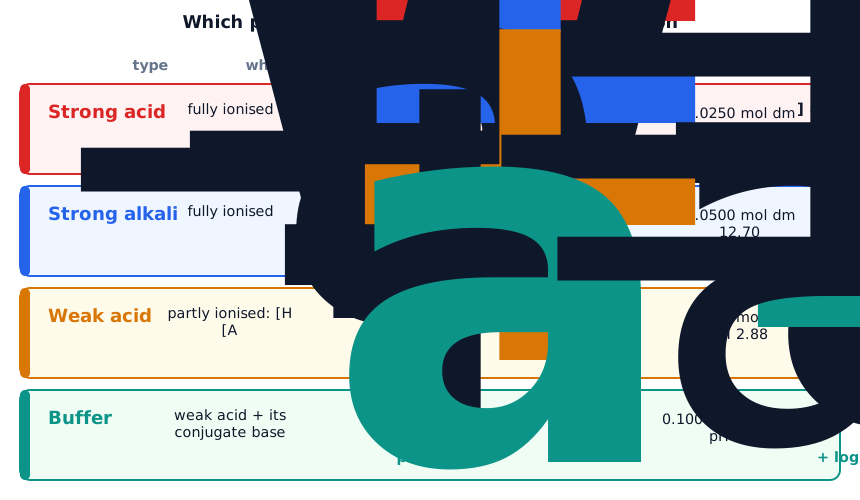
Worked example 1. Calculate the pH of a buffer containing 0.600 mol dm−3 propanoic acid and 0.800 mol dm−3 sodium propanoate (Ka = 1.35 × 10⁻⁵ mol dm−3).
- [H+] = 1.35 × 10−5 × 0.600 / 0.800 = 1.01 × 10⁻⁵ mol dm−3; pH = 4.99
Worked example 2 (amount of salt needed). How many moles of sodium ethanoate must be added to 1.00 dm3 of 0.100 mol dm−3 ethanoic acid to make a buffer of pH 4.90? (Ka = 1.74 × 10⁻⁵)
- [H+] = 10−4.90 = 1.26 × 10⁻⁵ mol dm−3
- [CH3COO−] = Ka [CH3COOH] / [H+] = 1.74 × 10−5 × 0.100 / 1.26 × 10−5 = 0.138 mol dm−3, so 0.138 mol in 1.00 dm3
Worked example 3 (mixing two solutions). 25.0 cm3 of 0.200 mol dm−3 CH3COOH is mixed with 15.0 cm3 of 0.100 mol dm−3 CH3COONa.
- moles of acid = 0.0250 × 0.200 = 5.00 × 10⁻³ mol; moles of salt = 0.0150 × 0.100 = 1.50 × 10⁻³ mol
- [H+] = 1.74 × 10−5 × (5.00 × 10−3) / (1.50 × 10⁻³) = 5.80 × 10⁻⁵; pH = 4.24 (the total volume cancels)
Worked example 4 (acid partly neutralised by alkali). 50.0 cm3 of 0.200 mol dm−3 CH3COOH is mixed with 20.0 cm3 of 0.100 mol dm−3 NaOH.
- moles of acid at the start = 0.0100 mol; moles of OH− = 0.00200 mol. The alkali reacts completely: acid left = 0.00800 mol; ethanoate formed = 0.00200 mol
- [H+] = 1.74 × 10−5 × 0.00800 / 0.00200 = 6.96 × 10⁻⁵; pH = 4.16
Worked example 5 (finding the starting concentration). 250 cm3 of a methanoic acid solution is mixed with 150 cm3 of 0.200 mol dm−3 sodium methanoate. The buffer has pH 3.50 (Ka of HCOOH = 1.60 × 10⁻⁴). Find the concentration of the methanoic acid.
- moles of salt = 0.150 × 0.200 = 0.0300 mol; [H+] = 10−3.50 = 3.16 × 10⁻⁴
- [HA]/[A−] = [H+]/Ka = 3.16 × 10⁻⁴ / 1.60 × 10−4 = 1.98, so moles of acid = 1.98 × 0.0300 = 0.0593 mol
- concentration in the 250 cm3 used = 0.0593 / 0.250 = 0.237 mol dm−3
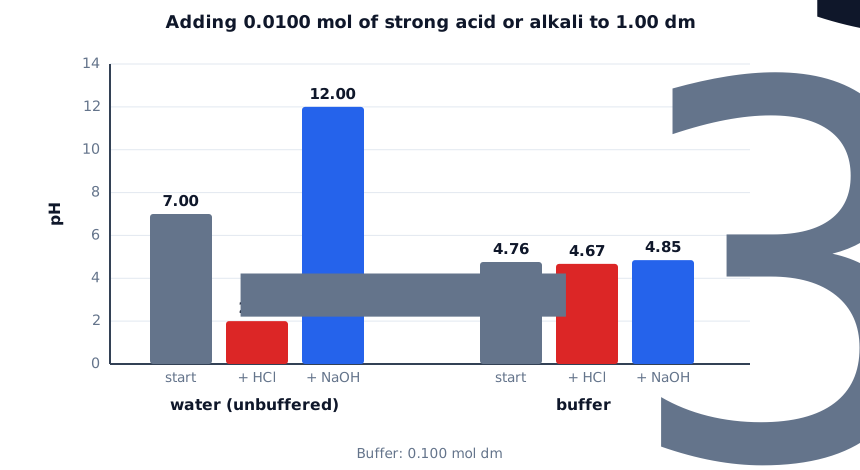
Worked example 6 (the effect of adding acid or alkali). A 1.00 dm3 buffer contains 0.100 mol CH3COOH and 0.100 mol CH3COONa. The pH is pKa = −log(1.74 × 10⁻⁵) = 4.76. Add 0.0100 mol HCl (volume unchanged).
- The HCl reacts with the base: ethanoate = 0.100 − 0.0100 = 0.090 mol; acid = 0.100 + 0.0100 = 0.110 mol
- [H+] = 1.74 × 10−5 × 0.110 / 0.090 = 2.13 × 10⁻⁵; pH = 4.67 (a fall of 0.09; the same HCl in water gives pH 2.00)
- Adding 0.0100 mol NaOH instead gives acid 0.090 mol, ethanoate 0.110 mol and pH 4.85.
6. Solubility Product, Ksp
Ionic compounds such as AgCl and BaSO4 are called ‘insoluble’ but dissolve to a very small extent. In contact with its saturated solution a sparingly soluble salt is in dynamic equilibrium. For silver chloride, AgCl(s) ⇌ Ag+(aq) + Cl−(aq).
Solubility product, Ksp. For a sparingly soluble salt, the product of the concentrations of its ions in a saturated solution, each raised to the power of its coefficient in the dissolving equation, at a stated temperature. The solid does not appear in the expression.

For Fe(OH)2: Fe(OH)2(s) ⇌ Fe2+(aq) + 2OH−(aq), so Ksp = [Fe2+][OH−]2. The units come from the powers: (mol dm−3) × (mol dm−3)2 = mol3 dm−9.
Worked example 1: Ksp from solubility. The solubility of magnesium hydroxide in water is 1.65 × 10⁻⁴ mol dm−3 at 298 K. Calculate Ksp.
- Mg(OH)2(s) ⇌ Mg2+(aq) + 2OH−(aq)
- [Mg2+] = 1.65 × 10⁻⁴; [OH−] = 2 × 1.65 × 10−4 = 3.30 × 10⁻⁴ mol dm−3
- Ksp = (1.65 × 10⁻⁴)(3.30 × 10⁻⁴)2 = 1.80 × 10⁻¹¹ mol3 dm−9
Worked example 2: Ksp from solubility in g dm−3. A saturated solution of lead(II) iodide, PbI2, contains 0.680 g dm−3 (Mr = 461.0).
- solubility s = 0.680 / 461.0 = 1.475 × 10⁻³ mol dm−3
- [Pb2+] = s, [I−] = 2s; Ksp = 4s3 = 4 × (1.475 × 10−3)3 = 1.28 × 10⁻⁸ mol3 dm−9
Worked example 3: solubility from Ksp. Calculate the solubility of lead(II) chloride in water (Ksp = 1.6 × 10⁻⁵ mol3 dm−9).
- PbCl2(s) ⇌ Pb2+ + 2Cl−, so Ksp = [Pb2+][Cl−]2 = s(2s)2 = 4s3
- s = (Ksp / 4)1/3 = (4.0 × 10⁻⁶)1/3 = 1.59 × 10⁻² mol dm−3
Worked example 4: solubility in g dm−3. For BaSO4 (Ksp = 1.0 × 10⁻¹⁰ mol2 dm−6): s = √(1.0 × 10⁻¹⁰) = 1.0 × 10⁻⁵ mol dm−3; with Mr = 233.4 the solubility is 1.0 × 10−5 × 233.4 = 2.3 × 10⁻³ g dm−3.
Predicting precipitation. Mix two solutions and find the concentrations of the ions immediately after mixing (each is diluted). The ion product Q is the Ksp expression evaluated with these concentrations.
- If Q > Ksp, a precipitate forms.
- If Q ≤ Ksp, no precipitate forms (the solution is unsaturated or just saturated).
Worked example 5. 50.0 cm3 of 2.0 × 10⁻⁴ mol dm−3 AgNO3 is mixed with 50.0 cm3 of 2.0 × 10⁻⁴ mol dm−3 NaCl. [Ag+] = [Cl−] = 1.0 × 10⁻⁴ mol dm−3 (doubling the volume halves each); Q = 1.0 × 10⁻⁸, which is greater than Ksp(AgCl) = 1.8 × 10⁻¹⁰, so AgCl precipitates. With 1.0 × 10⁻⁵ mol dm−3 solutions each ion would be 5.0 × 10⁻⁶ and Q = 2.5 × 10⁻¹¹ < Ksp: no precipitate.
7. Common Ion Effect and Precipitation
Common ion effect. The solubility of an ionic compound is lower in a solution that already contains one of its ions (a common ion) than it is in pure water. The added common ion shifts the dissolving equilibrium to the left, so more solid is formed.

To calculate solubility in a solution with a common ion, take [common ion] from the solution (the contribution from the sparingly soluble salt is so small that it can be ignored) and find the concentration of the other ion from Ksp. The solubility is equal to that concentration, divided by the number of that ion in the formula.
Worked example 1. Calculate the solubility of AgCl (Ksp = 1.8 × 10⁻¹⁰ mol2 dm−6) (a) in water and (b) in 0.100 mol dm−3 NaCl.
- (a) s = √Ksp = 1.34 × 10⁻⁵ mol dm−3
- (b) [Cl−] = 0.100 mol dm−3, so [Ag+] = 1.8 × 10⁻¹⁰ / 0.100 = 1.8 × 10⁻⁹ mol dm−3, which is the solubility of AgCl, about 7000 times smaller than in water.
Worked example 2. Calculate the solubility of PbCl2 in 0.100 mol dm−3 HCl (Ksp = 1.6 × 10⁻⁵ mol3 dm−9). [Cl−] = 0.100, so [Pb2+] = 1.6 × 10⁻⁵ / (0.100)2 = 1.6 × 10⁻³ mol dm−3, ten times lower than the 1.59 × 10⁻² mol dm−3 in water.
Worked example 3 (hydroxide as common ion; pH of a saturated solution). Using Ksp[Mg(OH)2] = 1.8 × 10⁻¹¹ mol3 dm−9:
- In water: s = (1.8 × 10⁻¹¹ / 4)1/3 = 1.65 × 10⁻⁴ mol dm−3; [OH−] = 3.30 × 10⁻⁴ mol dm−3; pOH = 3.48 and pH = 10.52
- In NaOH of pH 12.0 ([OH−] = 0.0100 mol dm−3): [Mg2+] = 1.8 × 10⁻¹¹ / (0.0100)2 = 1.8 × 10⁻⁷ mol dm−3, roughly 1000 times less than in water.
A comparison to explain. BaSO4 dissolves to 1.0 × 10⁻⁵ mol dm−3 in water but only about 1.0 × 10⁻⁹ mol dm−3 in 0.100 mol dm−3 H2SO4: [Ba2+] = 1.0 × 10⁻¹⁰ / 0.100 = 1.0 × 10⁻⁹ mol dm−3, because the sulfate from the acid is a common ion.
8. Partition Coefficients
When a solute X is shaken with two immiscible solvents (that is, solvents that do not mix and form two layers), it distributes itself between them until a dynamic equilibrium is reached. X(solvent 1) ⇌ X(solvent 2).
Partition coefficient, Kpc. The equilibrium constant that relates the concentrations of a solute in two immiscible solvents at a stated temperature:
Kpc = [X in solvent 1] / [X in solvent 2] (at constant temperature)
The value applies when the solute is in the same physical and molecular state in both solvents (for example NH3 molecules in water and in the organic solvent). There are no units, because the concentrations are in the same units. Always state which solvent is in the numerator.
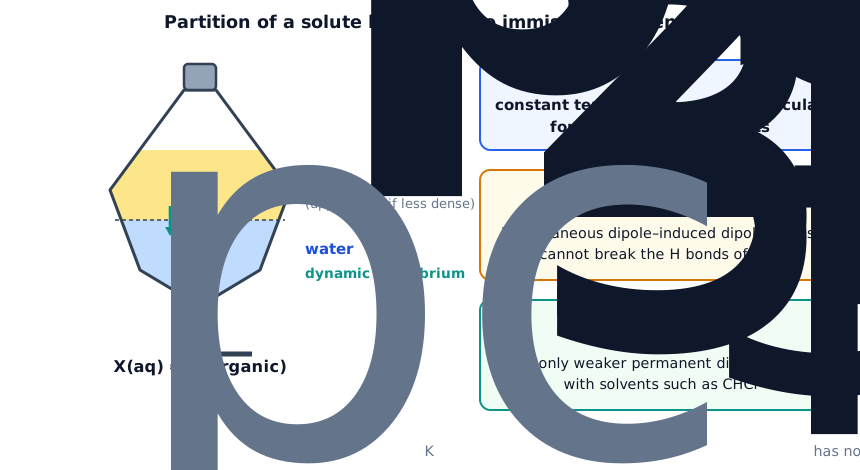
What controls the value? The size of Kpc depends on how soluble the solute is in each solvent, which depends on the intermolecular forces it can form with each solvent:
- Polar or hydrogen-bonding solutes (such as NH3) dissolve well in water because they form hydrogen bonds with it. They are less soluble in an organic solvent such as CHCl3, which can offer only weaker permanent dipole forces. Kpc (organic / water) is less than 1.
- Non-polar solutes (such as I2) cannot break the strong hydrogen bonds between water molecules, so they are much less soluble in water. They dissolve in non-polar solvents such as cyclohexane by instantaneous dipole–induced dipole forces. Kpc (cyclohexane / water) is much greater than 1.
- The more similar the polarity of the solute and the solvent, the more soluble the solute is in that solvent (‘like dissolves like’).
Worked example 1: mass extracted. A 50.0 cm3 aqueous solution contains 1.20 g of X. It is shaken with 25.0 cm3 of ether, Kpc = [X]ether / [X]water = 6.00. Find the mass of X extracted into the ether.
- Let m g be in the ether. Then 1.20 − m g remains in the water.
- Kpc = (m / 25.0) / ((1.20 − m) / 50.0) = 2m / (1.20 − m) = 6.00
- 2m = 7.20 − 6.00m, so m = 0.900 g extracted, 0.300 g left in the water
(Volumes may be left in cm3, because they appear in the ratio. Concentrations can be in g per cm3 or mol per dm3, provided they are the same in both layers.)
Worked example 2: calculating Kpc. 0.0500 mol of a compound Y dissolved in 40.0 cm3 of ether is shaken with 100.0 cm3 of water. At equilibrium 0.0110 mol of Y is in the water. Find Kpc (ether / water).
- in water: 0.0110 mol / 0.1000 dm3 = 0.110 mol dm−3; in ether: (0.0500 − 0.0110) = 0.0390 mol / 0.0400 dm3 = 0.975 mol dm−3
- Kpc = 0.975 / 0.110 = 8.86
Worked example 3: one extraction or two? Using the data of example 1, split the 25.0 cm3 of ether into two portions of 12.5 cm3. After each portion the fraction of X left in the water is 1 / (1 + Kpc × Vorg / Vaq) = 1 / (1 + 6.00 × 12.5 / 50.0) = 0.400. After two portions the fraction left is 0.4002 = 0.160, so 0.192 g remains and 1.008 g is extracted, more than the 0.900 g removed by one 25.0 cm3 portion.

Link to chromatography. In paper chromatography a solute partitions between the mobile phase (the moving solvent) and the stationary phase (water held in the paper). A solute that is more soluble in the mobile phase moves further and faster. The solute must be in the same state in both phases for a single Kpc to apply, so associations such as dimerisation of a carboxylic acid in an organic solvent are outside the calculations asked.
9. Quick Sheet and Checklist
| Quantity | Statement to learn |
|---|---|
| pH, Kw | pH = −log[H+]; Kw = [H+][OH−] = 1.00 × 10⁻¹⁴ mol2 dm−6 (298 K) |
| Strong acid / alkali | [H+] = c (acid); [OH−] = c × n(OH−), [H+] = Kw/[OH−] |
| Weak acid | Ka = [H+][A−]/[HA]; [H+] = √(Kac); pKa = −log Ka |
| Buffer | [H+] = Ka[HA]/[A−]; weak acid + conjugate base; two equations for the explanation |
| Ksp | product of [ion]coefficient in a saturated solution; Q > Ksp gives a precipitate |
| Common ion effect | adding an ion common to the salt lowers solubility; Ksp unchanged |
| Kpc | [X in solvent 1] / [X in solvent 2] at constant temperature; no units; solute in same state in both solvents |
Checklist. Before the exam you should be able to:
- [ ] identify conjugate acid–base pairs in any equation and complete a Brønsted–Lowry equilibrium for an acid and water
- [ ] write the expressions for pH, Kw, Ka and pKa and convert between Ka and pKa
- [ ] calculate the pH of a strong acid and a strong alkali (including Ba(OH)2), and find a mass or concentration from a pH
- [ ] calculate the pH of a weak acid, Ka from a pH, and a concentration from a pH and a pKa, stating the two assumptions
- [ ] define a buffer, say how to make one, and explain its action with two equations
- [ ] describe the role of HCO3− in blood and give two uses of buffers
- [ ] calculate the pH of a buffer, including from mixed volumes, after partial neutralisation and after adding strong acid or alkali
- [ ] write Ksp expressions with units and calculate Ksp from solubility and solubility from Ksp
- [ ] predict precipitation by comparing Q with Ksp after dilution
- [ ] explain and calculate the effect of a common ion on solubility
- [ ] define Kpc, calculate a mass extracted or a Kpc, and explain its size using polarity and intermolecular forces