 Score
Group 2 (A Level)
0. What Examiners Want
This guide covers Topic 27 of Cambridge International AS & A Level Chemistry 9701 (2025–27) and follows the learning outcomes below, word for word. The right-hand column shows where each one is taught. The topic extends AS Topic 10 (Group 2) and uses the energy cycles of Topic 23.
| 27.1 Similarities and trends in the properties of the Group 2 metals, magnesium to barium, and their compounds. Candidates should be able to: | Section |
|---|---|
| 1 describe and explain qualitatively the trend in the thermal stability of the nitrates and carbonates including the effect of ionic radius on the polarisation of the large anion | 2, 3, 4 |
| 2 describe and explain qualitatively the variation in solubility and of enthalpy change of solution, ΔHsol°, of the hydroxides and sulfates in terms of relative magnitudes of the enthalpy change of hydration and the lattice energy | 5, 6, 7 |
- Thermal stability: the trend (increases down the group), the ionic radius and charge density of the cation, and the polarisation of the anion weakening its bonds.
- Equations: balanced equations with state symbols for MCO3 and M(NO3)2, with the brown gas and the oxygen test.
- Solubility and ΔHsol: an energy cycle, then a comparison of how ΔHlatt and ΔHhyd change down the group.
- Sign and size: exothermic or endothermic, and ‘less exothermic’ rather than ‘decreases’.
- Predictions: using the trends for an unseen compound (for example radium) or an unnamed metal.
1. Group 2 Recap and the Ions
From AS Topic 10 you know the elements magnesium to barium form M2+ ions and react more vigorously down the group, because the first and second ionisation energies fall as the atoms get larger. The reactions you must still know are summarised here.
| Reaction | Equation (M = Mg, Ca, Sr, Ba) | Trend down the group |
|---|---|---|
| metal + oxygen | 2M + O2 → 2MO | more vigorous |
| metal + water | M + 2H2O → M(OH)2 + H2 | more vigorous (Mg very slow, Ba fast) |
| metal + dilute acid | M + 2HCl → MCl2 + H2 | more vigorous |
| oxide + water | MO + H2O → M(OH)2 | solution more alkaline |
| hydroxide, oxide or carbonate + acid | MCO3 + 2HCl → MCl2 + H2O + CO2 | as expected: salt + water (+ CO2) |
Mg reacts with steam to give MgO and H2. Calcium, strontium and barium react with dilute sulfuric acid only briefly, because an insoluble sulfate layer forms on the metal or carbonate. That is the first hint of the solubility trend explained in section 7.
The key to this topic is the size of the M2+ ion. Each step down the group adds a full electron shell.

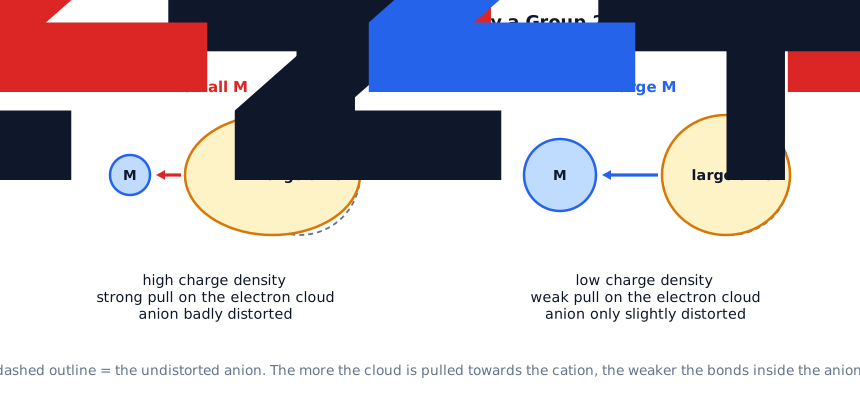
Charge density is charge divided by size. Every Group 2 ion has the same 2+ charge, so a smaller ion has a higher charge density. The Mg2+ ion has the highest charge density in the group and Ba2+ the lowest. Every trend in this topic follows from that single fact.
2. Polarisation of the Anion
An ionic bond is not perfectly ionic. A positive ion attracts the electron cloud of a neighbouring negative ion. Polarisation is the distortion of the electron cloud of an anion by a cation. The more the cloud is pulled towards the cation, the more covalent character the bond has, and the weaker the bonds inside the anion become.
| Factor | Effect on polarisation of the anion |
|---|---|
| cation charge | higher charge: more polarisation |
| cation radius | smaller radius: more polarisation (higher charge density) |
| anion size | larger anion: more easily polarised (the outer electrons are held less tightly) |
So the polarising power of a Group 2 cation is greatest for Mg2+ and least for Ba2+. The anions that matter here, CO32− and NO3−, are large and have a spread-out electron cloud, so they are easily polarised.
3. Thermal Decomposition of the Carbonates
All the Group 2 carbonates decompose on heating to the oxide and carbon dioxide:
The temperature needed increases down the group: magnesium carbonate decomposes at a much lower temperature than barium carbonate. The values below are approximate and vary between sources; you will not be asked to recall them.

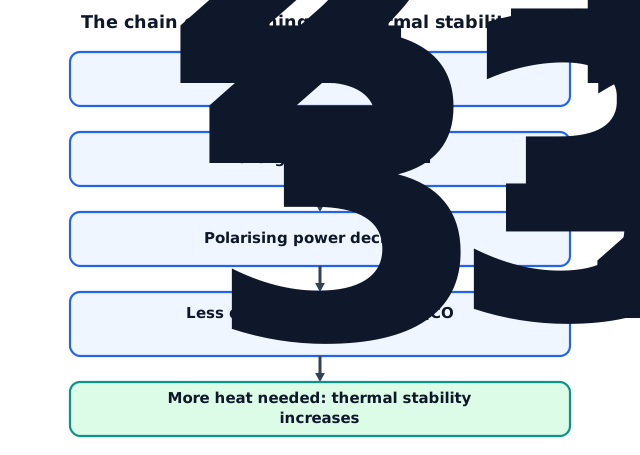
Explanation. A small cation with a high charge density (Mg2+) polarises the carbonate ion strongly. The electron cloud is pulled towards the cation, which weakens a C–O bond. When heated, the carbonate breaks up easily: CO2 is lost and the very stable oxide ion is left next to the small cation. Going down the group the cation is larger, so its charge density is lower, it polarises the carbonate ion less, the C–O bonds are weakened less, and more heat is needed.

Worked example. Calculate the volume of CO2 produced at room conditions when 5.00 g of calcium carbonate is heated strongly. (Ar: Ca 40.1, C 12.0, O 16.0.)
Mr(CaCO3) = 100.1. Moles = 5.00 ÷ 100.1 = 0.0500 mol. CaCO3 → CaO + CO2, so 0.0500 mol of CO2. Volume = 0.0500 × 24.0 = 1.20 dm3.
4. Thermal Decomposition of the Nitrates
The Group 2 nitrates decompose on heating to the oxide, nitrogen dioxide and oxygen:
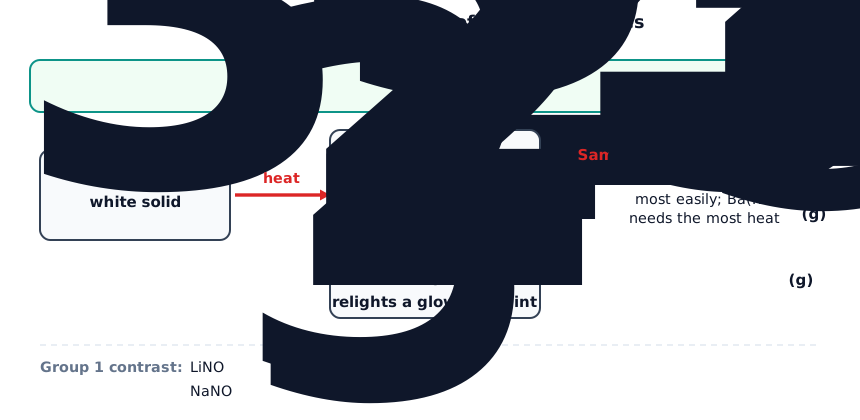
The trend is the same as for the carbonates: the nitrates become more stable to heat down the group. The explanation is also the same. A small, highly charged cation such as Mg2+ polarises the large nitrate ion strongly, weakening the N–O bonds, so the nitrate decomposes at a lower temperature. A large cation such as Ba2+ polarises it less.
The three marks. (1) Thermal stability increases down the group. (2) The radius of the cation increases (so the charge density decreases). (3) There is less polarisation (distortion) of the nitrate ion, so less weakening of the N–O bonds.
Contrast with Group 1. The Group 1 cations are larger and carry only a 1+ charge, so they polarise the anions far less. Group 1 carbonates (except lithium carbonate) do not decompose at Bunsen temperatures, and Group 1 nitrates (except lithium nitrate) give only the nitrite and oxygen: 2NaNO3 → 2NaNO2 + O2. Lithium, with the smallest Group 1 ion, behaves like Group 2: 4LiNO3 → 2Li2O + 4NO2 + O2. Copper(II) nitrate also decomposes like Group 2 nitrates: 2Cu(NO3)2 → 2CuO + 4NO2 + O2.
Worked example. Calculate the total volume of gas, at room conditions, produced when 3.00 g of magnesium nitrate is heated until it has all decomposed. (Ar: Mg 24.3, N 14.0, O 16.0.)
Mr(Mg(NO3)2) = 24.3 + 2(14.0 + 48.0) = 148.3. Moles = 3.00 ÷ 148.3 = 0.02023 mol. From 2Mg(NO3)2 → 2MgO + 4NO2 + O2: each mole gives 2 mol NO2 and 0.5 mol O2, i.e. 2.5 mol of gas. Gas = 2.5 × 0.02023 = 0.05057 mol. Volume = 0.05057 × 24.0 = 1.21 dm3.
5. Enthalpy of Solution: Hydration versus Lattice Energy
When an ionic solid dissolves in water, the ions leave the lattice and become surrounded by water molecules. Two energy changes are involved (Topic 23):
- Lattice energy, ΔHlatt: the enthalpy change when one mole of an ionic solid forms from its gaseous ions. It is always exothermic (negative). A higher charge and smaller ions give a more exothermic lattice energy.
- Enthalpy change of hydration, ΔHhyd: the enthalpy change when one mole of a gaseous ion dissolves in water to form an aqueous ion. It is always exothermic. A higher charge and a smaller ion give a more exothermic value, because water molecules are attracted more strongly.
The enthalpy change of solution, ΔHsol, is the enthalpy change when one mole of a solid dissolves in enough water that no further change occurs on dilution. It follows from a cycle.

Worked example. Use the data to find ΔHsol for magnesium sulfate and for barium sulfate. ΔHhyd(SO42−) = −1000 kJ mol−1 for both.
| ΔHlatt / kJ mol−1 | ΔHhyd(M2+) / kJ mol−1 | |
|---|---|---|
| MgSO4 | −2829 | −1920 |
| BaSO4 | −2379 | −1360 |
MgSO4: ΔHsol = +2829 − 1920 − 1000 = −91 kJ mol−1. BaSO4: ΔHsol = +2379 − 1360 − 1000 = +19 kJ mol−1. So dissolving becomes less favourable down the group, because the hydration enthalpy of the cation falls by more than the lattice energy does.
The general argument. For a given anion, both ΔHlatt and ΔHhyd(M2+) become less exothermic down the group as the cation gets larger. ΔHsol depends on which falls more:
| If the change in ... is larger | then ΔHsol becomes ... down the group | Solubility |
|---|---|---|
| ΔHhyd (cation hydration falls by more) | less exothermic (more endothermic) | decreases |
| ΔHlatt (lattice energy falls by more) | more exothermic (less endothermic) | increases |
6. Solubility of the Hydroxides
The Group 2 hydroxides become more soluble down the group. This is why a saturated solution of barium hydroxide has a higher pH than limewater, and why Mg(OH)2 (milk of magnesia) is barely soluble.
| Hydroxide | Solubility at 298 K / mol per 100 g water |
|---|---|
| Mg(OH)2 | 2.0 × 10⁻⁵ |
| Ca(OH)2 | 1.5 × 10⁻³ |
| Sr(OH)2 | 3.4 × 10⁻³ |
| Ba(OH)2 | 1.5 × 10⁻² |
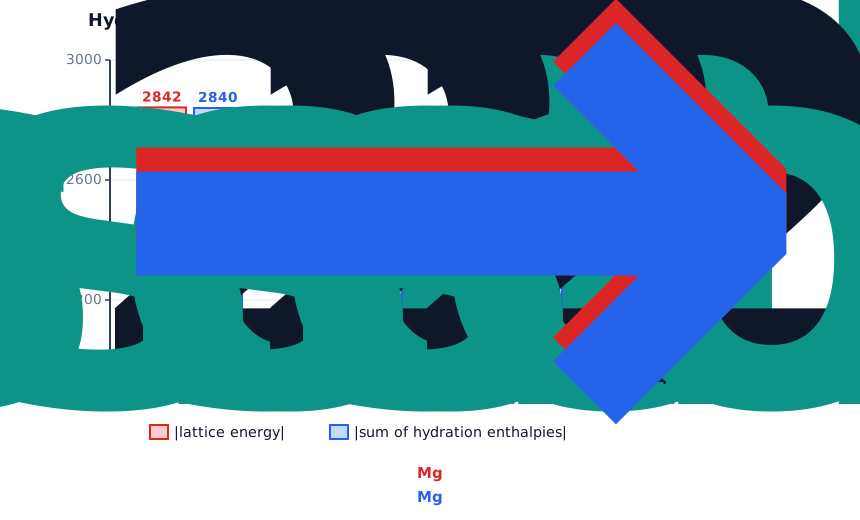
Explanation. The hydroxide ion is small. The sum of the two radii in the lattice, r(M2+) + r(OH−), changes a lot when the cation changes size, so the lattice energy becomes much less exothermic down the group. The hydration enthalpy of the cation also becomes less exothermic, but the lattice energy falls by more. So ΔHsol becomes more exothermic (less endothermic), and solubility increases.
7. Solubility of the Sulfates
The Group 2 sulfates become less soluble down the group. Magnesium sulfate is very soluble, calcium sulfate is slightly soluble, strontium sulfate is only sparingly soluble and barium sulfate is insoluble.
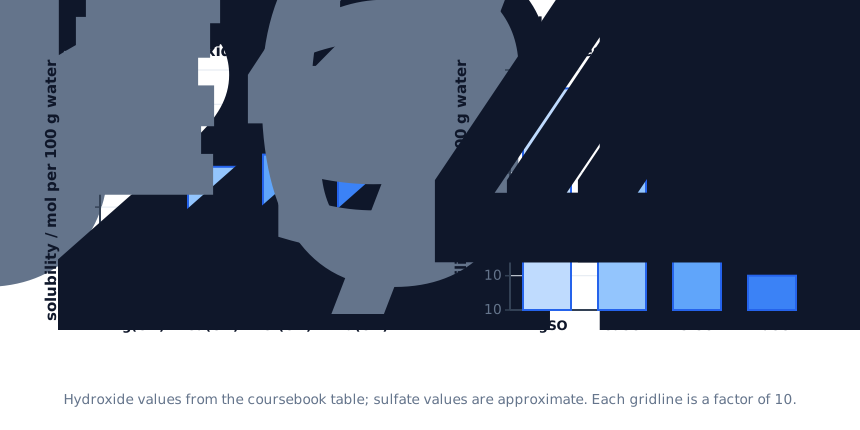
Explanation. The sulfate ion is large. In the lattice the distance between the ion centres is r(M2+) + r(SO42−), and the sulfate radius is so much larger than the cation radius that changing the cation barely changes this sum. The lattice energy therefore changes only a little. The hydration enthalpy of the cation, however, depends on its own size, so it becomes much less exothermic from Mg2+ to Ba2+. The fall in hydration enthalpy is larger than the fall in lattice energy, so ΔHsol becomes less exothermic and then endothermic, and the solubility decreases.

| Hydroxides, X(OH)2 | Sulfates, XSO4 | |
|---|---|---|
| anion | small OH− | large SO42− |
| lattice energy down the group | falls a lot (sensitive to cation size) | falls only a little |
| bigger change | ΔHlatt | ΔHhyd |
| ΔHsol down the group | more exothermic | less exothermic |
| solubility | increases | decreases |
8. Predicting and Using the Trends
Use the trends for compounds you have not met. Radium, below barium, follows the pattern: the Ra2+ ion is the largest, so radium is the most reactive metal, RaCO3 and Ra(NO3)2 are the most stable to heat, Ra(OH)2 is the most soluble hydroxide (a strongly alkaline solution) and RaSO4 is the least soluble sulfate (a white precipitate when Ra2+ meets sulfate ions).
Uses that rely on the trends
- Barium sulfate is so insoluble that the toxic Ba2+ does not enter the body; it is used in the ‘barium meal’ to show the gut in X-rays.
- Test for sulfate ions: add acidified barium chloride or nitrate. A white precipitate of BaSO4 forms: Ba2+(aq) + SO42−(aq) → BaSO4(s). The acid removes carbonate ions that would also give a precipitate.
- Calcium hydroxide (slaked lime) is used in agriculture to neutralise acidic soil, and limewater (Ca(OH)2(aq)) is the test for CO2.
- Magnesium hydroxide is used in antacids, and calcium carbonate is heated in a lime kiln to make calcium oxide (about 900 °C), which shows the high stability of the carbonate down the group.
Worked example. Strontium carbonate and magnesium carbonate are heated separately with the same Bunsen burner. Predict and explain what you would see.
MgCO3 decomposes readily to the white MgO and CO2, because the small Mg2+ polarises the carbonate ion strongly. SrCO3 is much more stable, since Sr2+ is larger, has a lower charge density and polarises the carbonate ion less; little or no decomposition occurs at the Bunsen temperature.
9. Quick Sheet and Checklist
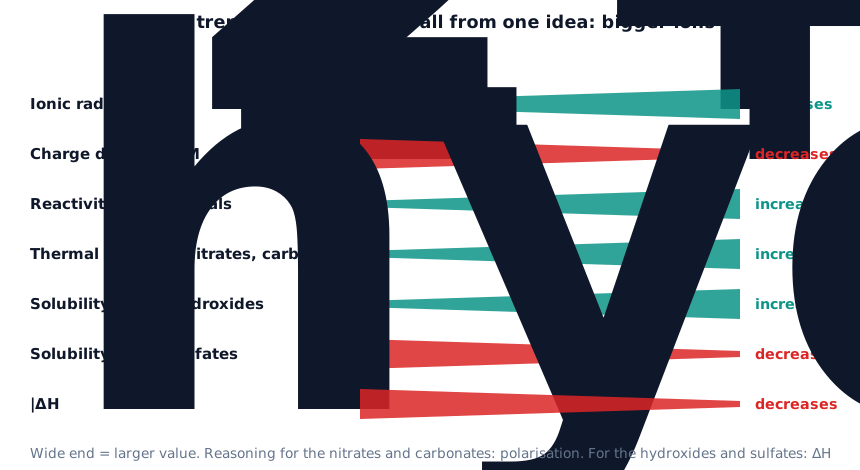
| Property (Mg → Ba) | Trend | Reason |
|---|---|---|
| radius of M2+ | increases | extra shell each time |
| charge density of M2+ | decreases | same charge, larger ion |
| thermal stability of MCO3 and M(NO3)2 | increases | less polarisation of the anion, so its bonds are weakened less |
| MCO3 products | MO + CO2 | |
| M(NO3)2 products | MO + NO2 + O2 | brown gas NO2 |
| solubility of hydroxides | increases | small anion: ΔHlatt falls by more than ΔHhyd |
| solubility of sulfates | decreases | large anion: ΔHhyd falls by more than ΔHlatt |
| ΔHsol | = −ΔHlatt + ΔHhyd(cation) + ΔHhyd(anions) |
Checklist. Before the exam you should be able to:
- [ ] explain what is meant by the charge density of an ion and how it changes down Group 2
- [ ] define polarisation and say which ion polarises which
- [ ] write equations for the thermal decomposition of Group 2 carbonates and nitrates, with state symbols
- [ ] describe the trend in thermal stability and explain it in terms of ionic radius and polarisation of the anion
- [ ] state the observations on heating a nitrate (brown gas, oxygen) and contrast Group 1 nitrates and carbonates
- [ ] define enthalpy change of solution, hydration and lattice energy, and draw a cycle linking them
- [ ] calculate ΔHsol from lattice energy and hydration enthalpies, with the right number of anions
- [ ] explain the solubility trend of the hydroxides (small anion) and of the sulfates (large anion) in terms of the relative magnitudes of ΔHlatt and ΔHhyd
- [ ] use the trends to predict the properties of radium compounds