 Score
Electrochemistry (A Level)
0. What Examiners Want
This guide covers Topic 24 of Cambridge International AS & A Level Chemistry 9701 (2025–27) and follows the learning outcomes below, word for word. The right-hand column shows where each one is taught.
| 24.1 Electrolysis. Candidates should be able to: | Section |
|---|---|
| 1 predict the identities of substances liberated during electrolysis from the state of electrolyte (molten or aqueous), position in the redox series (electrode potential) and concentration | 1 |
| 2 state and apply the relationship F = Le between the Faraday constant, F, the Avogadro constant, L, and the charge on the electron, e | 2, 3 |
| 3 calculate: (a) the quantity of charge passed during electrolysis, using Q = It; (b) the mass and/or volume of substance liberated during electrolysis | 2 |
| 4 describe the determination of a value of the Avogadro constant by an electrolytic method | 3 |
| 24.2 Standard electrode potentials E°, standard cell potentials E°cell and the Nernst equation. Candidates should be able to: | Section |
|---|---|
| 1 define the terms: (a) standard electrode (reduction) potential (b) standard cell potential | 4 |
| 2 describe the standard hydrogen electrode | 4 |
| 3 describe methods used to measure the standard electrode potentials of: (a) metals or non-metals in contact with their ions in aqueous solution (b) ions of the same element in different oxidation states | 5 |
| 4 calculate a standard cell potential by combining two standard electrode potentials | 6 |
| 5 use standard cell potentials to: (a) deduce the polarity of each electrode and hence explain/deduce the direction of electron flow in the external circuit of a simple cell (b) predict the feasibility of a reaction | 6, 7 |
| 6 deduce from E° values the relative reactivity of elements, compounds and ions as oxidising agents or as reducing agents | 7 |
| 7 construct redox equations using the relevant half-equations | 7 |
| 8 predict qualitatively how the value of an electrode potential, E, varies with the concentrations of the aqueous ions | 8 |
| 9 use the Nernst equation, e.g. E = E° + (0.059/z) log [oxidised species]/[reduced species], to predict quantitatively how the value of an electrode potential varies with the concentrations of the aqueous ions; examples include Cu2+(aq) + 2e− ⇌ Cu(s), Fe3+(aq) + e− ⇌ Fe2+(aq) | 8 |
| 10 understand and use the equation ΔG° = –nE°cellF | 9 |
- Definitions and descriptions: the standard electrode potential and standard cell potential in full, and the standard hydrogen electrode with its platinum, hydrogen at 101 kPa and 1.00 mol dm−3 H+. Labelling a diagram of a measuring cell is a regular task.
- Cells: E°cell from two data values, the polarity of each electrode, the direction of electron flow, and the overall equation.
- Predictions: will this reaction go? Which is the stronger oxidising agent? Always give the two E° values and the calculated E°cell.
- Calculations: Q = It, moles of electrons, mass or volume, the Faraday and Avogadro constants, the Nernst equation and ΔG° = −nE°cellF. Use the Data Booklet: F = 9.65 × 10⁴ C mol−1, e = 1.60 × 10⁻¹⁹ C, L = 6.02 × 10²³ mol−1.
- Graphs and data: read or draw how E changes with log of a concentration, and take the E° values you need from the Data Booklet (Table 5), which is given in the exam.
1. Electrolysis and What Is Discharged
Electrolysis is the decomposition of an ionic compound, molten or in aqueous solution, by passing an electric current through it. Electrical energy is used to make a reaction happen that does not go by itself. The current comes from a d.c. supply, and the ions move through the liquid: positive ions towards the negative electrode, negative ions towards the positive one.
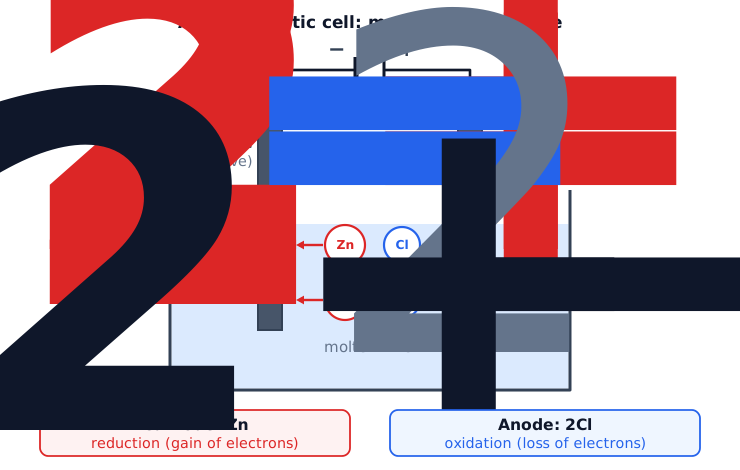
- The cathode is the negative electrode. Reduction happens here: cations gain electrons.
- The anode is the positive electrode. Oxidation happens here: anions lose electrons.
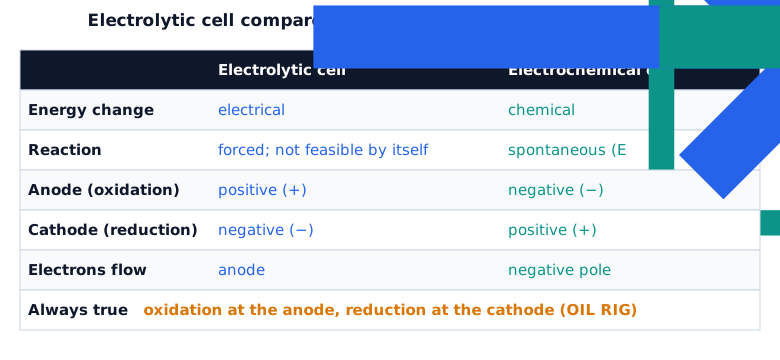
- Remember OIL RIG and ‘the anode is where oxidation happens’. In an electrolytic cell the anode is positive; in a voltaic cell it is negative (section 6).
Molten electrolytes. Only two kinds of ion are present, so the products are fixed. The metal forms at the cathode and the non-metal at the anode.
| Molten compound | Cathode (−) | Anode (+) |
|---|---|---|
| NaCl | Na+ + e− → Na | 2Cl− → Cl2 + 2e− |
| PbBr2 | Pb2+ + 2e− → Pb | 2Br− → Br2 + 2e− |
| Al2O3 (in molten cryolite) | Al3+ + 3e− → Al | 2O2− → O2 + 4e− |
Aqueous electrolytes. Water adds two more ions, H+ and OH−, so at each electrode there are two competing species. Three things decide which one is discharged:
- The position in the redox series. At the cathode the ion with the more positive E° is reduced more easily. At the anode the species with the less positive E° is oxidised more easily.
- The concentration. E° values apply at 1.00 mol dm−3. A very different concentration can swap the order of two close values.
- The electrode material. A reactive (active) electrode such as copper can itself be oxidised.
At the cathode. H+ is reduced to H2 (E° = 0.00 V at 1.00 mol dm−3; in neutral water, where [H+] = 10−7 mol dm−3, the electrode potential is about −0.41 V). Compare this with the metal ion.
| Metal ion | E° / V (Data Booklet) | Compared with H+ | Cathode product |
|---|---|---|---|
| Ag+ | +0.80 | far more positive | Ag |
| Cu2+ | +0.34 | more positive | Cu |
| Zn2+ | −0.76 | more negative | H2 |
| Mg2+ | −2.38 | far more negative | H2 |
| Na+ | −2.71 | far more negative | H2 |
Reactive metals (Group 1, Group 2 and aluminium) are never obtained from aqueous solution: hydrogen is discharged instead. The rule at A Level: an ion with an E° more negative than H+ is not discharged from aqueous solution; hydrogen is formed instead.
At the anode. The competition is between OH− (water) and the anion present.
- Sulfate, nitrate and other oxo-anions are not oxidised. Oxygen is formed: 4OH− → O2 + 2H2O + 4e− (or, as water is the source, 2H2O → O2 + 4H+ + 4e−). E°(O2/H2O) = +1.23 V.
- Bromide and iodide have less positive E° than oxygen (+1.07 V and +0.54 V against +1.23 V), so Br2 and I2 are formed.
- Chloride has E° = +1.36 V, slightly more positive than oxygen, so on E° alone oxygen would be expected. In concentrated chloride solution the high concentration of Cl− makes chlorine the main product. In dilute chloride solution, oxygen is mainly formed (often with some chlorine).
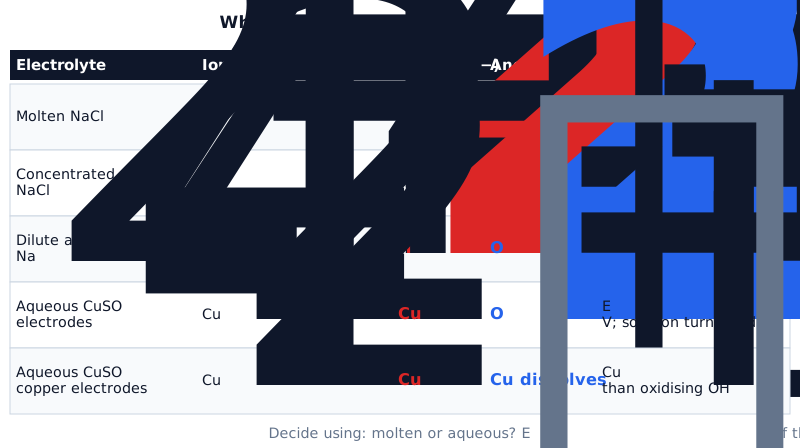
Worked example: electrolysis of aqueous sodium chloride. Ions present: Na+, H+, Cl−, OH−.
- Cathode: H+ (E° = 0.00 V) is reduced in preference to Na+ (−2.71 V): 2H+ + 2e− → H2.
- Anode (concentrated): chloride is oxidised because of its high concentration: 2Cl− → Cl2 + 2e−.
- Solution left: H+ has been removed from water, leaving an excess of OH−, so the solution near the cathode becomes alkaline (NaOH forms). This is the basis of the industrial chlor-alkali process.
Copper electrodes. When aqueous copper(II) sulfate is electrolysed with inert electrodes (graphite or platinum), copper is deposited at the cathode and oxygen forms at the anode; the blue colour fades and the solution becomes acidic because H+ accumulates. With copper electrodes, the anode itself dissolves, since Cu → Cu2+ + 2e− (E° = +0.34 V) is easier than oxidising water (+1.23 V). The anode loses the same mass that the cathode gains and the colour of the solution does not change. This is how copper is purified.
2. Quantitative Electrolysis
The amount of substance liberated is proportional to the charge that flows. The steps are always the same.
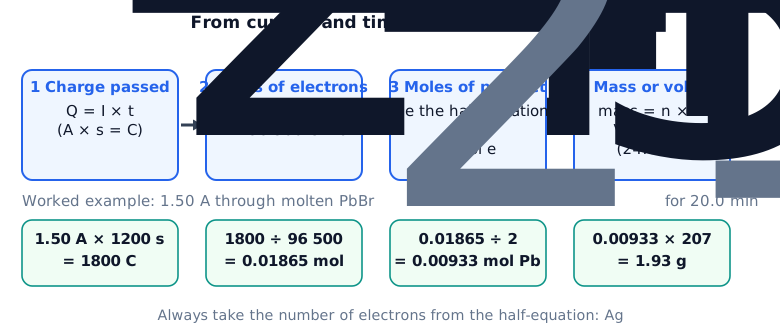
Charge. Q = I × t, where Q is in coulombs (C), I in amperes (A) and t in seconds. Convert minutes and hours to seconds first.
The Faraday constant. The charge on one mole of electrons is F. Since one electron carries e = 1.60 × 10⁻¹⁹ C and a mole contains L = 6.02 × 10²³ electrons,
F = L × e = 6.02 × 1023 × 1.60 × 10−19 ≈ 9.65 × 10⁴ C mol−1
The Data Booklet gives F = 9.65 × 10⁴ C mol−1. Moles of electrons passed = Q / F.
Electrons per mole of product come from the half-equation.
| Half-equation | Electrons per mole of product | Charge per mole of product / C |
|---|---|---|
| Ag+ + e− → Ag | 1 | 9.65 × 10⁴ |
| Cu2+ + 2e− → Cu | 2 | 1.93 × 10⁵ |
| Al3+ + 3e− → Al | 3 | 2.90 × 10⁵ |
| 2H+ + 2e− → H2 | 2 | 1.93 × 10⁵ |
| 2Cl− → Cl2 + 2e− | 2 | 1.93 × 10⁵ |
| 4OH− → O2 + 2H2O + 4e− | 4 | 3.86 × 10⁵ |
Worked example 1 (mass). Molten lead(II) bromide is electrolysed for 20.0 minutes with a current of 1.50 A. Find the mass of lead formed. [Ar: Pb = 207]
- Q = It = 1.50 × (20.0 × 60) = 1800 C
- moles of electrons = 1800 / 9.65 × 104 = 0.01865 mol
- Pb2+ + 2e− → Pb, so moles of Pb = 0.01865 / 2 = 0.00933 mol
- mass = 0.00933 × 207 = 1.93 g
Worked example 2 (volume). A current of 0.50 A is passed through dilute sulfuric acid for 30.0 minutes. Calculate the volume of oxygen formed at room temperature and pressure.
- Q = 0.50 × 1800 = 900 C; moles of electrons = 900 / 9.65 × 104 = 9.33 × 10⁻³ mol
- 4OH− → O2 + 2H2O + 4e−, so moles of O2 = 9.33 × 10⁻³ / 4 = 2.33 × 10⁻³ mol
- volume = 2.33 × 10−3 × 24.0 = 0.0560 dm3 = 56.0 cm3
Worked example 3 (time needed). How long does a current of 0.500 A take to deposit 2.00 g of silver? [Ar: Ag = 107.9]
- moles of Ag = 2.00 / 107.9 = 0.01854 mol; Ag+ + e− → Ag, so moles of electrons = 0.01854 mol
- Q = 0.01854 × 9.65 × 104 = 1789 C
- t = Q / I = 1789 / 0.500 = 3577 s = 59.6 min
Worked example 4 (hydrogen at s.t.p.). A current of 1.04 A is passed for 6.00 min through dilute sulfuric acid. Q = 1.04 × 360 = 374 C, so moles of electrons = 3.88 × 10⁻³ mol and moles of H2 = 1.94 × 10⁻³ mol. Volume = 1.94 × 10−3 × 22.4 = 0.0435 dm3 = 43.5 cm3 at s.t.p. (at r.t.p. it is 46.6 cm3). Check which gas volume the question gives.
Comparing two electrolytes in series. If the same current flows through two cells for the same time, the same charge passes through both, so the moles of electrons are equal. Use that to link the two products: for example 1 mol of silver and ½ mol of copper are formed by the same charge.
3. Finding the Avogadro Constant
Electrolysis lets you count atoms indirectly, because the charge needed to deposit a known amount of metal tells you the charge on one mole of electrons, F. Since F = Le and the charge on one electron e is known, L = F / e.

Method.
- Clean the two copper electrodes with fine sandpaper, rinse with distilled water, then with propanone, dry and weigh the cathode accurately.
- Set up the circuit in series: d.c. supply, ammeter, variable resistor and the two electrodes in aqueous copper(II) sulfate. The cathode is connected to the negative terminal.
- Switch on and start a stopwatch. Adjust the variable resistor to keep the current constant (for example 0.20 A) and record it.
- After a measured time (for example 34 minutes) switch off, remove the cathode, rinse with distilled water and propanone, dry gently and reweigh.
- Calculate the mass of copper deposited and then the charge per mole of electrons.
Calculation (typical data). Current 0.20 A for 34 min; mass gained by the cathode 0.13 g. [Ar: Cu = 63.5]
- Q = 0.20 × (34 × 60) = 408 C
- moles of Cu = 0.13 / 63.5 = 2.05 × 10⁻³ mol; Cu2+ + 2e− → Cu, so moles of electrons = 4.09 × 10⁻³ mol
- charge on one mole of electrons, F = 408 / 4.09 × 10−3 = 9.96 × 10⁴ C mol−1
- L = F / e = 9.96 × 10⁴ / 1.60 × 10−19 = 6.23 × 10²³ mol−1
Sources of error and improvements.
- The current may drift: keep adjusting the resistor and use the mean current.
- Copper may flake off the cathode and be lost, which lowers the mass; dry gently and do not rub.
- The mass gained is small, so a balance reading to 0.001 g gives a large percentage error. Use a longer time or a higher current to give a bigger mass.
- Weigh the anode too. Its mass loss should equal the cathode gain, which is a useful check.
- Ensure the electrodes are fully dry (propanone) and weighed at the same state each time.
4. Electrode Potentials and the SHE
A metal in contact with its ions sets up an equilibrium, for example Zn2+(aq) + 2e− ⇌ Zn(s). The position of this equilibrium decides how strongly the electrode tends to push electrons into the circuit or to pull them in. We cannot measure the potential of a single electrode, only the difference between two. So all values are measured against one agreed reference electrode, the standard hydrogen electrode, whose potential is defined as exactly 0.00 V.
Standard electrode (reduction) potential, E°. The e.m.f. of a half-cell, measured relative to the standard hydrogen electrode, under standard conditions. Standard conditions are a temperature of 298 K, a concentration of 1.00 mol dm−3 for all aqueous ions, and a pressure of 101 kPa for any gas.
Standard cell potential, E°cell. The e.m.f. of a cell, measured under standard conditions, when the two half-cells are both standard half-cells. (The e.m.f. is the potential difference when no current flows.)
Electrode potentials are written as reduction potentials: the half-equation has the electrons on the left, oxidised form + ne− ⇌ reduced form.
The standard hydrogen electrode (SHE).
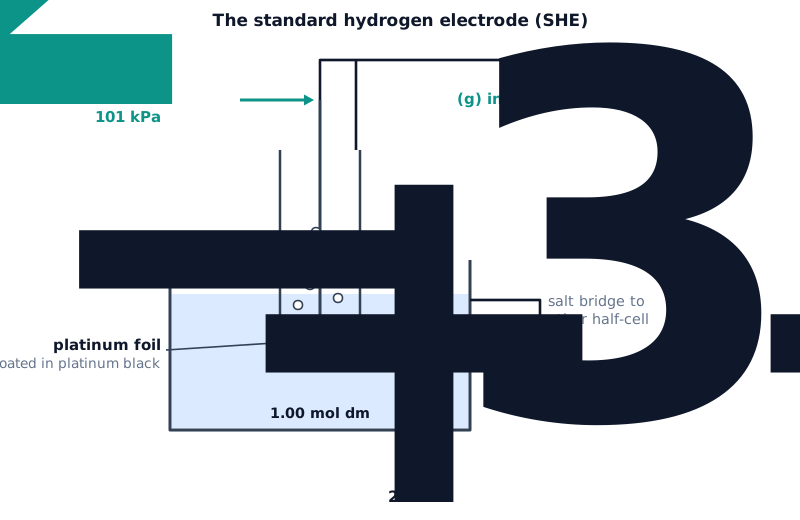
- Hydrogen gas at 101 kPa is bubbled over a piece of platinum foil coated with finely divided platinum (platinum black).
- The foil dips into a solution containing H+(aq) at 1.00 mol dm−3 (for example 1.00 mol dm−3 HCl or 0.50 mol dm−3 H2SO4), at 298 K.
- Platinum is used because it is inert, conducts electricity, and its black surface adsorbs hydrogen and speeds up the equilibrium 2H+ + 2e− ⇌ H2.
- The half-cell is joined to the other half-cell by a salt bridge.
5. Measuring Standard Electrode Potentials
To measure an E° value you build a cell from the half-cell under test and a SHE, join them with a salt bridge and connect a high-resistance voltmeter. The reading is the E° of the half-cell (with a sign given by the polarity, section 6). The high resistance means almost no current flows, so the voltmeter reads the e.m.f. and the concentrations do not change.

Type 1: a metal in contact with its ions (24.2.3a). For Cu2+/Cu, a copper rod dips into 1.00 mol dm−3 Cu2+(aq) (for example copper(II) sulfate).
Type 2: a non-metal in contact with its ions (24.2.3a). For Cl2/Cl−, chlorine gas at 101 kPa is bubbled over platinum foil in 1.00 mol dm−3 Cl−(aq). Platinum is needed because chlorine does not conduct.
Type 3: two ions of the same element in different oxidation states (24.2.3b). For Fe3+/Fe2+, a platinum foil dips into a solution containing both Fe3+ and Fe2+, each at 1.00 mol dm−3. The platinum just carries electrons to or from the solution. The same design applies to MnO4−/Mn2+ (with 1.00 mol dm−3 H+ as well) and Cr2O72−/Cr3+.
Cell used for the measurement. The figure below shows a zinc half-cell measured against the SHE. Know every labelled part.
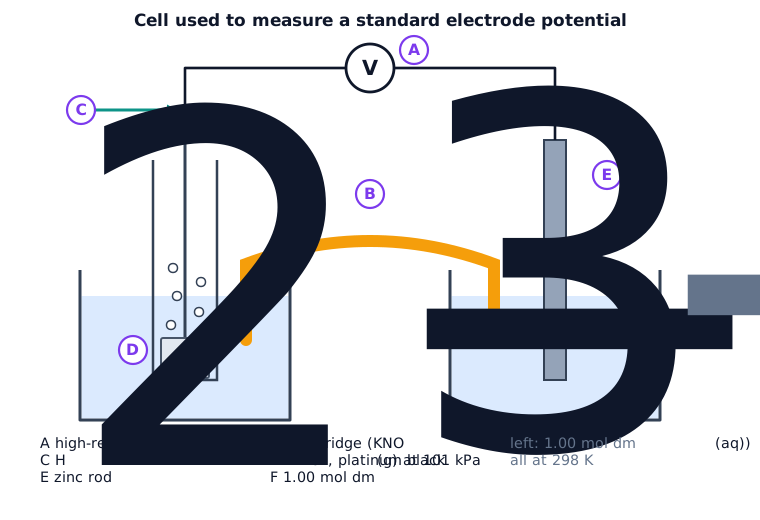
Why these details matter.
- Salt bridge: a strip of filter paper soaked in an unreactive electrolyte such as potassium nitrate. It completes the circuit and allows ions to move to balance charge, without letting the two solutions mix. A plain wire cannot do this job.
- High-resistance voltmeter: draws almost no current, so the cell is not discharged and the reading is the e.m.f.
- Standard conditions: if any concentration is not 1.00 mol dm−3 (or gas not 101 kPa, or temperature not 298 K) the reading is only an E value, not an E°.
6. Cell Potentials, Polarity and Electron Flow
When two half-cells are joined, one acts as the source of electrons and the other as the sink. A standard cell potential is found by combining two standard electrode potentials.
- The half-cell with the more positive E° is the positive pole. Reduction takes place there.
- The half-cell with the less positive (more negative) E° is the negative pole. Oxidation takes place there, so the half-equation is reversed.
- Electrons flow in the external circuit from the negative pole to the positive pole.
- E°cell is always positive when calculated this way. Its value is the voltage a voltmeter would show.

Worked example. Zn2+ + 2e− ⇌ Zn E° = −0.76 V; Cu2+ + 2e− ⇌ Cu E° = +0.34 V.
- E°cell = (+0.34) − (−0.76) = +1.10 V
- Zn is the negative electrode (oxidation): Zn → Zn2+ + 2e−
- Cu is the positive electrode (reduction): Cu2+ + 2e− → Cu
- Overall: Zn + Cu2+ → Zn2+ + Cu. Electrons flow from the zinc to the copper in the external circuit. In the salt bridge, anions move towards the zinc half-cell and cations towards the copper half-cell to keep each solution neutral.
Silver and copper. Ag+ + e− ⇌ Ag has E° = +0.80 V, so silver is the positive pole. E°cell = 0.80 − 0.34 = +0.46 V. Overall: 2Ag+ + Cu → 2Ag + Cu2+. Notice that the E° of silver is not doubled even though the equation needs 2Ag+.
Compare the two kinds of cell. An electrochemical (voltaic) cell generates a voltage from a spontaneous reaction. An electrolytic cell uses a supply to force a reaction that is not spontaneous.
7. Feasibility, Oxidising Power and Redox Equations
Predicting feasibility. A reaction is feasible under standard conditions if the E°cell for the overall reaction is positive. Method:
- Write the two half-equations as reductions with their E° values.
- The reaction goes forward for the half-cell with the more positive E° (it is reduced) and backwards for the other (it is oxidised).
- Combine them so the electrons cancel, and calculate E°cell = E°(reduction) − E°(oxidation). Positive means feasible.
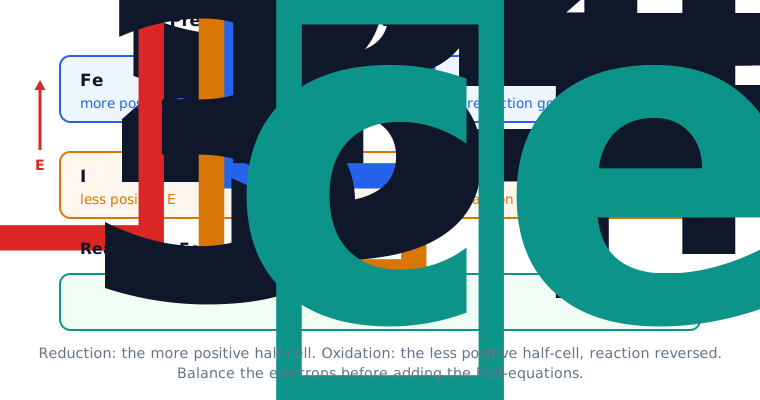
Worked example. Will Fe3+ oxidise I− to I2? Fe3+ + e− ⇌ Fe2+ E° = +0.77 V; I2 + 2e− ⇌ 2I− E° = +0.54 V. Fe3+ is reduced, I− oxidised. E°cell = 0.77 − 0.54 = +0.23 V, so the reaction is feasible: 2Fe3+ + 2I− → 2Fe2+ + I2.
Oxidising and reducing agents from E°. The more positive the E°, the stronger the oxidising agent (the left-hand species); the more negative the E°, the stronger the reducing agent (the right-hand species).

| If E° is… | The left-hand species (oxidised form) is… | The right-hand species (reduced form) is… |
|---|---|---|
| very positive (e.g. MnO4−/Mn2+ +1.52 V; F2/F− +2.87 V) | a strong oxidising agent | a very weak reducing agent |
| near zero (e.g. Cu2+/Cu +0.34 V) | a moderate oxidising agent | a moderate reducing agent |
| very negative (e.g. Mg2+/Mg −2.38 V; Na+/Na −2.71 V) | a very weak oxidising agent | a strong reducing agent |
The halogens. E°(Cl2/Cl−) = +1.36 V, E°(Br2/Br−) = +1.07 V, E°(I2/I−) = +0.54 V. So the oxidising power falls Cl2 > Br2 > I2 and the reducing power of the halide ions rises Cl− < Br− < I−. Chlorine oxidises bromide (E°cell = 1.36 − 1.07 = +0.29 V) and iodide, but bromine does not oxidise chloride (E°cell = 1.07 − 1.36 = −0.29 V).
Constructing redox equations (24.2.7). Use the half-equations from the Data Booklet.
- Reverse the half-equation of the species being oxidised.
- Multiply by whole numbers so the electrons are equal.
- Add the equations and cancel the electrons (and any species that appears on both sides).
Example 1: manganate(VII) and iron(II) in acid. MnO4− + 8H+ + 5e− → Mn2+ + 4H2O (+1.52 V); Fe2+ → Fe3+ + e− (+0.77 V). Multiply the iron half-equation by 5: MnO4− + 8H+ + 5Fe2+ → Mn2+ + 5Fe3+ + 4H2O; E°cell = 1.52 − 0.77 = +0.75 V.
Example 2: dichromate(VI) and iron(II). Cr2O72− + 14H+ + 6e− → 2Cr3+ + 7H2O (+1.33 V) with 6Fe2+ → 6Fe3+ + 6e− gives Cr2O72− + 14H+ + 6Fe2+ → 2Cr3+ + 6Fe3+ + 7H2O; E°cell = 1.33 − 0.77 = +0.56 V.
Example 3: manganate(VII) and iodide. 2MnO4− + 16H+ + 10e− → 2Mn2+ + 8H2O and 10I− → 5I2 + 10e− give 2MnO4− + 16H+ + 10I− → 2Mn2+ + 5I2 + 8H2O; E°cell = 1.52 − 0.54 = +0.98 V.
What a positive E°cell does not tell you.
- Rate. E° says whether a reaction is feasible, not whether it is fast. A reaction with a high activation energy may not happen at a measurable rate. For example, aluminium (E° = −1.66 V) should react readily with water and acid, but a thin layer of aluminium oxide on the surface protects it.
- Conditions. E° applies at 298 K and 1.00 mol dm−3. At other concentrations or temperatures the value changes (next section).
- Position of equilibrium. A reaction with E°cell only slightly positive (or slightly negative) may go to a useful extent if the concentrations are changed.
8. Concentration and the Nernst Equation
Electrode potentials in the Data Booklet are for 1.00 mol dm−3. At other concentrations the potential E changes, because the position of the electrode equilibrium changes.
Qualitative prediction (Le Chatelier). Take Cu2+(aq) + 2e− ⇌ Cu(s).
- Increase [Cu2+]: the equilibrium shifts to the right, so the electrode accepts electrons more readily and E becomes more positive.
- Decrease [Cu2+]: the equilibrium shifts to the left, so E becomes less positive (more negative).
The same applies to any half-equation: raising the concentration of the oxidised species (left side) makes E more positive; raising the concentration of the reduced species (right side) makes E less positive. For MnO4− + 8H+ + 5e− ⇌ Mn2+ + 4H2O, H+ is on the left, so a higher [H+] makes E more positive: manganate(VII) is a stronger oxidising agent in more acidic solution. For a whole cell, the effect of a change on Ecell is the sum of the effects on the two electrodes.
Quantitative: the Nernst equation. At 298 K,
z = number of electrons in the half-equation. Solids and pure liquids are left out of the ratio.
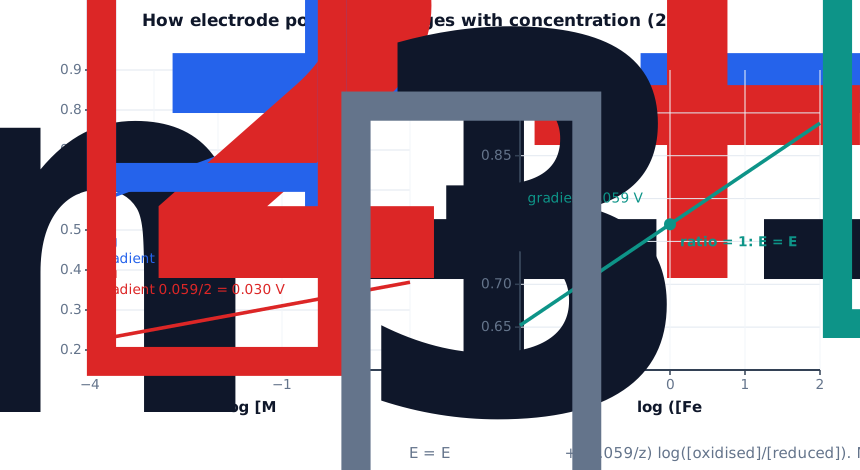
Worked example 1: Cu2+/Cu. Calculate E for Cu2+(aq) + 2e− ⇌ Cu(s) when [Cu2+] = 0.001 mol dm−3. E° = +0.34 V, z = 2, and copper metal is a solid.
- E = 0.34 + (0.059 / 2) × log (0.001) = 0.34 + 0.0295 × (−3) = 0.34 − 0.0885 = +0.25 V
Worked example 2: Fe3+/Fe2+. Fe3+(aq) + e− ⇌ Fe2+(aq), E° = +0.77 V, z = 1, [Fe3+] = 0.50 mol dm−3, [Fe2+] = 1.0 mol dm−3.
- E = 0.77 + 0.059 × log (0.50 / 1.0) = 0.77 + 0.059 × (−0.301) = 0.77 − 0.018 = +0.75 V
Worked example 3: a whole cell. A cell is made from Cu(s) | Cu2+(aq, 0.001 mol dm−3) and Ag+(aq, 1.00 mol dm−3) | Ag(s). E(Cu2+/Cu) = +0.25 V (example 1) and E(Ag+/Ag) = +0.80 V (log 1.00 = 0). So Ecell = 0.80 − 0.25 = +0.55 V, larger than the standard value of +0.46 V because the lower [Cu2+] pushes the copper half-cell more negative.
Worked example 4: concentration of silver ions from a measured voltage. In the cell Cu(s) | Cu2+(aq, 1.00 mol dm−3) || Ag+(aq, x) | Ag(s), E°cell = +0.46 V and Ecell = 0.46 + 0.059 log[Ag+]. When [Ag+] = 0.010 mol dm−3, Ecell = 0.46 + 0.059 × (−2) = +0.34 V. Reversing, a reading of +0.40 V means log[Ag+] = (0.40 − 0.46) / 0.059 = −1.02, so [Ag+] = 0.096 mol dm−3.
9. E and Gibbs Free Energy
Electrical energy is the link between cell voltage and the feasibility you met in Topic 23. For a cell reaction in which n moles of electrons are transferred per mole of reaction,
ΔG° in J mol−1 (divide by 1000 for kJ mol−1), E°cell in V, F = 9.65 × 10⁴ C mol−1
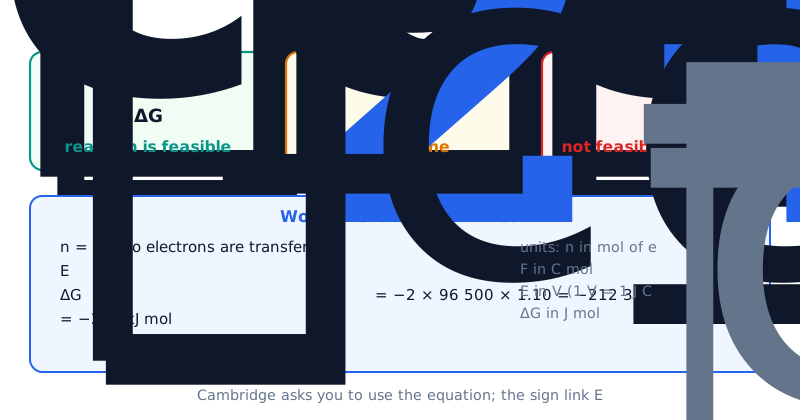
- n is the number of electrons that appear in the balanced equation as written. If you double the equation, n and ΔG° double but E°cell does not.
- Because F is in coulombs per mole and E is in volts (J C−1), the product is in J mol−1.
Worked example 1. Zn + Cu2+ → Zn2+ + Cu, E°cell = +1.10 V, n = 2. ΔG° = −2 × 9.65 × 104 × 1.10 = −2.12 × 10⁵ J mol−1 = −212 kJ mol−1 (negative, so feasible).
Worked example 2. 2Fe3+ + 2I− → 2Fe2+ + I2, E°cell = +0.23 V, n = 2. ΔG° = −2 × 9.65 × 104 × 0.23 = −44.4 kJ mol−1.
Worked example 3 (finding E°cell). A reaction in which 2 mol of electrons are transferred has ΔG° = −317 kJ mol−1. E°cell = −ΔG° / (nF) = 317 000 / (2 × 9.65 × 104) = +1.64 V.
10. Quick Sheet and Checklist
| Quantity | Statement to learn |
|---|---|
| E° | e.m.f. of a half-cell relative to the standard hydrogen electrode, at 298 K, 1.00 mol dm−3, 101 kPa |
| E°cell | e.m.f. of a cell under standard conditions; E°(more positive) − E°(less positive) |
| SHE | H2(g) 101 kPa over Pt black in 1.00 mol dm−3 H+, 298 K; E° = 0.00 V |
| Charge | Q = It, with t in seconds |
| Faraday | F = Le = 9.65 × 10⁴ C mol−1 |
| Moles of electrons | Q / F; then use the half-equation for the product |
| Nernst (298 K) | E = E° + (0.059/z) log([ox]/[red]) |
| Gibbs | ΔG° = −nE°cellF |
Equations to learn. Pb2+ + 2e− → Pb; Al3+ + 3e− → Al; 2H+ + 2e− → H2; 4OH− → O2 + 2H2O + 4e−; MnO4− + 8H+ + 5e− → Mn2+ + 4H2O; Cr2O72− + 14H+ + 6e− → 2Cr3+ + 7H2O.
Checklist. Before the exam you should be able to:
- [ ] predict the products at each electrode for a molten or aqueous electrolyte and justify them with E° values and concentration
- [ ] explain why copper dissolves at a copper anode and why the solution near the cathode in brine becomes alkaline
- [ ] calculate charge, moles of electrons, mass or gas volume from a current and a time, and the time needed for a given mass
- [ ] state and use F = Le, and describe how a copper electrolysis experiment gives F and L
- [ ] define E° and E°cell in full and describe the standard hydrogen electrode
- [ ] describe a cell for measuring E° of a metal/metal ion, a non-metal/non-metal ion and an ion/ion system, and label it
- [ ] calculate E°cell, name the positive and negative poles, and give the direction of electron flow
- [ ] predict whether a reaction is feasible, and explain why a feasible reaction may not be seen
- [ ] rank oxidising and reducing agents from E° values and build full redox equations from half-equations
- [ ] predict how E changes with concentration, and use the Nernst equation with a graph or a calculation
- [ ] calculate ΔG° from E°cell and E°cell from ΔG°