 Score
Chemical Energetics (A Level)
0. What Examiners Want
This guide covers Topic 23 of Cambridge International AS & A Level Chemistry 9701 (2025–27) and follows the learning outcomes below, word for word. The right-hand column shows where each one is taught.
| 23.1 Lattice energy and Born–Haber cycles. Candidates should be able to: | Section |
|---|---|
| 1 define and use the terms: (a) enthalpy change of atomisation, ΔHat; (b) lattice energy, ΔHlatt (the change from gas phase ions to solid lattice) | 1 |
| 2 (a) define and use the term first electron affinity, EA; (b) explain the factors affecting the electron affinities of elements; (c) describe and explain the trends in the electron affinities of the Group 16 and Group 17 elements | 2 |
| 3 construct and use Born–Haber cycles for ionic solids (limited to +1 and +2 cations, –1 and –2 anions) | 3 |
| 4 carry out calculations involving Born–Haber cycles | 3 |
| 5 explain, in qualitative terms, the effect of ionic charge and of ionic radius on the numerical magnitude of a lattice energy | 4 |
| 23.2 Enthalpies of solution and hydration. Candidates should be able to: | Section |
|---|---|
| 1 define and use the term enthalpy change with reference to hydration, ΔHhyd, and solution, ΔHsol | 5 |
| 2 construct and use an energy cycle involving enthalpy change of solution, lattice energy and enthalpy change of hydration | 6 |
| 3 carry out calculations involving the energy cycles in 23.2.2 | 6 |
| 4 explain, in qualitative terms, the effect of ionic charge and of ionic radius on the numerical magnitude of an enthalpy change of hydration | 5 |
| 23.3 Entropy change, ΔS. Candidates should be able to: | Section |
|---|---|
| 1 define the term entropy, S, as the number of possible arrangements of the particles and their energy in a given system | 7 |
| 2 predict and explain the sign of the entropy changes that occur: (a) during a change in state, e.g. melting, boiling and dissolving (and their reverse); (b) during a temperature change; (c) during a reaction in which there is a change in the number of gaseous molecules | 7 |
| 3 calculate the entropy change for a reaction, ΔS°, given the standard entropies, S°, of the reactants and products, ΔS° = ΣS°(products) – ΣS°(reactants) (use of ΔS°total = ΔS°surr + ΔS°sys is not required) | 7 |
| 23.4 Gibbs free energy change, ΔG. Candidates should be able to: | Section |
|---|---|
| 1 state and use the Gibbs equation ΔG° = ΔH° – TΔS° | 8 |
| 2 perform calculations using the equation ΔG° = ΔH° – TΔS° | 8 |
| 3 state whether a reaction or process will be feasible by using the sign of ΔG | 8 |
| 4 predict the effect of temperature change on the feasibility of a reaction, given standard enthalpy and entropy changes | 8 |
- Definitions: exact wording, with ‘1 mole’, the right starting and finishing species (gaseous ions, solid, aqueous ions) and ‘standard conditions’. State symbols are marked in equations.
- Cycles: complete a partly drawn Born–Haber cycle or energy cycle with the right species, state symbols and arrows, or draw one from nothing.
- Calculations: choose the correct data from a table that often contains values you do not need, apply every sign and multiplier, and show the working.
- Explanations: lattice energy and hydration enthalpy in terms of ionic charge and ionic radius (charge density), and solubility trends in terms of the two energies together.
- Entropy and ΔG: predict the sign of ΔS, calculate ΔS from standard entropies, then calculate ΔG and the temperature at which a reaction becomes feasible.
1. Atomisation, Lattice Energy and the Terms
An ionic solid such as sodium chloride is held together by the strong electrostatic attraction between its ions in a giant lattice. We cannot measure the energy of forming this lattice directly from gaseous ions, so we calculate it with an energy cycle. First we need two new definitions (23.1.1) and one you met in outline at AS.
Standard enthalpy change of atomisation, ΔHat. The enthalpy change when 1 mole of gaseous atoms is formed from the element in its standard state.
| Element | Equation | ΔHat / kJ mol−1 |
|---|---|---|
| sodium | Na(s) → Na(g) | +107 |
| chlorine | ½Cl2(g) → Cl(g) | +122 |
| oxygen | ½O2(g) → O(g) | +249 |
| magnesium | Mg(s) → Mg(g) | +148 |
The result is always endothermic, because bonds between atoms must be broken. For a diatomic element the equation shows half a molecule, because the definition is per mole of atoms: ΔHat(Cl) = ½ × 244 = +122 kJ mol−1, where 244 is the Cl–Cl bond energy in the Data Booklet.
Lattice energy, ΔHlatt. The enthalpy change when 1 mole of an ionic solid is formed from its gaseous ions (under standard conditions). The syllabus puts it as ‘the change from gas phase ions to solid lattice’.
Na+(g) + Cl−(g) → NaCl(s) ΔHlatt ≈ −785 kJ mol−1
Mg2+(g) + 2Cl−(g) → MgCl2(s) ΔHlatt ≈ −2520 kJ mol−1
Because the definition describes ions coming together, ΔHlatt is always exothermic (negative). The more negative it is, the stronger the ionic bonding. Standard conditions are 298 K and 100 kPa.
2. Electron Affinity
For a non-metal the step that forms the negative ion is not an ionisation energy but an electron affinity.
First electron affinity, EA1. The enthalpy change when 1 mole of electrons is added to 1 mole of gaseous atoms to form 1 mole of gaseous ions with a single negative charge.
Cl(g) + e− → Cl−(g) EA1 = −349 kJ mol−1
O(g) + e− → O−(g) EA1 = −141 kJ mol−1
EA1 is usually exothermic, because the incoming electron is attracted by the nucleus. The second electron affinity is always endothermic: the electron is being added to an ion that is already negative, so it is repelled.
O−(g) + e− → O2−(g) EA2 = +798 kJ mol−1
O(g) + 2e− → O2−(g) EA1 + EA2 = (−141) + (+798) = +657 kJ mol−1
The overall change to O2−(g) is endothermic, yet oxides form easily, because the very large lattice energy of an oxide more than pays for it. For sulfur, EA1 = −200 and EA2 = +640, so S(g) + 2e− → S2−(g) is (−200) + (+640) = +440 kJ mol−1.
Factors affecting electron affinity (23.1.2b). The value depends on how strongly the incoming electron is attracted by the nucleus:
- Nuclear charge: a greater nuclear charge attracts the electron more strongly, so EA1 is more exothermic. Chlorine (17+) is more exothermic than sulfur (16+) in the same period.
- Distance from the nucleus (atomic radius): the further the new electron enters from the nucleus, the weaker the attraction.
- Shielding: more inner shells shield the nucleus, so the attraction is weaker.
- Repulsion between electrons: in a very small atom the incoming electron is repelled by the electrons already in the compact outer shell, which reduces the energy released.
Trends in Groups 17 and 16 (23.1.2c).
| Group 17 | F | Cl | Br | I |
|---|---|---|---|---|
| EA1 / kJ mol−1 | −328 | −349 | −325 | −295 |
| Group 16 | O | S | Se | Te |
|---|---|---|---|---|
| EA1 / kJ mol−1 | −141 | −200 | −195 | −190 |
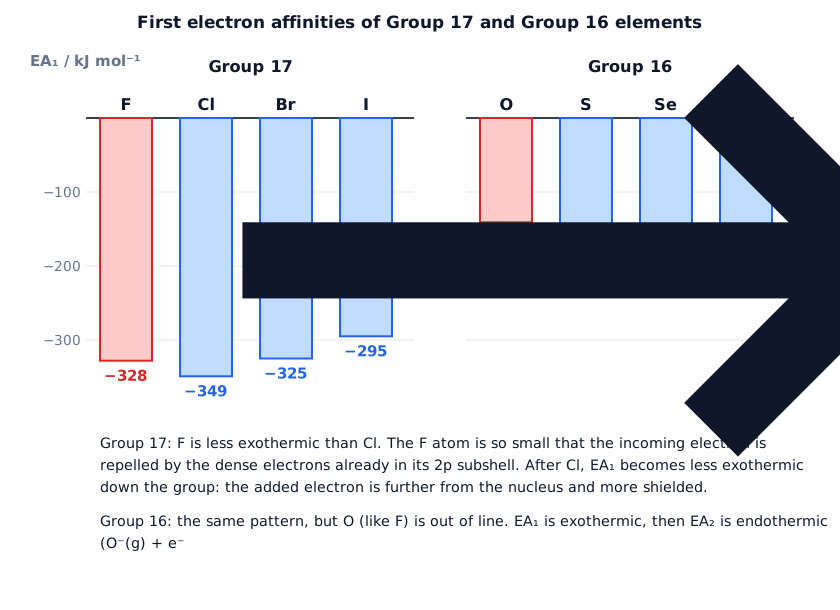
- Down the group (Cl to I, and S to Te): EA1 becomes less exothermic. Each atom has one more shell, so the added electron is further from the nucleus and is more shielded. The attraction is weaker, so less energy is released.
- The first element is the exception: fluorine is less exothermic than chlorine, and oxygen is less exothermic than sulfur. The F and O atoms are so small that the added electron is repelled strongly by the dense cloud of electrons already in the 2p subshell. This repulsion offsets the strong attraction of the nucleus.
3. Born–Haber Cycles
A Born–Haber cycle is Hess’s law applied to the formation of an ionic solid. There are two routes from the elements in their standard states to the solid:
- Route 1 (direct): form the solid from its elements, ΔHf.
- Route 2 (indirect): turn the elements into gaseous atoms, then into gaseous ions, then let the ions form the lattice.
Both routes have the same overall enthalpy change, so for a compound of one metal M and one non-metal X:
ΔHf = ΔHat(M) + IE(M) + ΔHat(X) + EA(X) + ΔHlatt
so that ΔHlatt = ΔHf − (the sum of all the other steps). The cycle is limited to cations with a charge of 1+ or 2+ and anions with a charge of 1− or 2−.
Which steps are needed for each ion.
| Ion formed | Steps from the element | Take care |
|---|---|---|
| M+ | ΔHat(M), then IE1 | multiply both by the number of M in the formula |
| M2+ | ΔHat(M), then IE1 and IE2 | IE2 is much larger than IE1 (Data Booklet) |
| X− | ΔHat(X) (half the molecule), then EA1 | multiply both by the number of X in the formula |
| X2− | ΔHat(X), then EA1 and EA2 | EA2 is positive |
How to draw the cycle as an energy level diagram.
- Put the elements in their standard states (for example Na(s) + ½Cl2(g)) as the first level, near the bottom left.
- Draw the atomisation of the metal (arrow up), then its ionisation(s) (arrows up). Show the electrons you have removed on the next level.
- Draw the atomisation of the non-metal (arrow up).
- Draw the electron affinity step(s) (EA1 arrow down, EA2 arrow up) to reach the gaseous ions.
- Draw the lattice energy as an arrow down from the gaseous ions to the solid, and the enthalpy change of formation as an arrow down from the elements to the same solid.
- Give every level its state symbols, and put the right multiplier in front of each species and each arrow (2Na, 2Cl).
Arrows pointing up are endothermic (+). Arrows pointing down are exothermic (−). The diagram is not drawn to scale.
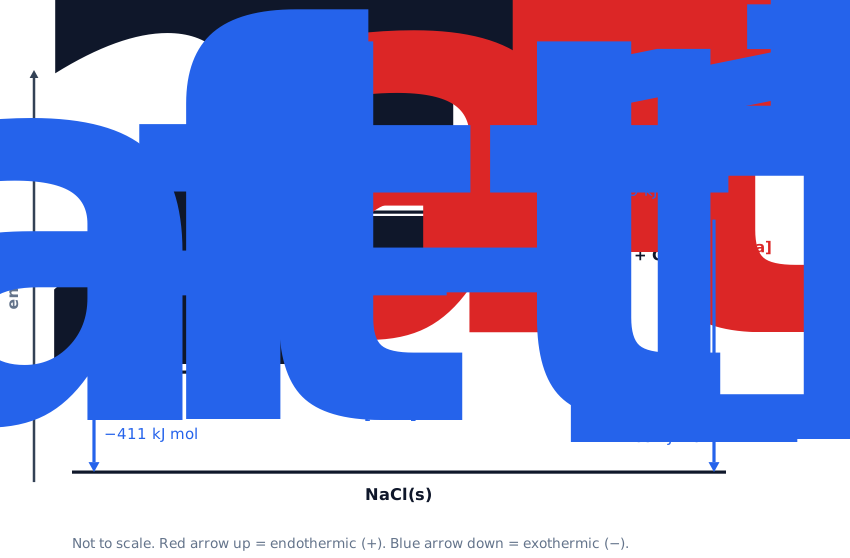
Worked example 1: NaCl (1+ and 1−). Calculate the lattice energy of sodium chloride from: ΔHf[NaCl] = −411; ΔHat[Na] = +107; IE1[Na] = +494; ΔHat[Cl] = +122; EA1[Cl] = −349 (all kJ mol−1).
Sum of the steps to the gaseous ions = (+107) + (+494) + (+122) + (−349) = +374 kJ mol−1.
ΔHlatt = ΔHf − (sum of steps) = (−411) − (+374) = −785 kJ mol−1.

Worked example 2: MgCl2 (2+ and 1−). ΔHf[MgCl2] = −641; ΔHat[Mg] = +148; IE1[Mg] = +736; IE2[Mg] = +1450 (Data Booklet); ΔHat[Cl] = +122; EA1[Cl] = −349.
Sum of the steps = (+148) + (+736) + (+1450) + 2(+122) + 2(−349) = 148 + 736 + 1450 + 244 − 698 = +1880 kJ mol−1.
ΔHlatt = (−641) − (+1880) = −2521 kJ mol−1.

Worked example 3: Na2O (1+ and 2−). ΔHf[Na2O] = −414; ΔHat[Na] = +107; IE1[Na] = +494; ΔHat[O] = +249; EA1[O] = −141; EA2[O] = +798.
Sum of the steps = 2(+107) + 2(+494) + (+249) + (−141) + (+798) = 214 + 988 + 249 − 141 + 798 = +2108 kJ mol−1.
ΔHlatt = (−414) − (+2108) = −2522 kJ mol−1.

Worked example 3b: CaCl2 (2+ and 1−). ΔHf[CaCl2] = −796; ΔHat[Ca] = +178; IE1 = +590; IE2 = +1150; Cl–Cl bond energy 244; EA1[Cl] = −349.
Sum of the steps = 178 + 590 + 1150 + 244 − 698 = +1464 kJ mol−1. ΔHlatt = (−796) − (+1464) = −2260 kJ mol−1. This is less exothermic than MgCl2 (−2521) because Ca2+ is larger than Mg2+.
Worked example 4: finding a different unknown. The cycle works for any one missing value. The lattice energy of KCl is −717 kJ mol−1; ΔHf[KCl] = −437; ΔHat[K] = +89; IE1[K] = +419; ΔHat[Cl] = +122. Find EA1[Cl].
ΔHf = ΔHat(K) + IE1(K) + ΔHat(Cl) + EA1(Cl) + ΔHlatt
−437 = 89 + 419 + 122 + EA1 + (−717)
EA1 = −437 − (89 + 419 + 122 − 717) = −437 − (−87) = −350 kJ mol−1 (the usual value, −349, to rounding).
4. What Controls Lattice Energy
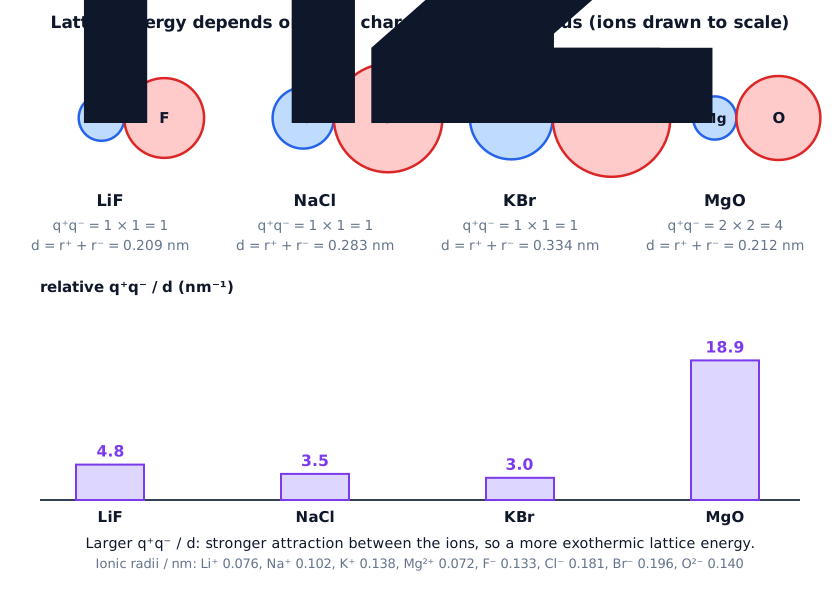
The lattice energy comes from the electrostatic attraction between oppositely charged ions. The force between ions of charge q+ and q− whose centres are a distance d apart increases with q+ × q− and decreases as d increases, where d is the sum of the two ionic radii (r+ + r−). So the numerical size of the lattice energy increases with ionic charge and decreases with ionic radius.
- Ionic charge. The greater the charge on the ions, the stronger the attraction and the more exothermic the lattice energy. MgO (2+, 2−) has a far more exothermic lattice energy than NaCl (1+, 1−), partly because the product of the charges is four times greater and partly because Mg2+ and O2− are small.
- Ionic radius. The larger the ions, the further apart their centres and the weaker the attraction, so the lattice energy is less exothermic. It becomes less exothermic from LiF to NaF to KF (larger cation) and from LiF to LiCl to LiBr (larger anion). Another way to say it: smaller ions of the same charge have a higher charge density.
Worked example. Place NaCl, MgO, KBr and CaCl2 in order, from the most to the least exothermic lattice energy.
MgO > CaCl2 > NaCl > KBr. MgO has 2+ and 2− ions that are both small, so it has the greatest attraction. CaCl2 has a 2+ ion, so its lattice energy is greater than that of the compounds with only 1+ ions. NaCl has smaller ions than KBr (Na+ is smaller than K+ and Cl− is smaller than Br−), so the ions are closer, the attraction is stronger and its lattice energy is more exothermic.
5. Hydration and Solution
When an ionic solid dissolves in water, the lattice breaks up and each ion becomes surrounded by water molecules. Water is polar: the δ− oxygen is attracted to cations and the δ+ hydrogens are attracted to anions. These attractions are ion–dipole bonds.

Enthalpy change of hydration, ΔHhyd. The enthalpy change when 1 mole of a specified gaseous ion dissolves in sufficient water to form a very dilute solution.
Na+(g) + aq → Na+(aq) ΔHhyd = −406 kJ mol−1
Cl−(g) + aq → Cl−(aq) ΔHhyd = −364 kJ mol−1
ΔHhyd is always exothermic because ion–dipole bonds are formed. It is defined for a specified ion, so each ion has its own value.
Enthalpy change of solution, ΔHsol. The enthalpy change when 1 mole of an ionic solid dissolves in sufficient water to form a very dilute solution.
NaCl(s) + aq → Na+(aq) + Cl−(aq) ΔHsol = +3.9 kJ mol−1
MgCl2(s) + aq → Mg2+(aq) + 2Cl−(aq) ΔHsol = −55 kJ mol−1
ΔHsol may be positive or negative. It is the small difference between two large numbers: the energy released by hydrating the ions and the energy needed to break the lattice.
Effect of charge and radius on hydration enthalpy (23.2.4). The size of ΔHhyd depends on the charge density of the ion, which is its charge divided by its size. The greater the charge density, the stronger the attraction to the water dipoles and the more exothermic ΔHhyd.

| Compare | Explanation |
|---|---|
| Li+ (−519) with Na+ (−406) with K+ (−322) | same charge; the ion gets bigger, so the charge density falls and the attraction to water is weaker |
| Mg2+ (−1920) with Li+ (−519) | similar radius (0.072 and 0.076 nm); the 2+ charge gives a much higher charge density |
| F− (−506), Cl− (−364), Br− (−335) | the same trend for anions: bigger anion, lower charge density, less exothermic |
6. Energy Cycles for Dissolving
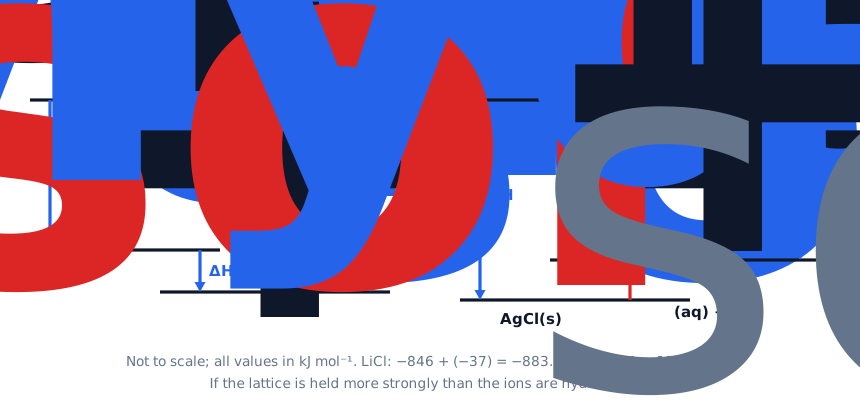
The three quantities are linked by Hess’s law. Start from the gaseous ions. They can reach the aqueous ions directly by being hydrated, or by first forming the solid (lattice energy) and then dissolving it.

ΔHlatt + ΔHsol = ΔHhyd(cation) + ΔHhyd(anion)
So ΔHsol = ΣΔHhyd − ΔHlatt. Remember to multiply a hydration enthalpy by the number of that ion in the formula (for MgCl2: ΔHhyd[Mg2+] + 2 × ΔHhyd[Cl−]).
Worked example 1 (find ΔHsol). ΔHlatt[LiCl] = −846; ΔHhyd[Li+] = −519; ΔHhyd[Cl−] = −364 (kJ mol−1).
ΔHsol = (−519) + (−364) − (−846) = −883 + 846 = −37 kJ mol−1. Exothermic.
Worked example 2 (find ΔHsol, endothermic). ΔHlatt[AgCl] = −905; ΔHhyd[Ag+] = −475; ΔHhyd[Cl−] = −364.
ΔHsol = (−475) + (−364) − (−905) = −839 + 905 = +66 kJ mol−1. Endothermic, and AgCl is almost insoluble in water.
Worked example 3 (find a lattice energy). ΔHsol[NaBr] = −0.6; ΔHhyd[Na+] = −406; ΔHhyd[Br−] = −335.
ΔHlatt = ΣΔHhyd − ΔHsol = (−406 − 335) − (−0.6) = −741 + 0.6 = −740 kJ mol−1.
Worked example 4 (find a hydration enthalpy). ΔHlatt[NaF] = −913; ΔHsol[NaF] = +1; ΔHhyd[Na+] = −406.
ΔHhyd[F−] = ΔHlatt + ΔHsol − ΔHhyd[Na+] = (−913) + (+1) − (−406) = −506 kJ mol−1.
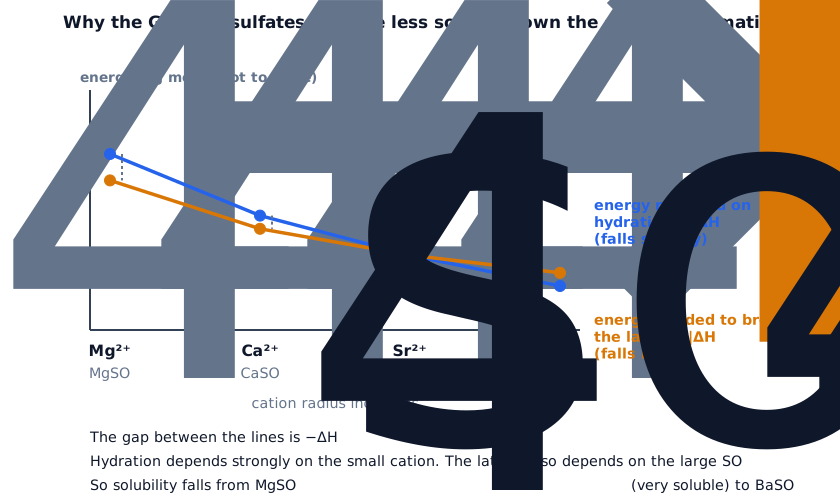
Application: the solubility of the Group 2 sulfates. Solubility decreases down Group 2 from MgSO4 (very soluble) to BaSO4 (insoluble). Both energies become less exothermic down the group, but not by the same amount:
- ΔHhyd of the cation depends strongly on its size, so it becomes much less exothermic from Mg2+ to Ba2+.
- The sulfate ion is large, so the lattice energy depends on the radius of the sulfate as well as on the cation. The lattice energy therefore changes less than the hydration enthalpy.
- So ΔHsol = ΣΔHhyd − ΔHlatt becomes less exothermic (more positive) down the group, and the sulfates become less soluble.
7. Entropy
Energetically favourable (exothermic) changes are not the only ones that happen: ammonium nitrate dissolves in water and the solution gets cold, and ice melts at room temperature while absorbing energy. A second quantity, entropy, is needed.
Entropy, S. Entropy is a measure of the number of possible arrangements of the particles and their energy in a given system. The more ways of arranging the particles and their energy, the greater the entropy. It is often described as the disorder of a system, but the definition in terms of arrangements is the one to use. The units are J K−1 mol−1.
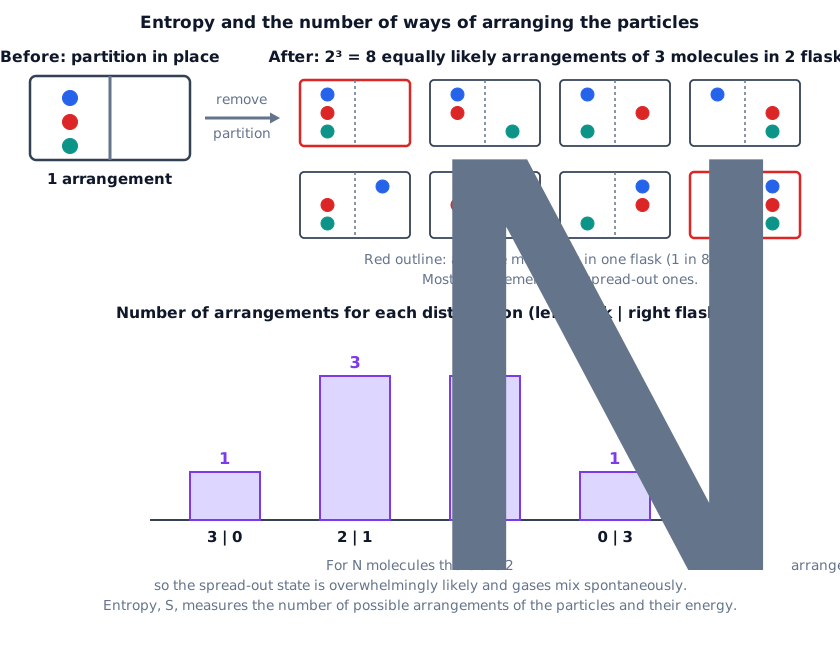
Standard molar entropy, S°. The entropy of 1 mole of a substance in its standard state (298 K, 100 kPa), in J K−1 mol−1. Unlike enthalpy of formation, the S° of an element is not zero: every substance has a positive S°. (A perfect crystal at 0 K has zero entropy.)

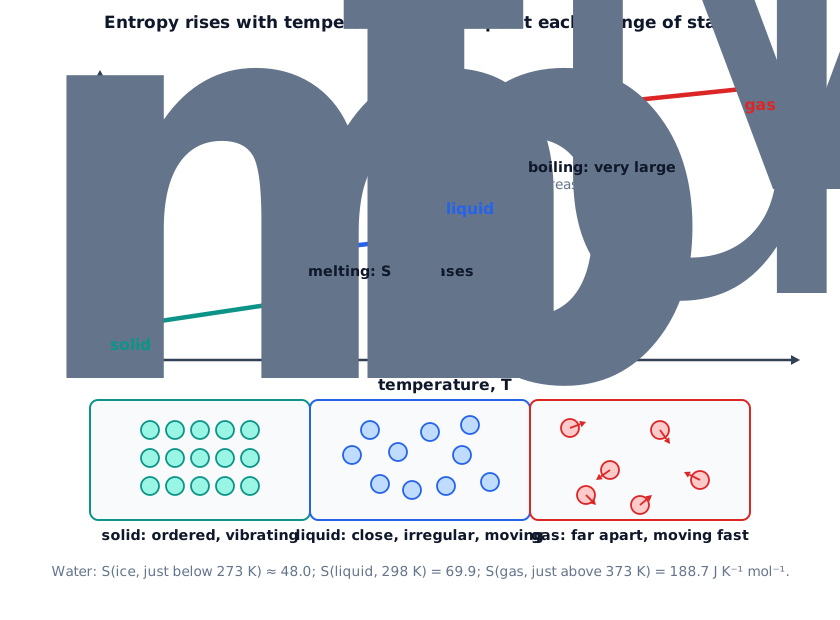
Predicting the sign of ΔS (23.3.2).
| Change | Sign of ΔS | Reason |
|---|---|---|
| melting (solid → liquid) | + | the ordered lattice becomes a liquid with more arrangements |
| boiling or subliming | + (large) | particles become free and far apart; many more arrangements |
| freezing, condensing | − | particles become more ordered |
| dissolving a solid | usually + | ions leave the ordered lattice and spread through the solution |
| crystallising from solution | − | ions leave the solution to form an ordered lattice |
| raising the temperature | + | more energy is available, so more ways of arranging it among the particles (more energy levels occupied) |
| reaction with more moles of gas in the products | + | gases have much higher entropy |
| reaction with fewer moles of gas in the products | − | fewer gas molecules, fewer arrangements |
Examples. CaCO3(s) → CaO(s) + CO2(g): one gas molecule is produced from a solid, so ΔS is positive. N2(g) + 3H2(g) → 2NH3(g): 4 mol of gas become 2 mol, so ΔS is negative. 2NO2(g) → N2O4(g): 2 mol become 1 mol, so ΔS is negative. When the number of gas molecules does not change (for example H2(g) + I2(g) → 2HI(g)), predict only a small ΔS and say that it is difficult to decide.
Calculating the entropy change of a reaction (23.3.3).
ΔS° = ΣS°(products) − ΣS°(reactants)
Multiply each S° by its coefficient in the equation, use the value for the correct state, and give the answer in J K−1 mol−1 with its sign.
Worked example 1. CaCO3(s) → CaO(s) + CO2(g). S°: CaCO3 92.9; CaO 39.7; CO2 213.6.
ΔS° = (39.7 + 213.6) − 92.9 = +160.4 J K−1 mol−1. Positive, as predicted.
Worked example 2. N2(g) + 3H2(g) → 2NH3(g). S°: N2 191.6; H2 130.6; NH3 192.3.
ΔS° = 2(192.3) − [191.6 + 3(130.6)] = 384.6 − 583.4 = −198.8 J K−1 mol−1. Negative, as predicted.
Worked example 3. 2H2(g) + O2(g) → 2H2O(l). S°: H2 130.6; O2 205.0; H2O(l) 69.9.
ΔS° = 2(69.9) − [2(130.6) + 205.0] = 139.8 − 466.2 = −326.4 J K−1 mol−1. Three moles of gas become a liquid, so the large negative value is expected.
8. Gibbs Free Energy
A reaction is feasible when the total entropy of the system and its surroundings increases. The Gibbs free energy change, ΔG, takes both into account in one quantity that refers to the reaction itself:
ΔG° = ΔH° − TΔS°
ΔH° is the enthalpy change of the reaction, T is the temperature in kelvin, and ΔS° is the entropy change of the reaction. (You do not need to use ΔStotal = ΔSsys + ΔSsurr.)
- If ΔG is negative, the reaction is feasible (spontaneous) at that temperature.
- If ΔG is positive, the reaction is not feasible at that temperature.
- If ΔG = 0, the reaction is just on the borderline: the temperature at which feasibility changes is T = ΔH° / ΔS°.
Calculating ΔG. Check the units first: ΔH is in kJ mol−1, ΔS is in J K−1 mol−1. Convert ΔH to J (×1000) or ΔS to kJ (÷1000).
Worked example 1. ZnCO3(s) → ZnO(s) + CO2(g); ΔH° = +71.0 kJ mol−1. S°: ZnCO3 82.4; ZnO 43.6; CO2 213.6 J K−1 mol−1.
ΔS° = (43.6 + 213.6) − 82.4 = +174.8 J K−1 mol−1.
At 298 K: ΔG° = 71 000 − 298 × 174.8 = +18 910 J = +18.9 kJ mol−1. Positive: not feasible at 298 K.
At 1200 K: ΔG° = 71 000 − 1200 × 174.8 = −138 760 J = −139 kJ mol−1. Negative: feasible at 1200 K.
The effect of temperature (23.4.4). Because ΔG° = ΔH° − TΔS°, a graph of ΔG against T is a straight line with gradient −ΔS and intercept ΔH (at T = 0). The signs of ΔH and ΔS decide what happens:
| ΔH | ΔS | −TΔS | ΔG | Feasible? |
|---|---|---|---|---|
| − (exothermic) | + | negative | always negative | at all temperatures |
| + (endothermic) | − | positive | always positive | at no temperature |
| − (exothermic) | − | positive | negative at low T | only below T = ΔH/ΔS |
| + (endothermic) | + | negative | negative at high T | only above T = ΔH/ΔS |


Worked example 2: the minimum temperature (endothermic, ΔS positive). CaCO3(s) → CaO(s) + CO2(g); ΔH° = +178.0 kJ mol−1; ΔS° = +160.4 J K−1 mol−1 (worked out in section 7).
At 298 K: ΔG° = 178 000 − 298 × 160.4 = +130 201 J = +130 kJ mol−1, so limestone does not decompose at room temperature.
ΔG° = 0 when T = ΔH° / ΔS° = 178 000 / 160.4 = 1110 K. Above about 1110 K the reaction is feasible.
Worked example 3: the maximum temperature (exothermic, ΔS negative). N2(g) + 3H2(g) → 2NH3(g); ΔH° = −92.2 kJ mol−1; ΔS° = −198.8 J K−1 mol−1 (section 7).
At 298 K: ΔG° = −92 200 − 298 × (−198.8) = −92 200 + 59 242 = −33.0 kJ mol−1: feasible.
ΔG° = 0 when T = −92 200 / −198.8 = 464 K. The reaction is feasible only below about 464 K. (This is why a high temperature favours the reactants in the Haber process, and why a compromise temperature is used industrially to get a reasonable rate.)
Worked example 4: a salt that dissolves endothermically. Ammonium nitrate dissolves with ΔHsol = +25.7 kJ mol−1 and ΔS = +108 J K−1 mol−1. At 298 K: ΔG = 25 700 − 298 × 108 = −6484 J = −6.5 kJ mol−1. The process is feasible because the entropy gain (ions spreading through the solution) outweighs the positive enthalpy change.
9. Quick Sheet and Checklist
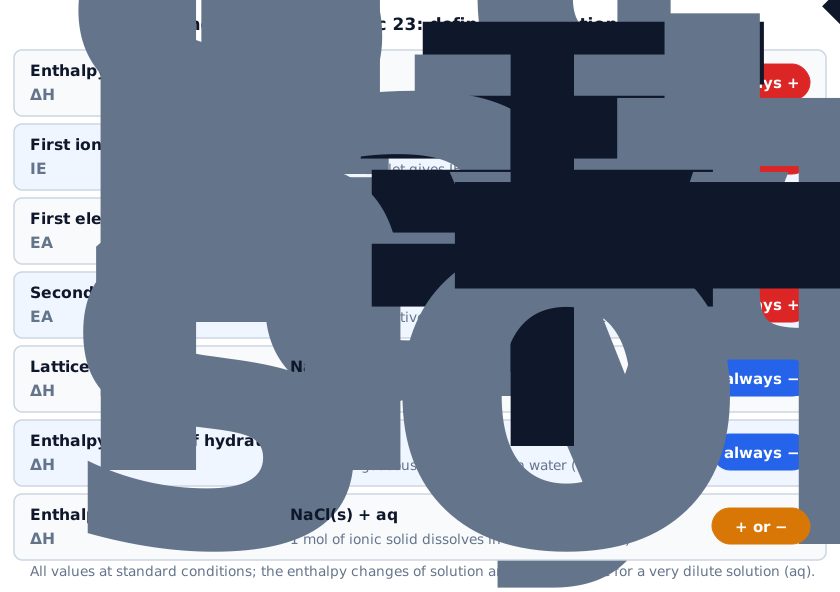
| Quantity | Definition (key words) | Sign |
|---|---|---|
| ΔHat | 1 mol of gaseous atoms from the element in its standard state | always + |
| EA1 | 1 mol of electrons added to 1 mol of gaseous atoms → gaseous 1− ions | usually − |
| EA2 | electron added to a gaseous 1− ion → 2− ion | always + |
| ΔHlatt | 1 mol of ionic solid formed from gaseous ions | always − |
| ΔHhyd | 1 mol of a specified gaseous ion dissolves in water (very dilute) | always − |
| ΔHsol | 1 mol of ionic solid dissolves in water (very dilute) | + or − |
| S | number of possible arrangements of the particles and their energy | S° always + |
Equations to learn.
- ΔHf = ΔHat(M) + IE(M) + ΔHat(X) + EA(X) + ΔHlatt, with the multipliers and all the steps for each ion.
- ΔHlatt + ΔHsol = ΣΔHhyd.
- ΔS° = ΣS°(products) − ΣS°(reactants).
- ΔG° = ΔH° − TΔS°; feasible if ΔG is negative; T = ΔH / ΔS when ΔG = 0.
Checklist. Before the exam you should be able to:
- [ ] write each definition from memory with its starting and finishing species, and give an equation with state symbols for each
- [ ] explain the trend in EA1 down Groups 16 and 17, name the exception and give its reason
- [ ] explain why EA2 is endothermic
- [ ] draw a Born–Haber cycle for a compound with 1+ or 2+ cations and 1− or 2− anions, with the multipliers and state symbols
- [ ] pick only the relevant data and calculate a lattice energy, a formation enthalpy or an electron affinity from a cycle
- [ ] explain how ionic charge and ionic radius change a lattice energy and a hydration enthalpy
- [ ] build the lattice–solution–hydration cycle and calculate any one of the three quantities
- [ ] explain why the Group 2 sulfates become less soluble down the group, using both energies
- [ ] predict the sign of ΔS for a change of state, a temperature change and a change in the number of gas molecules
- [ ] calculate ΔS° from standard entropies and ΔG° from ΔH° and ΔS° with consistent units
- [ ] work out the temperature at which a reaction becomes feasible, and say whether it is a minimum or a maximum